Beginner’s guide · Reflect & explore
Cross the river
and learn why the palace matters.
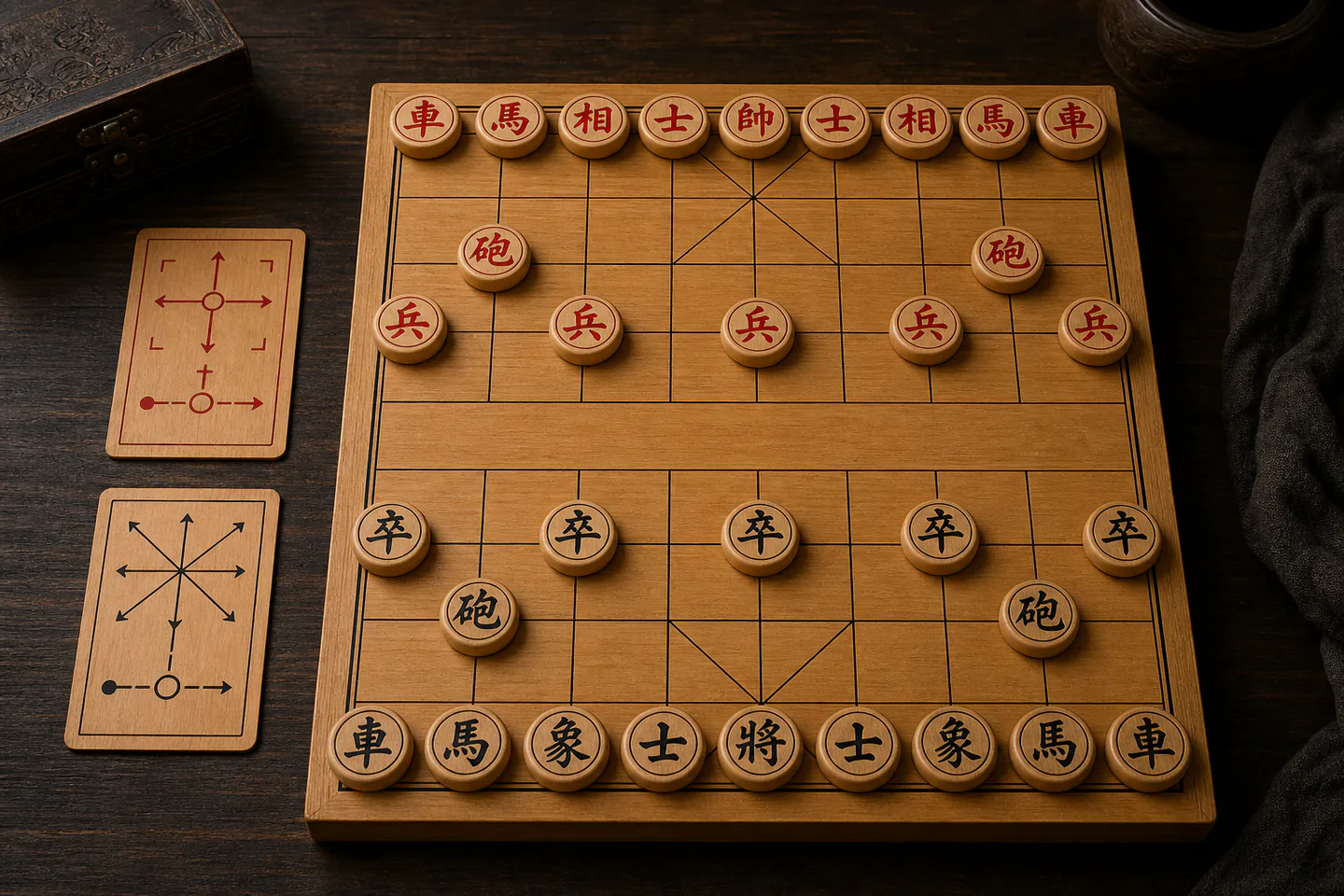
Xiangqi becomes clear through board geography, the cannon capture, restricted generals and one complete open game before tactical study.
Quick answer
Learn the complete turn before studying advanced theory
Use a board with clear diagrams or bilingual piece labels. Learn the river and palaces, place each piece, practise the cannon screen and flying-general rule, then play one open game with legal-move checking enabled.
- 01
Orient the board, match every character to its movement and place both armies from a reference before starting the clock or hiding advice. Keep the first attempt narrow enough that preparation, the main action and the result can all be reviewed together.
- 02
State the moving piece, destination, capture rule and whether either general is exposed after every beginner move. Keep the first attempt narrow enough that preparation, the main action and the result can all be reviewed together.
- 03
Review illegal general alignment, missed cannon screens, undefended pieces, checks and whether development served a coherent attack or defence. Keep the first attempt narrow enough that preparation, the main action and the result can all be reviewed together.
- 04
Restore the starting position from a diagram, record one tactic and repeat from the same opening only long enough to understand the error. Keep the first attempt narrow enough that preparation, the main action and the result can all be reviewed together.
What to expect
Fluent play grows from repeated small decisions
A short open game with visible explanation teaches more than memorising expert sequences without context.
The first attempt
Open-board play with movement reminders reveals how xiangqi differs from western chess without requiring Chinese character fluency. For xiangqi (chinese chess), note what actually happened rather than relying on memory; that turns the next attempt into a controlled change instead of another guess.
The control point
State the moving piece, destination, capture rule and whether either general is exposed after every beginner move. For xiangqi (chinese chess), note what actually happened rather than relying on memory; that turns the next attempt into a controlled change instead of another guess.
The useful signal
Review illegal general alignment, missed cannon screens, undefended pieces, checks and whether development served a coherent attack or defence. For xiangqi (chinese chess), note what actually happened rather than relying on memory; that turns the next attempt into a controlled change instead of another guess.
The common trap
Transferring western-chess assumptions to cannons, elephants, advisers and the general creates illegal moves and misses the board’s real geometry. For xiangqi (chinese chess), note what actually happened rather than relying on memory; that turns the next attempt into a controlled change instead of another guess.
Core method
Learn the rules, play openly, review and repeat
Prepare deliberately
Orient the board, match every character to its movement and place both armies from a reference before starting the clock or hiding advice. For xiangqi (chinese chess), note what actually happened rather than relying on memory; that turns the next attempt into a controlled change instead of another guess.
Control the central variable
State the moving piece, destination, capture rule and whether either general is exposed after every beginner move. For xiangqi (chinese chess), note what actually happened rather than relying on memory; that turns the next attempt into a controlled change instead of another guess.
Read the result
Review illegal general alignment, missed cannon screens, undefended pieces, checks and whether development served a coherent attack or defence. For xiangqi (chinese chess), note what actually happened rather than relying on memory; that turns the next attempt into a controlled change instead of another guess.
Reset before repeating
Restore the starting position from a diagram, record one tactic and repeat from the same opening only long enough to understand the error. For xiangqi (chinese chess), note what actually happened rather than relying on memory; that turns the next attempt into a controlled change instead of another guess.
Useful products
Products with a clear job in the setup
A wooden shogi set and chess reference are comparisons, not xiangqi substitutes; blank cards can build bilingual movement aids while a proper xiangqi set is selected.
Apostrophe Games Blank Playing Cards, 180 Cards
One card per piece can show character, name, movement and palace or river limits.
Bantam Bobby Fischer Teaches Chess
Its teaching structure can inspire checks-and-captures drills.
Yellow Mountain Imports Wooden Shogi Japanese Chess Game
Side-by-side identification prevents buying the wrong game under a generic chess label.
First project
Play one open game with movement cards
Finish the game, then review cannon screens and exposed generals before adding an opening lesson.
- 01
Set up
Orient the board, match every character to its movement and place both armies from a reference before starting the clock or hiding advice. For xiangqi (chinese chess), note what actually happened rather than relying on memory; that turns the next attempt into a controlled change instead of another guess.
- 02
Begin the first attempt
Open-board play with movement reminders reveals how xiangqi differs from western chess without requiring Chinese character fluency. For xiangqi (chinese chess), note what actually happened rather than relying on memory; that turns the next attempt into a controlled change instead of another guess.
- 03
Hold one variable steady
State the moving piece, destination, capture rule and whether either general is exposed after every beginner move. For xiangqi (chinese chess), note what actually happened rather than relying on memory; that turns the next attempt into a controlled change instead of another guess.
- 04
Inspect the result
Review illegal general alignment, missed cannon screens, undefended pieces, checks and whether development served a coherent attack or defence. For xiangqi (chinese chess), note what actually happened rather than relying on memory; that turns the next attempt into a controlled change instead of another guess.
- 05
Reset and record
Restore the starting position from a diagram, record one tactic and repeat from the same opening only long enough to understand the error. For xiangqi (chinese chess), note what actually happened rather than relying on memory; that turns the next attempt into a controlled change instead of another guess.
What can wait
What can wait until the first result
Delay tournament accessories and advanced systems until ordinary play feels fluent.
- 01
A large first setup
Scale multiplies Transferring western-chess assumptions to cannons, elephants, advisers and the general creates illegal moves and misses the board’s real geometry. before the basic routine is known. For xiangqi (chinese chess), note what actually happened rather than relying on memory; that turns the next attempt into a controlled change instead of another guess.
- 02
Premium specialist equipment
It should solve a limitation you can describe after several xiangqi (chinese chess) sessions. For xiangqi (chinese chess), note what actually happened rather than relying on memory; that turns the next attempt into a controlled change instead of another guess.
- 03
Several methods at once
Changing materials and technique together makes the cause of a result hard to see. For xiangqi (chinese chess), note what actually happened rather than relying on memory; that turns the next attempt into a controlled change instead of another guess.
- 04
Buying for a future version
Finish and review the small route before equipping an imagined advanced practice. For xiangqi (chinese chess), note what actually happened rather than relying on memory; that turns the next attempt into a controlled change instead of another guess.
Upgrade path
Upgrade the repeated limitation
Add study and competition only after games are easy to complete.
Try it
About £15–£45 or free onlineFree rules diagram and online legal-move board
Complete one meaningful result and learn the whole sequence.Repeat it
About £15–£45 or free onlineBilingual physical xiangqi set
Reduce setup friction and compare several attempts.Improve the bottleneck
£100–£400Tactics workbook and annotated games
Address Transferring western-chess assumptions to cannons, elephants, advisers and the general creates illegal moves and misses the board’s real geometry. with a targeted change.Go deeper
VariableClub play, clocks and tournament notation
Add scale, precision or public participation with evidence from practice.Safety & care
Keep translation and rules sources explicit
Different romanisations and piece symbols can confuse beginners even when the underlying game is the same.
- Use a complete rule source and state whether notation is Chinese, algebraic or another system. Follow current manufacturer, food-safety, access, wildlife or local guidance wherever it applies.
- Keep small round pieces away from young children and pets. Follow current manufacturer, food-safety, access, wildlife or local guidance wherever it applies.
- Take movement and vision breaks during long games. Follow current manufacturer, food-safety, access, wildlife or local guidance wherever it applies.
- Protect personal and payment information on online game platforms. Follow current manufacturer, food-safety, access, wildlife or local guidance wherever it applies.
- Keep stakes nominal or play without money and maintain respectful cross-cultural language. Follow current manufacturer, food-safety, access, wildlife or local guidance wherever it applies.
Outside help
When outside help earns its place
A Chinese chess club or reputable online teaching board helps with character recognition, legal moves and the first tactical patterns.
Use one complete lesson that covers preparation, the central technique, common mistakes and finishing. For a first xiangqi (chinese chess) attempt, one coherent method is easier to diagnose than fragments collected from several creators.
Outside help earns its place when safe setup, access, identification or live correction removes a real obstacle. Ask what equipment, materials, access and follow-up support are included before booking.
Representative UK learning options checked 31 August 2026; local prices, access, materials and tutor support vary.
Sources
Where the guidance came from
The method is grounded in specialist, manufacturer and public guidance, then checked against recurring beginner problems and the exact products linked here.
-
01
World Xiangqi Federation
International rules, events and xiangqi context.
Open source -
02
European Xiangqi Federation
European clubs, learning and competition context.
Open source -
03
Xiangqi.com · Learn
Interactive beginner rules and movement guidance.
Open source -
04
Ancient Chess · Xiangqi
Board, pieces and rule explanations.
Open source -
05
Reddit · r/xiangqi
Community evidence on sets, notation, openings and beginner resources.
Open source -
06
Amazon UK · Blank Playing Cards, 180 Cards
Exact Amazon UK product page or ISBN used for the recommendation; current price, seller, specification and availability should be confirmed.
Open source -
07
Amazon UK · Bobby Fischer Teaches Chess
Exact Amazon UK product page or ISBN used for the recommendation; current price, seller, specification and availability should be confirmed.
Open source -
08
Amazon UK · Wooden Shogi Japanese Chess Game
Exact Amazon UK product page or ISBN used for the recommendation; current price, seller, specification and availability should be confirmed.
Open source
Guide information and links checked 31 August 2026.