Beginner’s guide · Cook & bake
Remove moisture,
then prove it stays dry.
Begin with thin apple slices or herbs in an appliance that can hold an appropriate low temperature. Even cutting, complete drying, conditioning and storage matter more than tray count.
Quick answer
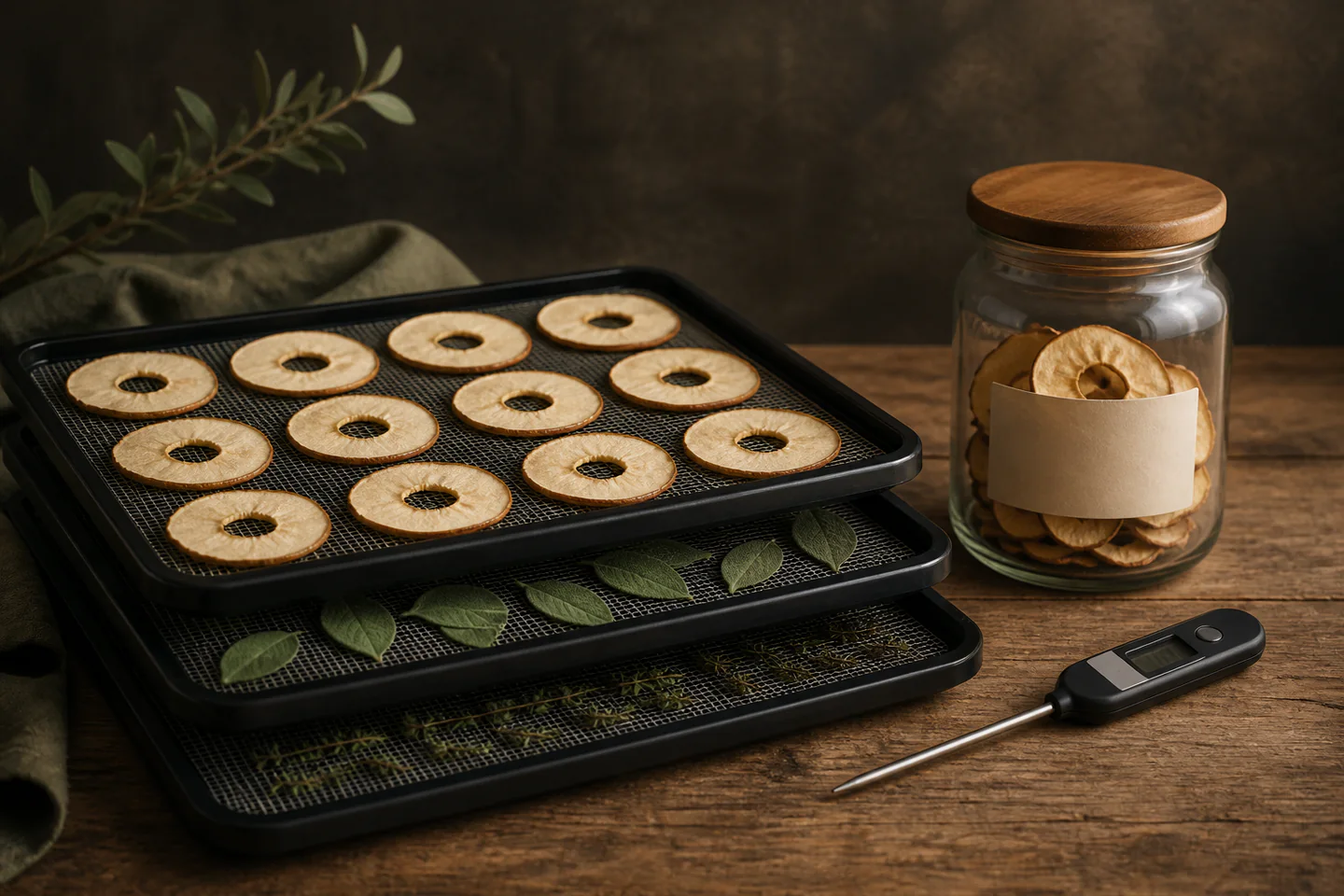
Dry one tray of evenly sliced apple and condition the result
Use a current tested method for apples and an appliance whose manual explicitly supports dehydration at the required temperature. Wash and prepare sound fruit, cut uniform thin slices, pretreat only as directed and arrange a single uncrowded layer. Dry for the method’s time and texture cues, rotating only if the appliance requires it. Cool pieces fully before testing, then condition them in a clean loosely filled jar for several days, shaking and checking for condensation. Redry or discard unsafe material rather than sealing moisture in.
- 01
Dehydration slows microbial growth by removing water; it does not sterilise contaminated or spoiled food.
- 02
Uniform thickness matters because the wettest piece determines whether the batch is safe to store.
- 03
Appliance temperature settings may cycle or differ from actual tray temperature. Use tested methods and a suitable thermometer where guidance calls for one.
- 04
Warm dried food can feel drier than it is and can create condensation when sealed. Cool and condition first.
- 05
Meat jerky has additional pathogen controls and is not the first project. Follow current official meat-specific guidance if pursued later.
What to expect
Drying time is a range, not a promise
Water content, slice thickness, humidity, appliance airflow, tray loading and door opening all change the finish time.
Preparation
Bruised or mouldy produce does not improve in a dehydrator. Begin with clean sound food and trim as the tested method directs.
Thickness
A mandoline can create consistency but adds severe blade risk; a knife and simple guide are adequate for one tray.
Airflow
Overlapping pieces and blocked vents trap moisture and produce a mixed batch.
Texture
Some fruit remains pliable when safely dry; crispness alone is not the universal test.
Conditioning
Moisture equalises between pieces in a jar. Condensation means the batch needs further drying or rejection.
Storage
Cool, dark, airtight storage and clear dates preserve quality; any mould, fermentation or off odour means discard.
Core method
Use one tested food, one thickness and one storage check
Match food to an official method
Start with apples or culinary herbs using guidance from a recognised preservation authority. Note slice size, pretreatment, temperature, drying cue, conditioning and expected storage. Do not transfer fruit settings to meat, dairy, eggs or complete meals.
Confirm the appliance route
Read the manual for tray placement, minimum temperature, duration, ventilation and unattended-use rules. A multi-function air fryer may dehydrate small batches but often has less surface area; a dedicated horizontal-flow unit becomes useful when capacity and evenness repeatedly limit results.
Prepare and load evenly
Wash hands, surfaces and sound produce. Cut consistent slices, remove damaged areas and apply only the tested pretreatment. Arrange without overlap and label the start time. Keep vents clear and follow the manual on tray rotation; do not lower temperature merely to make the food look less cooked.
Cool, condition and store
Test several thick pieces after cooling. Pack loosely into a clean dry jar and inspect daily during the method’s conditioning period, shaking to redistribute pieces. If condensation appears, return suitable food to the dehydrator immediately and repeat the check. Label food and date, store as directed and discard any suspect batch.
Useful products
Products with a clear job in the setup
The Ninja AF300UK offers a dehydration function for small batches and is useful only if its tray area and temperature range suit the chosen method. The ThermoPro probe supports food and appliance checks where appropriate, while the Etekcity scale records starting and finished weights. A dedicated dehydrator is the better later buy when long-duration capacity, airflow and tray access become the repeated limitation.
Ninja Foodi Dual Zone Air Fryer with Dehydrate, AF300UK
The controlled low-temperature mode lets a beginner test whether long slow drying fits their routine.
ThermoPro TP19 Instant-Read Food Thermometer
It provides evidence when a method includes a temperature checkpoint.
Etekcity Digital Kitchen Scale, 0.1 g to 5 kg
Starting and cooled finish weights show how dramatically food changes and support consistent packing.
First project
Dry and condition one tray of apples
Apple slices are visible, easy to compare and supported by established preservation guidance.
- 01
Read the full tested method
Write thickness, pretreatment, temperature, dryness and conditioning cues.
- 02
Inspect and prepare
Use sound fruit, clean tools and uniform slices.
- 03
Load one layer
Avoid overlap and keep every air path clear.
- 04
Dry by cue and time
Follow the appliance and method; rotate only when directed.
- 05
Cool before judging
Test several of the thickest pieces away from the warm tray.
- 06
Condition and label
Watch for condensation, redry if appropriate and store cool and dark.
What can wait
What can wait until the first result
Jerky, dairy, eggs and complete meals have stricter controls and are poor material for discovering whether the appliance dries evenly.
- 01
Raw meat jerky
Pathogen control requires meat-specific heating, temperature and storage guidance.
- 02
A nine-tray machine
One small batch reveals whether capacity and long run time fit the household.
- 03
Fruit leather
Puree depth, liners and sticking add variables after slices.
- 04
Vacuum sealing immediately
It can hide residual moisture before conditioning reveals it.
- 05
Wild-foraged foods
Identification and contaminant risks need expert certainty before preservation.
Upgrade path
Upgrade the repeated limitation
Upgrade airflow, tray area or storage only after safe small batches are consistently dry and conditioned.
Existing appliance trial
Free–£40Manual-approved dehydrating mode + trays
Learn cutting, drying and conditioning.Dedicated small dehydrator
About £70–£180Adjustable temperature + several trays
Gain area and repeat airflow.Preservation workflow
About £180–£450Quality horizontal-flow unit, jars and records
Dry varied produce consistently.Large seasonal batches
About £450–£1,200+High-capacity unit and storage system
Process harvests with measured control.Safety & care
Dry is a safety and storage decision, not just a texture
Use sound food, tested temperatures and conditioning. When moisture, mould, fermentation or storage history is uncertain, discard the batch.
- Use current authoritative guidance for the exact food; fruit, herbs, vegetables and meat require different preparation and pathogen controls.
- Follow the appliance manual for ventilation, loading, maximum run time, clearance and unattended operation; keep it away from water and combustible clutter.
- Prevent cross-contamination, wash hands and produce and do not dehydrate spoiled, mouldy or unidentified food.
- Cool and condition before airtight storage, label dates and inspect for condensation, mould, off odour or fermentation; discard suspect food without tasting.
- Use guarded slicing technique, protect fingers from mandolines and knives and keep hot trays and surfaces away from children and pets.
Outside help
When outside help earns its place
Official guidance and one apple batch are enough. A preservation workshop becomes useful for vegetables, leathers, jerky and long-term storage plans with measured safety controls.
Use food-specific preparation, temperature, dryness and conditioning advice.
Ask which foods, equipment, storage and safety tests are included.
Representative UK learning options checked 17 August 2026; local prices, access, materials and tutor support vary.
Sources
Where the guidance came from
Food-preservation authorities define safe processes; appliance makers define operating limits and experienced dehydrating communities add capacity and texture evidence.
-
01
National Center for Home Food Preservation · Drying
Research-based food-specific drying and storage methods.
Open source -
02
USDA · Jerky and food safety
Official meat-jerky pathogen-control context for later learning.
Open source -
03
Food Standards Agency · Food hygiene
UK home food hygiene and storage context.
Open source -
04
Ninja · AF300UK support
Manufacturer functions, manual and operating guidance.
Open source -
05
Reddit · r/dehydrating
Community evidence on machines, tray loading, conditioning and failures.
Open source -
06
Amazon UK · Foodi Dual Zone Air Fryer with Dehydrate, AF300UK
Exact product catalogue page or ISBN used for the recommendation; current price, seller and availability should be confirmed.
Open source -
07
Amazon UK · TP19 Instant-Read Food Thermometer
Exact product catalogue page or ISBN used for the recommendation; current price, seller and availability should be confirmed.
Open source -
08
Amazon UK · Digital Kitchen Scale, 0.1 g to 5 kg
Exact product catalogue page or ISBN used for the recommendation; current price, seller and availability should be confirmed.
Open source
Guide information and links checked 17 August 2026.