Beginner’s guide · Make & create
Mark every page,
fold the pattern into view.
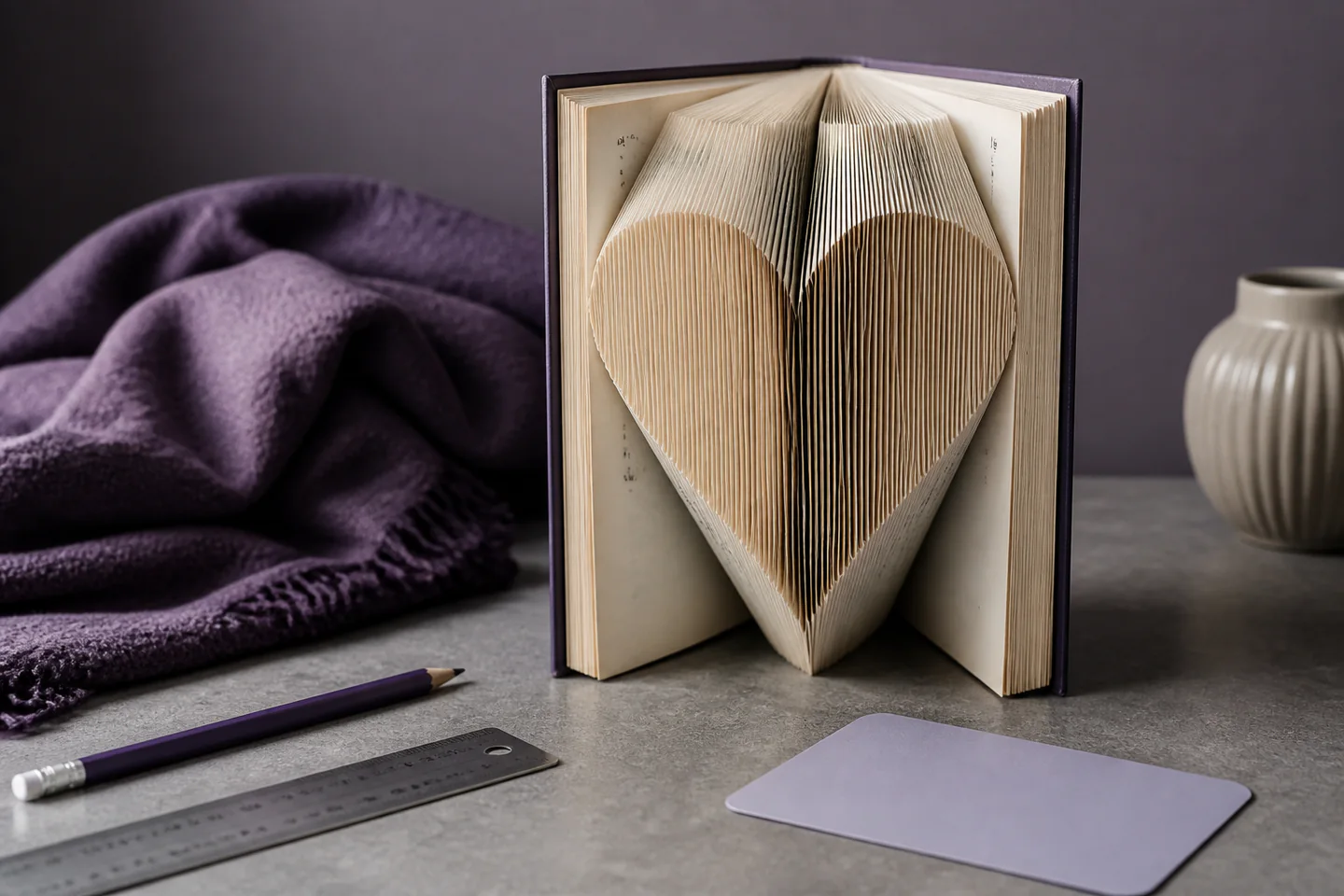
Book folding turns page edges into a silhouette through measured folds. Begin with a legal second-hand hardback and a simple measure-and-fold pattern.
Quick answer
Choose a fold-only pattern that fits the book’s page count
Use a legally owned second-hand hardback that is sound, dry and of no special value. Confirm the pattern’s required numbered leaves rather than assuming every printed page counts. Mark the top and bottom measurements on each required leaf with a pencil and ruler, fold the two corners precisely to those marks and keep the page sequence clipped. Stand the closed book upright periodically to inspect the emerging shape.
- 01
Choose a sound expendable hardback and measured fold-only pattern for the first result and resist substituting several unfamiliar materials at once. Record what you used on the first attempt so the result can be repeated or changed for a reason.
- 02
Make page count and millimetre marking visible with a small test before committing the full project. Record what you used on the first attempt so the result can be repeated or changed for a reason.
- 03
Change one variable between attempts and keep the preparation otherwise consistent. Record what you used on the first attempt so the result can be repeated or changed for a reason.
- 04
Inspect the work at each reversible stage instead of waiting until final display shape. Record what you used on the first attempt so the result can be repeated or changed for a reason.
- 05
Finish one modest result and note the actual time, material use and recurring difficulty. Record what you used on the first attempt so the result can be repeated or changed for a reason.
What to expect
The craft is repetitive measurement, not random page bending
A clear silhouette depends on the pattern matching the book, every leaf being counted consistently and folds reaching their marks without tearing the spine.
Book choice
Height, page count, paper weight and spine condition affect the pattern. Valuable, borrowed or mouldy books are unsuitable. In book folding, this is worth checking deliberately rather than trying to correct it after the next stage.
Counting
Patterns may count leaves, not printed page numbers. Establish the convention before the first mark. In book folding, this is worth checking deliberately rather than trying to correct it after the next stage.
Accuracy
A few millimetres of drift across many folds softens the outline. Use one ruler position and sharp pencil. In book folding, this is worth checking deliberately rather than trying to correct it after the next stage.
Spine
Forcing thick stacks backwards can crack adhesive or sewing. Support the book and turn pages gently. In book folding, this is worth checking deliberately rather than trying to correct it after the next stage.
Dust
Old books can contain dirt, allergens or mould. Reject damp or suspect copies rather than cleaning them through craft use. In book folding, this is worth checking deliberately rather than trying to correct it after the next stage.
Core method
Match pattern, page count and book before folding
Audit the book
Check ownership, condition, height, page count and spine, then remove jackets without damaging them. In book folding, this is worth checking deliberately rather than trying to correct it after the next stage.
Map the pattern range
Locate the exact first and last leaf, insert temporary markers and verify that the design centres. In book folding, this is worth checking deliberately rather than trying to correct it after the next stage.
Mark consistently
Measure from the same page edge, use light pencil marks and record progress every ten leaves. In book folding, this is worth checking deliberately rather than trying to correct it after the next stage.
Fold and inspect
Make sharp corner folds to the two marks, keep the sequence orderly and stand the book up for periodic checks. In book folding, this is worth checking deliberately rather than trying to correct it after the next stage.
Useful products
Products with a clear job in the setup
The first book supplies straightforward fold-only patterns; the follow-up offers more designs. The bookbinding tool kit is only a later precision aid for bone folders and rulers, not a reason to cut a valuable volume.
Holly DiBella-McCarthy Book Folding for Beginners
A published fold sequence removes pattern calculation from the first attempt.
Holly DiBella-McCarthy More Book Folding for Beginners: 20 Patterns
It extends the same technique without forcing a new tool system.
Jodsen Traditional Bookbinding Tool Kit
Reusable measuring and folding tools can support later paper and binding hobbies.
First project
Fold one broad heart silhouette
A wide symmetrical shape tolerates small errors and makes centring easy to assess from across the room.
- 01
Choose the donor book
Use a dry sound expendable hardback that meets the pattern’s height and leaf count. In book folding, this is worth checking deliberately rather than trying to correct it after the next stage.
- 02
Confirm the count
Identify whether the pattern numbers leaves or printed pages and mark the exact working range. In book folding, this is worth checking deliberately rather than trying to correct it after the next stage.
- 03
Make a progress card
Record each completed line so interruptions do not cause a repeated or skipped leaf. In book folding, this is worth checking deliberately rather than trying to correct it after the next stage.
- 04
Mark two measurements
Measure from the top edge in the same orientation and use small light pencil marks. In book folding, this is worth checking deliberately rather than trying to correct it after the next stage.
- 05
Fold to the marks
Bring corners to their marks, crease without tearing and keep completed leaves together. In book folding, this is worth checking deliberately rather than trying to correct it after the next stage.
- 06
Stand and inspect
View the book at normal display angle, correct only reversible errors and dust the surface gently. In book folding, this is worth checking deliberately rather than trying to correct it after the next stage.
What can wait
What can wait until the first result
Cut-and-fold portraits and custom text add calculations and irreversible cuts before basic counting is proven.
- 01
Cut-and-fold portrait
Cut depth and many marked points make mistakes permanent. In book folding, this is worth checking deliberately rather than trying to correct it after the next stage.
- 02
Rare or sentimental book
Craft value never justifies destroying a volume whose content or provenance matters. In book folding, this is worth checking deliberately rather than trying to correct it after the next stage.
- 03
Very thick encyclopaedia
Weight and spine strain make handling harder. In book folding, this is worth checking deliberately rather than trying to correct it after the next stage.
- 04
Custom name pattern
Pattern generation and font legibility are separate skills. In book folding, this is worth checking deliberately rather than trying to correct it after the next stage.
- 05
Painted page edges
Colour can transfer, stiffen pages and disguise the quality of the fold. In book folding, this is worth checking deliberately rather than trying to correct it after the next stage.
Upgrade path
Upgrade the repeated limitation
Move to denser patterns after several interruptions can be handled without losing the line.
Fold-only heart
About £8–£20Second-hand hardback and pattern
Learn counting and marking.Detailed silhouette
About £15–£35Fine ruler and progress sheet
Control repeated accuracy.Cut-and-fold design
About £25–£70Knife, mat and tested pattern
Add controlled cut depth.Custom pattern work
About £50–£200+Pattern software and test books
Translate text or images reliably.Safety & care
Use only suitable books and clean hand tools
The main ethical and practical decision is the donor volume. Condition, ownership and cultural value matter before any fold.
- Never alter library books, borrowed books, valuable editions, family records or material with uncertain ownership. Follow the current instructions supplied with the exact material, tool or living specimen.
- Reject damp, mould-smelling or pest-damaged books and avoid dispersing dust from them. Follow the current instructions supplied with the exact material, tool or living specimen.
- Support heavy books on the table and take hand and neck breaks during repeated folds. Follow the current instructions supplied with the exact material, tool or living specimen.
- Keep awls and knives stored because a measure-and-fold project does not need them. Follow the current instructions supplied with the exact material, tool or living specimen.
- Place finished books securely so their weight cannot fall from a high shelf. Follow the current instructions supplied with the exact material, tool or living specimen.
Outside help
When outside help earns its place
A complete beginner tutorial is enough for the first controlled attempt. A class becomes useful when cut-and-fold designs or custom pattern calculations become the goal.
Follow one method using a sound expendable hardback and measured fold-only pattern, including preparation and finishing rather than only the photogenic middle stage.
Check whether materials, troubleshooting, final display shape and a finished take-home result are included.
Representative UK learning options checked 28 August 2026; local prices, access, materials and tutor support vary.
Sources
Where the guidance came from
The method is grounded in specialist and public guidance, then checked against recurring beginner questions and the exact products linked here.
-
01
British Origami Society
UK paper-folding community and learning resources.
Open source -
02
Victoria and Albert Museum · paper collection
Material and historical context for paper arts.
Open source -
03
Library of Congress · paper permanence
Paper handling and preservation context.
Open source -
04
Paper Kawaii · tutorials
Specialist folding and paper-project tutorials.
Open source -
05
Reddit · r/papercraft
Community evidence on paper, tools and common failures.
Open source -
06
Amazon UK · Book Folding for Beginners
Exact product catalogue page or ISBN used for the recommendation; current price, seller, specification and availability should be confirmed.
Open source -
07
Amazon UK · More Book Folding for Beginners: 20 Patterns
Exact product catalogue page or ISBN used for the recommendation; current price, seller, specification and availability should be confirmed.
Open source -
08
Amazon UK · Traditional Bookbinding Tool Kit
Exact product catalogue page or ISBN used for the recommendation; current price, seller, specification and availability should be confirmed.
Open source
Guide information and links checked 28 August 2026.