Beginner’s guide · Observe & photograph
Photograph the city after the easy light.
Make stillness work for you.
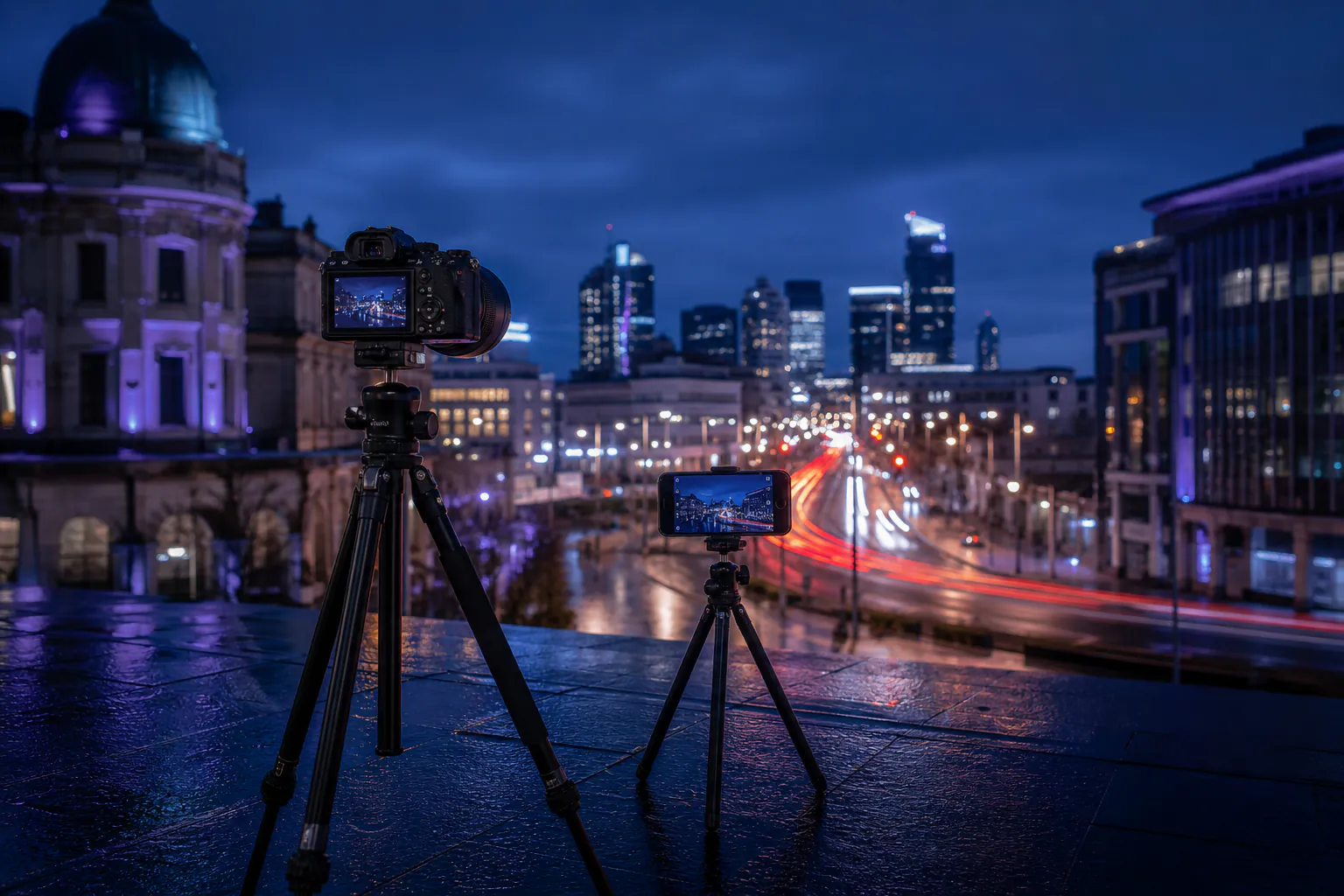
Start with a phone or camera, a stable support and the timer. Photograph lit streets and buildings at blue hour, then extend exposures deliberately. This is night photography without needing star tracking.
Quick answer
Use support before buying a faster lens
Photograph a well-lit static scene during blue hour with the device you own. Clean the lens, disable flash, brace the phone or mount the camera, use a short timer and expose for important highlights. On a phone, use Night mode and avoid moving it during capture; on a camera, begin around ISO 400–800, a moderate aperture and a shutter speed chosen from a test frame.
- 01
Night photography includes streets, buildings, interiors and light trails; stars and tracked deep-sky work are covered separately by astrophotography.
- 02
Long exposure records every movement, including tripod vibration, wind and people. Stability is part of composition.
- 03
Bright signs and lamps clip before shadows look bright. Protect the lights and allow genuine darkness.
- 04
A head torch helps setup, but red light still affects other people and some wildlife; aim it down and switch it off for exposures.
What to expect
Night scenes contain more contrast and movement than the eye reports
The camera can gather a beautiful interval, but it cannot keep moving subjects sharp and preserve every bright lamp in one effortless frame.
Phone mode
Night mode may combine several frames. It works best on static scenes with the phone supported and can produce ghosts around movement.
Camera exposure
A tripod lets ISO fall and shutter time grow; it does not stop people, leaves or traffic from moving.
Focus
Autofocus can hunt in darkness. Focus on a bright edge, magnify to check, then prevent accidental refocusing.
Colour
Street lighting mixes temperatures. RAW files give more adjustment, but there is no single objectively neutral night colour.
Safety
Attention narrows behind a screen. Choose the location in daylight, stay visible and do not stand in roads or block access.
Weather
Condensation, rain and cold affect batteries and optics. Acclimatise gear and dry it before storage.
Core method
Build the exposure around a stable, safe viewpoint
Scout before darkness
Choose a legal public viewpoint with a pavement, barrier or firm verge and note traffic, closing times and private-property rules. Look for one clear subject, such as a lit doorway, bridge or reflection. Blue hour gives residual sky colour and a gentler contrast than full darkness, making it the most forgiving start.
Stabilise the device and release it gently
Extend the thick tripod sections first, keep the centre column low and hang no swinging bag. Use the phone clamp or camera plate securely. Trigger a phone with its timer or a compatible Bluetooth remote. For a camera, use the self-timer or the correct cable release and disable stabilisation if the manufacturer recommends that on a tripod.
Expose for lights and check focus
Make a test frame and inspect bright signs, lamps and the main subject rather than judging only the rear-screen brightness. Lower exposure if important highlights have no detail. Magnify a high-contrast edge to verify focus. With a camera, shoot RAW plus JPEG if editing RAW is part of the intended workflow.
Vary one control with intent
Keep composition and focus fixed, then make three exposures that change only shutter time or phone exposure control. Compare moving traffic, water and people. Longer is not automatically better: stop when trails obscure the subject or highlights dominate. Keep the sharpest restrained frame as the baseline.
Useful products
Support, release and a light that stays out of the photograph
The compact tripod with phone clip is a low-cost phone route. The larger K&F tripod supports interchangeable-lens cameras. The Pixel timer is useful only in the correct version for a compatible camera, while the head torch is for safe setup rather than painting every scene red.
Victiv 50-Inch Phone and Camera Tripod with Remote
It lets Night mode gather frames without hand movement and remains useful for self-timed video.
K&F Concept 64-Inch Travel Camera Tripod
It addresses camera shake directly and supports consistent compositions across changing light.
Pixel TW-283 Wireless Timer Shutter Release
It solves handling vibration and repeat timing when the exact receiver cable matches the camera.
BORUIT Red and White LED Head Torch
It improves footing and equipment handling without relying on a phone torch.
First project
Make a blue-hour-to-night sequence
Return to one safe composition before sunset and make six frames as ambient light changes. The sequence teaches more than six unrelated locations.
- 01
Scout and frame
Choose a static subject and stable standing place before light falls.
- 02
Clean and stabilise
Clean the lens, mount the device and use the timer or compatible release.
- 03
Make the blue-hour baseline
Expose for the main lights while the sky retains colour.
- 04
Check focus at full size
Magnify edges and correct focus before continuing.
- 05
Extend one exposure
Try a slower frame for traffic or water without changing composition.
- 06
Edit lightly and compare
Correct level, crop and colour consistently and keep the frame whose light serves the subject.
What can wait
What can wait until the first result
Buy only when camera shake, field of view or remote timing has become the repeated obstacle.
- 01
An ultra-fast lens
It helps moving subjects and handheld work, but a tripod can solve a static-scene exposure first.
- 02
A star tracker
It compensates for Earth’s rotation in astrophotography and does not improve city light trails or architecture.
- 03
Heavy filters
Neutral-density filters usually reduce light that is already scarce; use them later for a specific very long effect.
- 04
A full lighting kit
Existing urban light defines this first practice. Added light brings permissions, balance and distraction.
- 05
Remote-release guesswork
Camera connector shapes differ. Verify the exact body and included cable before ordering.
Upgrade path
Upgrade the repeated limitation
Upgrade the type of night scene that the existing setup cannot make.
Phone at blue hour
FreeNight mode + timer + firm support
Learn composition and highlight control.Phone tripod
About £15Compact tripod + phone clip + remote
Repeat framing and reduce handling movement.Camera tripod
About £46Stable travel tripod + RAW capture
Control ISO, aperture and long shutter time.Faster lens or specialist support
About £200+Chosen for people, interiors or a specific field of view
Solve movement or framing rather than static stability.Safety & care
Make the location safer than the photograph needs to be
No image is worth a traffic, water, height, trespass or confrontation risk.
- Scout access and footing in daylight and obey closures, property rules and instructions from staff or police.
- Stay on pavements and public areas; never stand in a carriageway, railway environment or unsafe verge for a composition.
- Work with a companion where appropriate, keep valuables discreet and remain aware of people around you.
- Use lights without dazzling drivers, cyclists, residents or wildlife and leave the location as found.
- Dry damp gear, manage condensation and store batteries according to the manufacturer guidance.
Outside help
When outside help earns its place
A photo walk can help with location judgement and exposure feedback, but a safe familiar street is enough to learn the essentials.
Use current camera or phone guidance for timer, focus and exposure controls.
Check group size, route, accessibility, insurance and night-safety planning.
Representative UK prices and free learning routes checked 3 August 2026; local availability, materials and tutor support vary.
Sources
Where the guidance came from
Camera-maker guidance establishes exposure and focus technique; UK public photography advice informs access and responsible practice.
-
01
Nikon · Taking pictures at dusk and at night
Technique for exposure, support, focus and changing evening light.
Open source -
02
Apple · iPhone camera basics
Current camera controls, modes and capture basics for iPhone users.
Open source -
03
Metropolitan Police · Photography advice
UK public photography context and interaction with police.
Open source -
04
Royal Photographic Society · Nature photographers code
Responsible field practice, access and subject welfare principles.
Open source -
05
Amazon UK · Victiv phone and camera tripod
Exact product page, model or ISBN, observed price and availability checked for this guide.
Open source -
06
Amazon UK · K&F Concept 64-inch travel tripod
Exact product page, model or ISBN, observed price and availability checked for this guide.
Open source -
07
Amazon UK · Pixel TW-283 timer remote
Exact product page, model or ISBN, observed price and availability checked for this guide.
Open source -
08
Amazon UK · BORUIT red and white head torch
Exact product page, model or ISBN, observed price and availability checked for this guide.
Open source
Guide information and links checked 3 August 2026.