Beginner’s guide · Make & build
Build for water
then test at walking pace.
A simple low-voltage displacement boat kit teaches hull sealing, shaft alignment, radio installation and pond testing. Begin with a matched educational kit rather than designing a fast brushless hull from loose parts.
Quick answer
Choose a slow matched kit and bench-test it dry
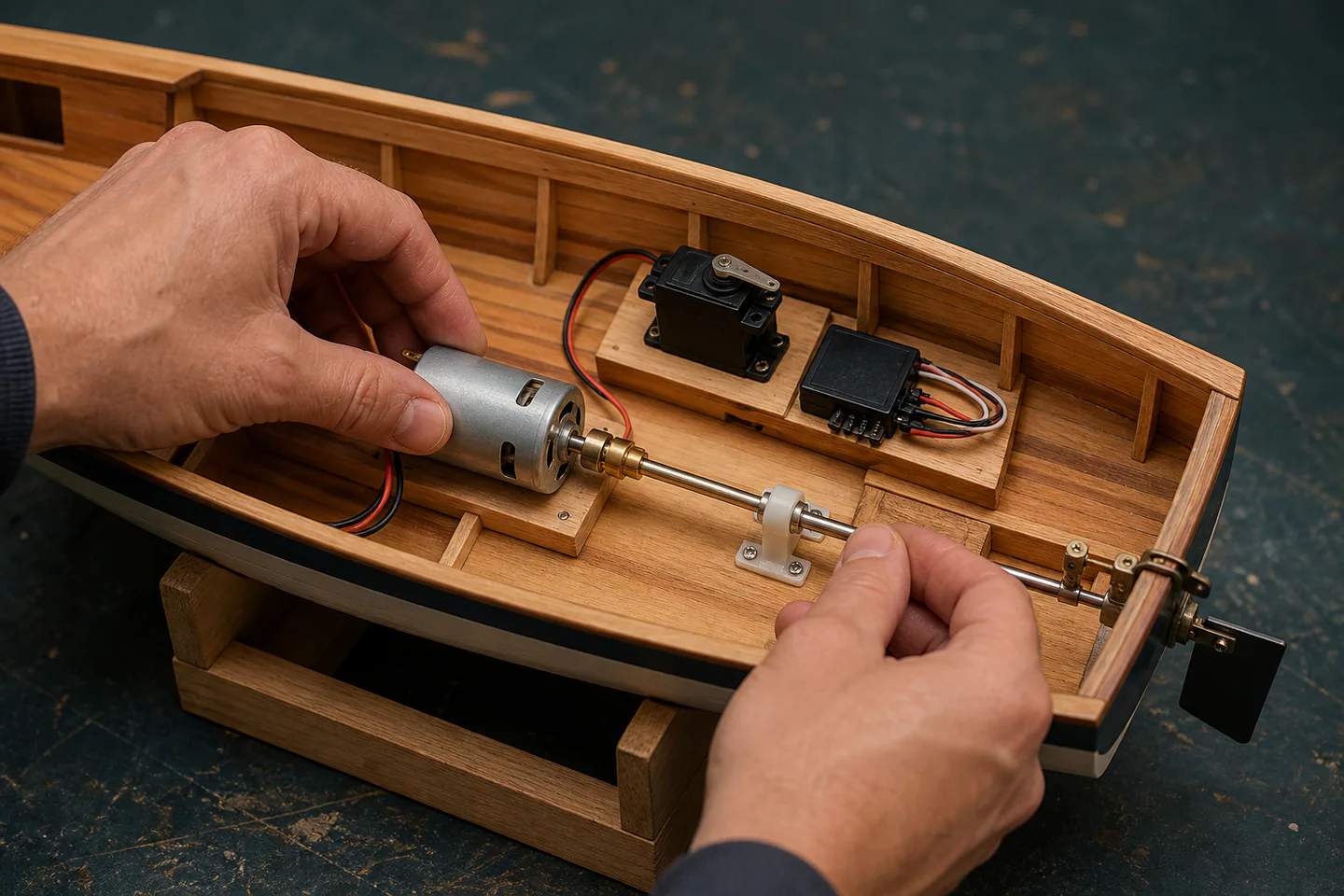
Start with a simple educational or wooden displacement-hull kit designed for radio control. Build and seal the hull, align motor and shaft without binding, install a modest 2.4 GHz radio system and test every function on the bench before water.
- 01
Buy a coherent hull or full kit before choosing motor, propeller, voltage and speed controller separately. Note the material, setting or measurement used so the result can be repeated or changed for a reason.
- 02
Align the propeller shaft and motor mechanically before tightening mounts or adding power. Note the material, setting or measurement used so the result can be repeated or changed for a reason.
- 03
Keep receiver and connections above the bilge and add splash protection without trapping heat. Note the material, setting or measurement used so the result can be repeated or changed for a reason.
- 04
Set failsafe and confirm steering direction with the propeller unable to injure anyone. Note the material, setting or measurement used so the result can be repeated or changed for a reason.
- 05
Make the first water test close to shore with a retrieval plan and calm conditions. Note the material, setting or measurement used so the result can be repeated or changed for a reason.
What to expect
Water finds small mistakes quickly
A boat can work perfectly on the bench and still fail through a leaking shaft, poor balance, radio range or inaccessible battery connector.
Hull sealing
Paint alone does not fix open joints. Every seam, shaft tube and deck opening needs the sealing method intended for its material. For radio-controlled boat building, check this deliberately while the work is still easy to alter; correcting it after the next stage usually costs more time or materials.
Driveline
A bent or misaligned shaft wastes power, vibrates and can loosen fittings. It should turn freely by hand before motor testing. For radio-controlled boat building, check this deliberately while the work is still easy to alter; correcting it after the next stage usually costs more time or materials.
Balance
Battery placement changes trim. A boat sitting bow- or stern-heavy may steer badly or take water over low edges. For radio-controlled boat building, check this deliberately while the work is still easy to alter; correcting it after the next stage usually costs more time or materials.
Recovery
Even a reliable model can catch weeds, flatten a battery or lose a coupling. Safe reachable test water matters more than maximum speed. For radio-controlled boat building, check this deliberately while the work is still easy to alter; correcting it after the next stage usually costs more time or materials.
Core method
Build a dry, straight mechanical system
Choose the route
Prefer a kit that states hull material, motor type and required radio parts; list every excluded component before ordering. For radio-controlled boat building, check this deliberately while the work is still easy to alter; correcting it after the next stage usually costs more time or materials.
Seal and inspect the hull
Complete structural joints, use the correct adhesive and finish, then test for leaks without installed electronics if the instructions allow. For radio-controlled boat building, check this deliberately while the work is still easy to alter; correcting it after the next stage usually costs more time or materials.
Align the shaft
Support the motor and shaft on their true centreline, turn the system by hand and correct binding before fixing mounts permanently. For radio-controlled boat building, check this deliberately while the work is still easy to alter; correcting it after the next stage usually costs more time or materials.
Install radio and power
Mount receiver, servo, speed controller and battery securely, route wires away from the coupling and set transmitter failsafe. For radio-controlled boat building, check this deliberately while the work is still easy to alter; correcting it after the next stage usually costs more time or materials.
Useful products
Products with a clear job in the setup
The beginner route combines a buildable boat project with a straightforward surface radio. The speed controller is a later component only when it matches the kit’s motor and battery.
Sarini RC Paddle Steamer Assembly Experiment Kit
A slow educational craft is a safer learning platform than a high-speed bare racing hull.
Flysky FS-GT2E 2.4 GHz Two-Channel Transmitter and Receiver
Two channels are sufficient for a conventional motor-and-rudder boat and keep setup understandable.
WANGCL 320A Brushed ESC with Forward, Reverse and Brake
Forward and reverse are useful on a slow model boat when voltage and motor current genuinely match.
First project
Bench-test, bath-test and then pond-test
Progressive tests keep leaks and radio faults within reach instead of discovering them in the centre of a lake.
- 01
Inventory the system
List hull, motor, coupling, shaft, propeller, rudder, servo, receiver, speed controller, battery and charger, marking anything not included. For radio-controlled boat building, check this deliberately while the work is still easy to alter; correcting it after the next stage usually costs more time or materials.
- 02
Build and align dry
Assemble the hull and driveline, rotate it by hand and operate steering with the propeller removed or safely isolated. For radio-controlled boat building, check this deliberately while the work is still easy to alter; correcting it after the next stage usually costs more time or materials.
- 03
Leak and balance test
Use a bath or shallow container only if suitable, keep electronics protected and adjust battery position until the hull sits on its intended waterline. For radio-controlled boat building, check this deliberately while the work is still easy to alter; correcting it after the next stage usually costs more time or materials.
- 04
Set radio safety
Bind the system, confirm directions, set throttle failsafe to stop and range-test according to the radio maker. For radio-controlled boat building, check this deliberately while the work is still easy to alter; correcting it after the next stage usually costs more time or materials.
- 05
Launch within reach
Choose calm legal water free of swimmers and wildlife, test at low speed close to shore and stop immediately if water enters. For radio-controlled boat building, check this deliberately while the work is still easy to alter; correcting it after the next stage usually costs more time or materials.
What can wait
What can wait until the first result
High-speed brushless power and scratch-designed hulls combine hydrodynamics, electrical loading and recovery risk before the basic system is proven.
- 01
Fast racing hull
Speed magnifies collision energy, cooling needs and the distance needed for recovery. For radio-controlled boat building, check this deliberately while the work is still easy to alter; correcting it after the next stage usually costs more time or materials.
- 02
Loose brushless system
Motor kV, propeller load, battery, controller current and cooling must be matched as a system. For radio-controlled boat building, check this deliberately while the work is still easy to alter; correcting it after the next stage usually costs more time or materials.
- 03
Open-water testing
Wind, current, weed and poor access can strand a model. Use small calm permitted water first. For radio-controlled boat building, check this deliberately while the work is still easy to alter; correcting it after the next stage usually costs more time or materials.
Upgrade path
Upgrade the repeated limitation
Upgrade the repeated limitation—runtime, radio reliability, handling or construction quality—while keeping the system matched.
Try it
£45–£120Simple matched kit and included or basic radio
Hull, steering, propulsion and close-range testing make sense.Improve reliability
£30–£100 extraKnown radio, sealed receiver box and serviceable coupling
Control and water resistance become more dependable.Build a scale boat
£100–£350+Quality hull kit, matched brushed system and fittings
Longer construction and realistic detail become practical.Build for speed
VariableMatched brushless powertrain, cooling and experienced club support
Higher performance becomes possible with proportionate safety and recovery planning.Safety & care
Protect people, batteries and waterways
Propellers, lithium batteries and public water make safe testing a core building skill.
- Disconnect the battery before touching the propeller or driveline and restrain the hull during powered bench tests. Follow the current instructions supplied with the exact material or tool.
- Use only a charger and settings matched to the battery chemistry, charge on a suitable surface and never leave charging unattended. Follow the current instructions supplied with the exact material or tool.
- Set throttle failsafe to stop, range-test the radio and keep the model well away from swimmers, animals and full-size craft. Follow the current instructions supplied with the exact material or tool.
- Use water only where model boating is permitted, inspect for invasive-species contamination and have a shore-based retrieval plan. Follow the current instructions supplied with the exact material or tool.
Outside help
When outside help earns its place
A matched educational kit can be built from clear instructions. A model-boat club is strongly useful before scratch building, high-speed power systems or testing on larger water.
Use one complete lesson that includes preparation, the working method, troubleshooting and finishing. Avoid combining measurements from several creators on the first attempt.
Ask whether materials, safe tool use, individual correction and a finished take-home result are included before booking.
Representative UK learning options checked 29 August 2026; local prices, access, materials and tutor support vary.
Sources
Where the guidance came from
The method is grounded in specialist and manufacturer guidance, then checked against recurring beginner problems and the exact products linked here.
-
01
Model Yachting Association
UK model-yachting clubs, water access and radio-sailing context.
Open source -
02
BMPRS
UK model powerboat racing context and experienced club route.
Open source -
03
Flysky · FS-GT2E
Manufacturer radio specifications and setup reference.
Open source -
04
BMFA · Radio control safety
UK model-radio safety and responsible operation context.
Open source -
05
GOV.UK · Countryside Code
Responsible access and wildlife consideration around outdoor test sites.
Open source -
06
Amazon UK · RC Paddle Steamer Assembly Experiment Kit
Exact product catalogue page or ISBN used for the recommendation; current price, seller, specification and availability should be confirmed.
Open source -
07
Amazon UK · FS-GT2E 2.4 GHz Two-Channel Transmitter and Receiver
Exact product catalogue page or ISBN used for the recommendation; current price, seller, specification and availability should be confirmed.
Open source -
08
Amazon UK · 320A Brushed ESC with Forward, Reverse and Brake
Exact product catalogue page or ISBN used for the recommendation; current price, seller, specification and availability should be confirmed.
Open source
Guide information and links checked 29 August 2026.