Beginner's guide · Grow & care
Cut below one healthy node.
Let the plant set the method.
Start with an easy houseplant, clean snips and either a clear jar or a small pot of airy compost. A cutting is not a universal recipe: the parent plant, cutting type, moisture and timing decide whether water, compost or a short drying period is appropriate.
Quick answer
Cut below one healthy node.
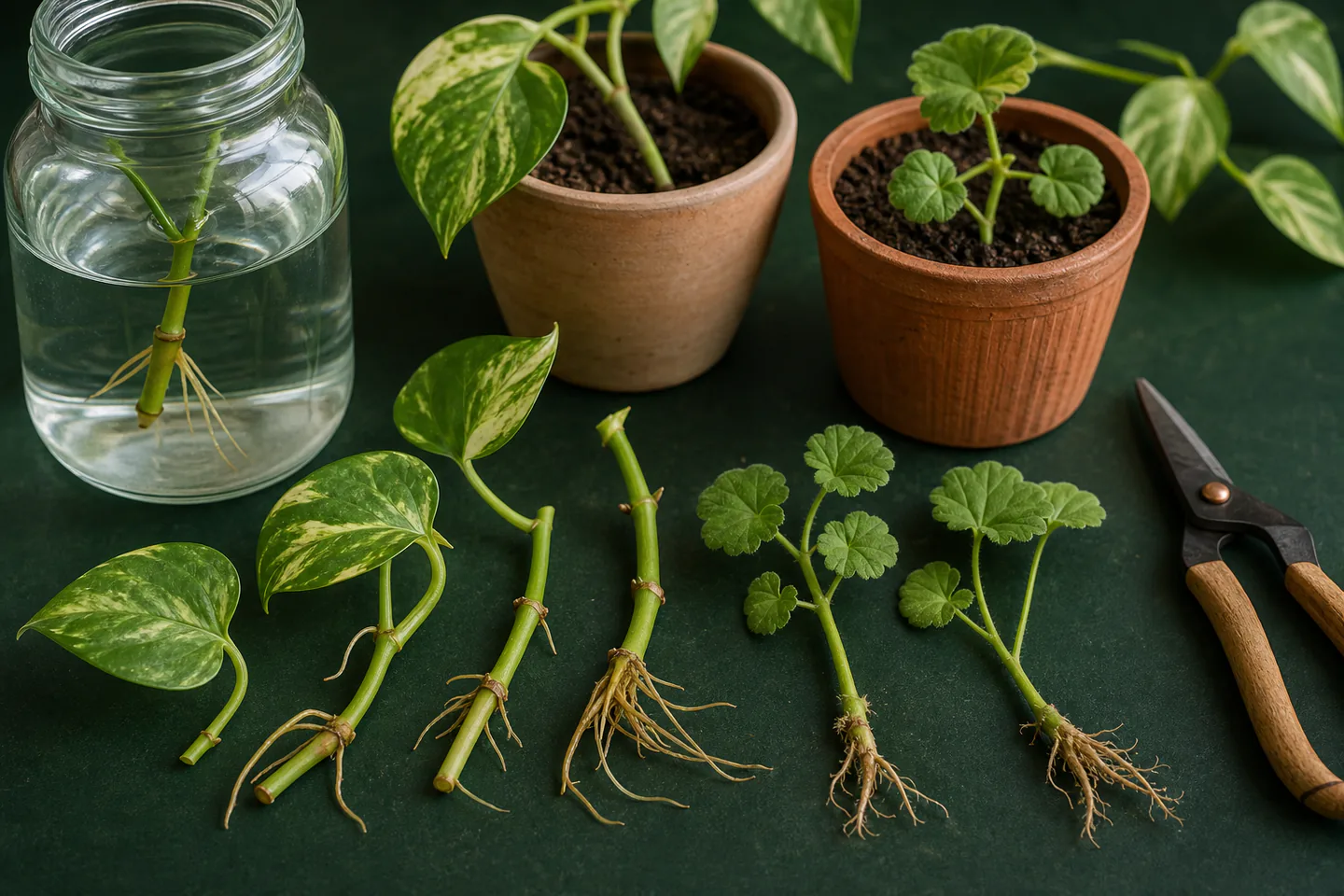
Identify the plant first, confirm which cutting type it accepts, then take a healthy non-flowering stem with clean sharp snips. For an easy pothos-style water cutting, keep one node under clean water and every leaf above it; for compost, use an airy peat-free mix kept moist rather than saturated.
- 01
The RHS water route is suitable for several easy houseplants, but succulents, woody plants and leaf-cutting species follow different preparation.
- 02
Clean blades reduce crushing and help prevent carrying pests or disease from the parent to the wound.
- 03
Rooting hormone is optional for many beginner houseplants. It is not a substitute for the correct node, season, species and moisture.
- 04
Take two or three cuttings rather than one precious stem. Propagation has a normal failure rate even when the method is sound.
What to expect
What the first attempts really involve
The first project is useful because it exposes the decisions that shopping pages tend to hide.
Identification
A pothos stem needs a node; a spider plant provides a rooted plantlet; many succulents use a callused leaf. The plant name comes before the cutting technique.
Parent health
A pest-infested, dehydrated or diseased parent is poor material. Propagation can also spread hidden scale, mites and fungal problems.
Moisture
No roots means little ability to replace lost water, yet saturated compost excludes oxygen and encourages rot. Humidity and drainage must work together.
Light
Bright indirect light supports growth without the heat and water loss of direct midday sun.
Transition
Water roots are adapted to water. Potting into compost requires a small pot, gentle handling and careful moisture while new roots adjust.
Fundamentals
Build the first attempt on reliable fundamentals
Name the plant and cutting type
Use the RHS or another authoritative plant-specific guide to decide whether the useful material is a stem, leaf, plantlet, root or division. Do not assume every cutting belongs in water. Some toxic houseplants also need gloves and careful disposal, while protected or privately owned plants should never be cut without permission.
Prepare clean material
Choose an actively growing, pest-free stem the parent can spare. Clean the snips before and after use, cut just below the appropriate node and remove leaves that would sit in water or compost. Keep at least a small upper leaf area unless the species guide says otherwise.
Control the small environment
A clear jar makes water roots visible; change cloudy water and keep the node submerged. A small pot of airy propagation mix should drain freely and remain just moist. A propagator lid may reduce water loss, but daily observation and ventilation matter because stagnant saturated air also favours disease.
Starter products
One clean cutting tool and optional rooting aids
The Fiskars snips are the reusable foundation. Clonex gel and Root Riot cubes are optional for plant-appropriate compost or plug propagation; they are not required for an easy pothos water cutting. Buy an aid only after choosing a species and method that can use it.
Fiskars Solid Micro-tip Snips SP13
Sharp clean snips improve control and remain useful for parent-plant care after the first cutting has rooted.
Growth Technology Clonex Rooting Gel
A named product with instructions is preferable to an anonymous powder when a plant-specific compost route genuinely benefits from rooting hormone.
Growth Technology Root Riot 24-cube tray with Clonex 50 ml
It becomes useful when several cuttings need consistent spacing and labels, rather than as a decorative replacement for a free jar.
First cutting
Root two pothos stem cuttings in water
Pothos is used because the nodes are visible and water rooting is easy to observe. If the available plant is different, stop and use a method written for that exact species.
- 01
Inspect the parent
Check leaf undersides, stems and compost for pests or disease. Water a dry parent in advance rather than taking from a stressed plant.
- 02
Find the nodes
Trace the vine and identify the slightly swollen leaf joints, often with an aerial-root nub. Plan two cuttings with at least one usable node each.
- 03
Clean the snips
Wash away debris and disinfect according to the tool and horticultural guidance. Let the blades dry before cutting.
- 04
Cut and trim
Make a clean cut below the node and remove the lowest leaf so no leaf blade will sit underwater.
- 05
Place in clean water
Submerge the node in a stable clear jar while keeping leaves above the water. Label the plant and date.
- 06
Set the light
Use bright indirect light in a warm stable room, away from a radiator, cold draught and harsh midday sun.
- 07
Observe rather than fuss
Top up clean water, replace it if cloudy and remove any cutting that turns soft or foul-smelling. Do not add fertiliser to a new water cutting.
- 08
Pot at a sensible stage
When several roots have developed and begun branching, use a small draining pot and peat-free mix. Keep evenly moist during the first adjustment without leaving it waterlogged.
Troubleshooting
Read the result before buying another tool
A black soft stem is rot
Remove it from the shared jar, clean the vessel and cut back to firm healthy tissue only if enough stem and a node remain. Recheck whether leaves were submerged or the water was stagnant.
No roots does not always mean failure
Temperature, season and species change the timetable. Look for firm tissue and new callus before disturbing the cutting. If the method is wrong for the species, switch based on an authoritative guide rather than adding more hormone.
Wilting in compost means water balance is wrong
Check that the mix is moist, the cutting has appropriate leaf area and the cover is not overheating in sun. Never rescue wilt by leaving the pot standing permanently in water.
Skip for now
What can wait
A windowsill propagation experiment needs observation more than equipment.
- 01
Rooting hormone for every cutting
Many soft houseplants root readily without it, while some products and concentrations are unsuitable for some methods. Use only when a plant-specific route supports it.
- 02
Decorative propagation stations
A stable clean jar shows roots just as well. Design-led narrow tubes can be awkward to clean and may give larger roots no space.
- 03
Heat mats
Bottom heat can help particular difficult cuttings, but it can also dry small pots or overheat an enclosed propagator. Add measured heat only for a species that benefits.
- 04
Rare parent material
Learn on a vigorous plant the owner can spare. A first cutting should not risk an expensive variegated node or a slow specimen.
Upgrade path
What a better setup changes
Upgrades move from seeing one root system to controlling repeat batches of species that genuinely benefit from plugs, humidity or bottom heat.
Visible water roots
Almost freeClean jar + easy stem cutting + snips
Teaches nodes, water quality and the transition into compost.Small plug batch
About £15–£30Rooting plugs + shallow tray + clear lid
Keeps several labelled cuttings organised in a consistent medium.Species-specific propagation
VariableMeasured heat, humidity and appropriate hormone only when justified
Improves control for slower material without pretending every plant wants the same conditions.Safety
Work safely from the first attempt
Plant sap, sharp tools, pests and unknown toxicity make identification and clean handling part of the hobby.
- Identify the plant before cutting; many common houseplants are irritating or toxic if eaten and some sap can affect skin or eyes.
- Keep snips, scalpels, hormone products and small plugs away from children and pets.
- Wear gloves for irritating sap and wash hands before touching the face or preparing food.
- Never take cuttings from parks, shops, collections or another person's plant without clear permission.
- Quarantine new cuttings from established plants until pests and disease have been ruled out.
Classes
When outside help is useful
A class is optional for easy houseplants but useful when moving into seasonal outdoor, hardwood, root or grafting techniques.
Local practical sessions often cover several seasonal cutting types and let participants take labelled material home.
A full day at a botanic garden can explain media, timing, hygiene and aftercare across a wider plant range.
Kew and EcoLocal propagation examples checked 30 July 2026; dates and availability change.
Sources
Sources and checking notes
RHS guidance sets the simple houseplant method, current workshop listings show what formal help adds and product pages confirm the exact optional tools.
-
01
RHS · Houseplant cuttings
Clean cuts, nodes, water and peat-free compost route.
Open source -
02
RHS · Softwood cuttings
Seasonal softwood method and clean cut below a node.
Open source -
03
Kew · Plant propagation workshop
Representative full-day UK propagation course content and price.
Open source -
04
EcoLocal · Autumn and winter propagation
Representative lower-cost practical workshop and techniques.
Open source -
05
Amazon UK · Fiskars SP13 snips
Exact micro-tip plant snips checked for current UK availability.
Open source -
06
Amazon UK · Clonex rooting gel
Exact optional rooting gel checked for current UK availability.
Open source -
07
Amazon UK · Clonex and Root Riot kit
Exact optional plug-and-gel combination checked for comparison.
Open source -
08
Amazon UK · Propagation potting mix
Exact small propagation-mix listing checked for current UK availability.
Open source
Guide information and links checked 30 July 2026.