Beginner’s guide · Build models
Build wear in thin layers,
then stop before every surface tells the same story.
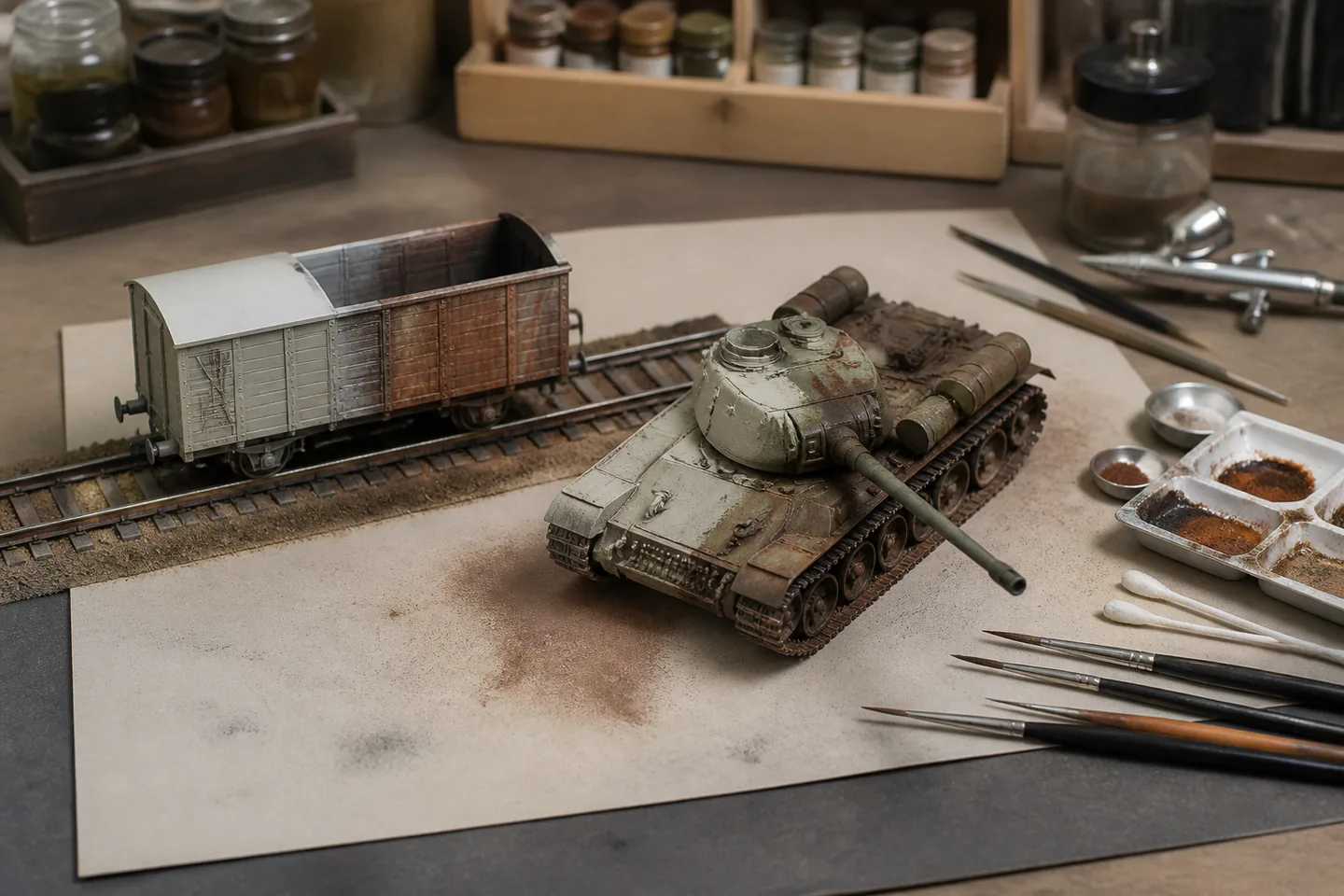
A gloss-protected test model can carry a pin wash, restrained dry brushing, dust pigments and small rust effects when scale, material and service history guide each mark.
Quick answer
Complete one weathered model before expanding the setup
Use an inexpensive completed model and gather three photographs of a comparable real subject in service. Photograph the clean model, apply a compatible protective gloss or satin coat and let it cure, add a controlled pin wash only to recesses, remove excess, dry-brush a slightly lighter base tone on selected edges, apply small amounts of dust pigment from the running gear upward and stop to compare under normal viewing distance before adding rust.
- 01
Weathering represents material, use, gravity and maintenance; random marks do not automatically create realism. Record what happened during scale-model weathering so the next attempt changes one known variable instead of several guesses.
- 02
Thin separated layers are easier to remove or correct than one strong overall effect. Record what happened during scale-model weathering so the next attempt changes one known variable instead of several guesses.
- 03
Washes flow differently over gloss, satin and matt surfaces and must be chemically compatible with paint and clear coat. Record what happened during scale-model weathering so the next attempt changes one known variable instead of several guesses.
- 04
Scale reduces apparent contrast and texture; a full-size rust chip can look enormous on a small model. Record what happened during scale-model weathering so the next attempt changes one known variable instead of several guesses.
What to expect
What scale-model weathering is really like at the start
The useful beginner controls are preparation, one bounded task and a record of the result; specialist equipment matters only when it solves a repeated limitation.
Reference
Museum and restored subjects may not represent operational wear, while dramatic online builds can exaggerate it. Record what happened during scale-model weathering so the next attempt changes one known variable instead of several guesses.
Wash
An all-over dark wash can stain flat areas and make every panel line equally prominent. Record what happened during scale-model weathering so the next attempt changes one known variable instead of several guesses.
Dry brush
Too much paint creates chalky highlights and catches unrealistic surfaces. Record what happened during scale-model weathering so the next attempt changes one known variable instead of several guesses.
Pigment
Fixer darkens and moves powders, so the dry appearance is not the final appearance. Record what happened during scale-model weathering so the next attempt changes one known variable instead of several guesses.
Core method
The core scale-model weathering method
Read the material story
Mark where water, exhaust, dust, hands, wheels and maintenance would actually affect the subject. Record what happened during scale-model weathering so the next attempt changes one known variable instead of several guesses.
Protect and test
Use a spare part or hidden area to check paint, clear coat, thinner and drying time. Record what happened during scale-model weathering so the next attempt changes one known variable instead of several guesses.
Apply local layers
Pin-wash recesses, remove tide marks and dry-brush only edges that catch wear or light. Record what happened during scale-model weathering so the next attempt changes one known variable instead of several guesses.
Add ground effects last
Build dust and mud from contact areas, vary tone and inspect from normal viewing distance. Record what happened during scale-model weathering so the next attempt changes one known variable instead of several guesses.
Useful products
Products with a clear job in the route
The model tool set supports preparation, fineliners are suitable only for specific tested marks and safety glasses provide baseline splash or fragment protection; paints, washes and pigments must be selected for chemical compatibility.
LIHAO 10-Piece Basic Model Building Tool Set
It covers the first restrained assembly and weathering-support tasks without a large tool collection.
Sakura Pigma Micron Fineliner Pen Set
Several nib sizes support diagrams, observation records and restrained model effects.
3M SecureFit 200 Safety Glasses
They are easy to keep at the bench for routine impact risks.
First project
Weather one spare wagon or inexpensive vehicle
Limit the finish to a pin wash, subtle edge wear and road or track dust so each layer can be judged.
- 01
Choose three references
Use comparable material, era and service rather than copying another model. Record what happened during scale-model weathering so the next attempt changes one known variable instead of several guesses.
- 02
Test compatibility
Try clear coat, wash and thinner on scrap and allow full cure time. Record what happened during scale-model weathering so the next attempt changes one known variable instead of several guesses.
- 03
Apply the pin wash
Touch recesses, let capillary action work and remove excess with a clean compatible tool. Record what happened during scale-model weathering so the next attempt changes one known variable instead of several guesses.
- 04
Add restrained highlights
Wipe almost all paint from the brush and touch selected raised detail. Record what happened during scale-model weathering so the next attempt changes one known variable instead of several guesses.
- 05
Build and fix dust
Work upward from contact areas, photograph, compare and stop before uniform coverage. Record what happened during scale-model weathering so the next attempt changes one known variable instead of several guesses.
What can wait
What can wait until the first result
Delay anything that adds cost, risk or another variable before the basic workflow has produced something you can review.
- 01
Heavy rust on every edge
Different materials, paint systems and maintenance histories wear differently. Record what happened during scale-model weathering so the next attempt changes one known variable instead of several guesses.
- 02
All-over black washes
They flatten colour and overstate panel lines. Record what happened during scale-model weathering so the next attempt changes one known variable instead of several guesses.
- 03
Unventilated airbrushing
Spray extraction and respiratory controls need their own setup. Record what happened during scale-model weathering so the next attempt changes one known variable instead of several guesses.
- 04
Permanent work on a prized model
A spare part or inexpensive build should prove compatibility first. Record what happened during scale-model weathering so the next attempt changes one known variable instead of several guesses.
Upgrade path
Add the capability you can now name
Each stage should remove a demonstrated constraint rather than make the setup look more advanced.
Use what you own
£0–£20Existing equipment and one written plan
Use acrylic-compatible effects on a spare model.Repeat the first route
About £20–£70 plus a modelA complete repeatable starter setup
Repeat the same limited sequence and photograph every stage.Add one capability
Often £50–£250One selected tool, service or learning resource
Add oils, enamel streaking or an airbrush only with compatible barriers and ventilation.Build specialist depth
Club, course or specialist dependentA documented specialist workflow
Develop material-specific weathering from primary reference photographs and controlled test pieces.Safety & care
Control solvents, pigment dust and historical context
Small quantities still require ventilation, labelled materials and proportionate care with subjects and markings.
- Read safety data and manufacturer compatibility instructions for every paint, thinner, fixer and clear coat.
- Use ventilation and task-appropriate respiratory protection for solvent vapour, aerosol, airbrush mist and fine pigment dust.
- Keep products labelled, closed and away from food, flame, children and pets and never use mouth-suction tools.
- Test on scrap and allow complete curing between incompatible paint systems.
- Research historical symbols and contexts and avoid casual presentation of hateful or traumatic markings.
Outside help
When outside help earns its place
A model club or weathering workshop is useful when several finishes can be tested on spoons or spare parts before touching a completed model.
Ask which paint chemistry, extraction and test surfaces are supplied and whether the tutor uses reference photographs.
Use outside help after the first scale-model weathering attempt can reveal the exact technique, access or safety problem that needs live correction.
Representative UK learning and access routes checked 1 September 2026; local prices, permissions, equipment and tutor support vary.
Sources
Where the guidance came from
Authoritative and specialist guidance supports the method and safety boundaries; community discussion contributes recurring beginner problems rather than unsupported claims.
-
01
Airfix · Knowing your kit
Manufacturer preparation, fit and staged assembly guidance.
Open source -
02
Revell · Model making guide
Manufacturer model-making, paint and skill-level context.
Open source -
03
The Army Painter · Guides
Washes, dry brushing, pigments and miniature finishing technique.
Open source -
04
FineScale Modeler · Weathering
Specialist reference-led weathering methods and examples.
Open source -
05
HSE · Paint and coatings
Solvent, spray and coating health-control context.
Open source -
06
Reddit · r/modelmakers
Community evidence on wash compatibility, over-weathering, pigments and first test models.
Open source -
07
Amazon UK · 10-Piece Basic Model Building Tool Set
Exact Amazon UK product page or ISBN used for this recommendation; current price, seller, specification and availability should be confirmed.
Open source -
08
Amazon UK · Pigma Micron Fineliner Pen Set
Exact Amazon UK product page or ISBN used for this recommendation; current price, seller, specification and availability should be confirmed.
Open source -
09
Amazon UK · SecureFit 200 Safety Glasses
Exact Amazon UK product page or ISBN used for this recommendation; current price, seller, specification and availability should be confirmed.
Open source
Guide information and links checked 1 September 2026.