Beginner’s guide · Reflect & explore
A complete two-hour introductory adventure
Begin with one clear situation and shared choices.
Start with a beginner box, two to five willing players and a short published adventure. Explain the rules as they matter and agree tone, boundaries and timing before play.
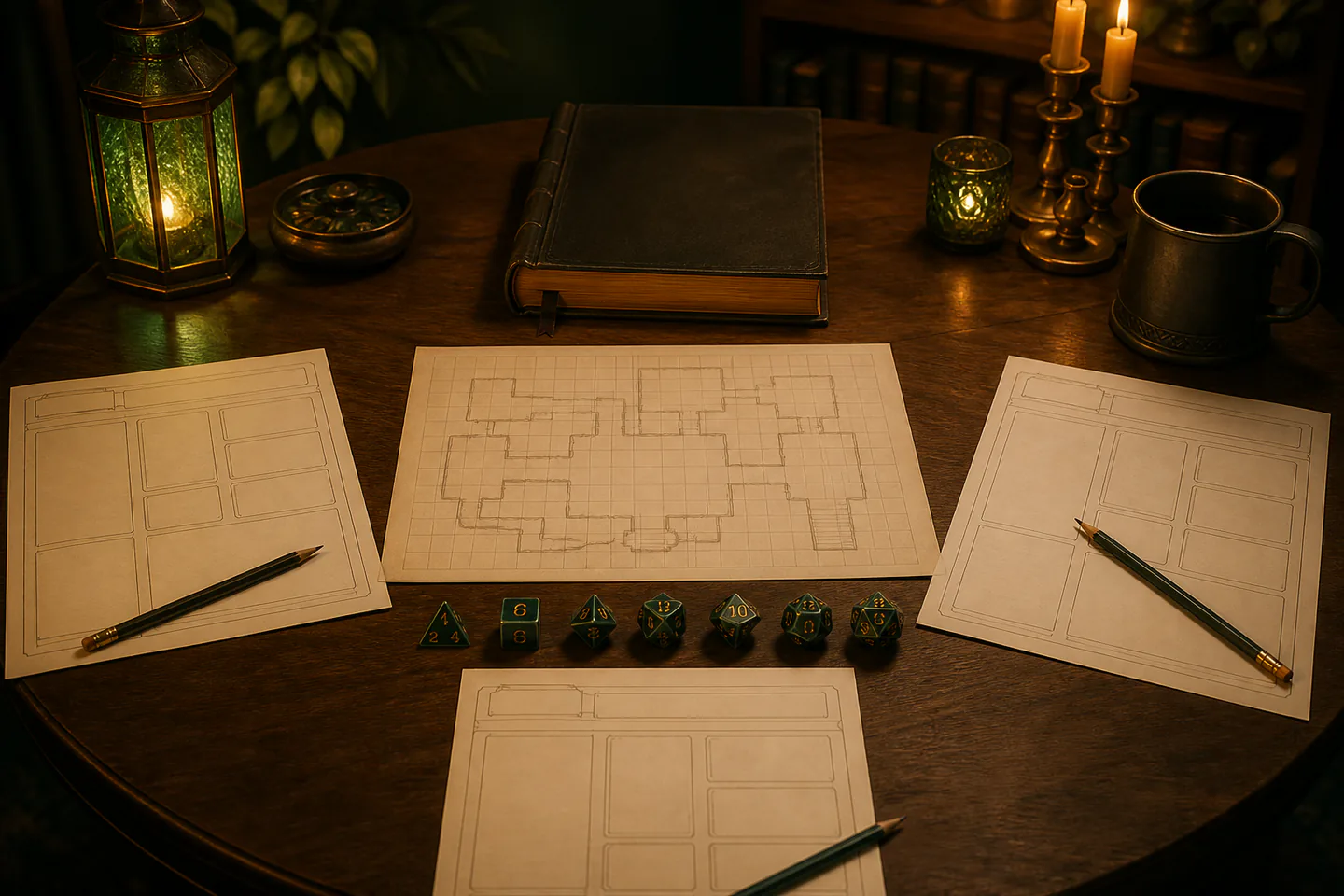
Quick answer
Use one beginner box and schedule a definite ending
Choose one game made for beginners, read only the short opening adventure and invite two to five players for a two-hour session. Explain that one person describes the world and adjudicates rules while everyone else describes a character’s actions. Agree the tone, content boundaries and a simple pause or rewind signal, then begin with pregenerated characters and teach dice and rules only when a choice requires them.
- 01
A tabletop RPG is a conversation with rules and uncertainty, not a board game that needs miniatures, terrain or a winner.
- 02
The game master prepares situations and consequences; they do not need to predict or force the players’ solution.
- 03
A “session zero” can be ten focused minutes for a starter game: expectations, characters, boundaries, breaks and finish time.
- 04
Different systems prioritise different experiences. D&D, Pathfinder and Dragonbane are alternatives, not expansion packs for one another.
What to expect
The social rhythm matters more than encyclopaedic rule knowledge
A first game succeeds when everyone understands the immediate choice, receives space to act and reaches a satisfying stopping point.
Facilitator
The game master tracks the situation and makes rulings, but can openly look up or simplify a rule.
Players
Pregenerated characters remove homework and let players discover preferences through actual choices.
Rules
Teach the smallest procedure that resolves the current action, then keep the result moving the fiction.
Attention
Scenes drift when one person dominates or a private plan takes too long; rotate direct questions around the table.
Preparation
Read locations, motives and likely clues, not a script of what players must do.
Ending
Stop after a solved immediate problem, a meaningful choice or a deliberate cliffhanger and ask what the group wants next.
Core method
Prepare the table and situation, not every possibility
Choose the experience before the brand
Ask whether the group wants tactical fantasy, investigation, humour, horror or collaborative storytelling and how much rules weight it welcomes. The D&D and Pathfinder boxes teach related heroic fantasy at different complexity; Dragonbane is a separate lighter alternative. Use one complete box rather than mixing rules.
Set expectations and boundaries
State the session length, who is facilitating, whether phones and breaks are welcome and how absent players are handled. Invite subjects players do not want in detail or at all, without requiring personal explanations. Use a visible or spoken pause, rewind and skip method that anyone can invoke without debate.
Prepare actionable scenes
For each location, know what is happening now, what important characters want and what changes if the players wait. Highlight only the rules likely to appear. Put names and clues on a small sheet, choose a clear opening problem and identify an ending reachable within the booked time.
Run toward choices and consequences
Describe a concrete situation, ask a specific player what their character does and clarify intent before selecting a rule. State stakes where a failed roll would be confusing, then narrate a consequence that changes the situation rather than simply asking for the same roll again. Share spotlight deliberately.
Useful products
Products with a clear job in the setup
Each listed box is a complete alternative route, not a shopping list. D&D has the broadest mainstream support, Pathfinder teaches a more detailed tactical system and Dragonbane offers a lighter roll-under fantasy game.
Wizards of the Coast Dungeons & Dragons Starter Set: Dragons of Stormwreck Isle
The clear box scope and large learning ecosystem make finding rule help and additional players comparatively easy.
Paizo Pathfinder Beginner Box, Second Edition
It is a complete learning route for groups that enjoy character options and precise combat procedures.
Free League Dragonbane Core Set
It offers a contained game and campaign material without requiring a large supplement line.
First project
Run the opening adventure from one beginner box
Use pregenerated characters and finish after the first clear objective rather than forcing the entire campaign into one night.
- 01
Choose one system
Match rules weight and tone to the actual group and ignore other boxes for now.
- 02
Read the opening only
Mark the immediate problem, useful names, clues and a reachable stopping point.
- 03
Hold a ten-minute session zero
Agree tone, boundaries, breaks, finish time and a pause or rewind signal.
- 04
Explain the character sheet
Point out only the few numbers and abilities likely to matter in the opening.
- 05
Ask clear rotating questions
Move the spotlight, clarify intent and use rules only when uncertainty is meaningful.
- 06
Debrief and decide
Ask what was fun, unclear or uncomfortable before choosing another session or system.
What can wait
What can wait until the first result
The table needs a shared premise and time, not a room full of accessories.
- 01
Miniatures and terrain
Tokens, paper or pure description are enough unless tactical positioning proves enjoyable.
- 02
Every rulebook and supplement
A beginner box deliberately limits choices and teaches its own contained version.
- 03
Writing a homebrew world first
A short published scenario reveals what the group actually cares about.
- 04
Performing professional voice acting
Clear intent, names and consequences matter more than accents.
- 05
A year-long campaign promise
Finish one bounded adventure before coordinating long-term attendance and story arcs.
Upgrade path
Upgrade the repeated limitation
Add only the tool that supports the group’s repeated preference.
Beginner-box night
About £25–£45Rules + adventure + pregenerated characters
Learn the conversation and core procedure.Short published arc
About £25–£55 extraCore rules or next adventure
Develop characters over several sessions.Table aids
About £10–£80Tokens, mat, reference cards or virtual table
Support the group’s chosen style.Home campaign
Mostly preparation timeReusable situations and session notes
Build continuity around player choices.Safety & care
Make consent, access and group time part of the rules
Fiction can involve intense subjects and social pressure even when the physical risks are small.
- Keep small pieces, dice, sleeves and batteries away from young children and pets.
- Use a well-lit table, support posture and take movement and visual breaks during long sessions.
- Agree the game, time limit, content boundaries and stopping point before play so social pressure does not override comfort.
- Store components dry and secure and wash hands before handling shared cards, tiles or painted miniatures.
- Treat collecting spend as entertainment, not guaranteed investment, and use a fixed budget that does not depend on resale.
Outside help
When outside help earns its place
The box can teach a home group. A library, shop or convention demo is useful when nobody wants to facilitate the first session, but check accessibility and conduct policies.
Use the selected publisher’s own quick-start material rather than mixing editions.
Ask about beginner tables, age range, accessibility, code of conduct and whether pregenerated characters are supplied.
Representative UK product, club, lesson and venue costs checked 9 August 2026; local prices, access, weather, materials and tutor support vary.
Sources
Where the guidance came from
Official publishers define each system; independent RPG communities and safety-tool resources inform group practice and recurring beginner problems.
-
01
D&D · Basic rules
Official current Dungeons & Dragons rules and learning material.
Open source -
02
Paizo · Pathfinder Beginner Box
Official Pathfinder box scope and support.
Open source -
03
Free League · Dragonbane
Official Dragonbane rules and core-set context.
Open source -
04
TTRPG Safety Toolkit
Practical consent and safety-tool resources for tabletop play.
Open source -
05
Reddit · r/rpg
Broad community experience with systems, facilitation and beginner boxes.
Open source -
06
Amazon UK · D&D Stormwreck Isle Starter Set
Exact product page, model or ISBN, observed price and availability checked for this guide.
Open source -
07
Amazon UK · Pathfinder Beginner Box
Exact product page, model or ISBN, observed price and availability checked for this guide.
Open source -
08
Amazon UK · Dragonbane Core Set
Exact product page, model or ISBN, observed price and availability checked for this guide.
Open source
Guide information and links checked 9 August 2026.