Beginner’s guide · Grow & care
Build a small climate.
Then learn to leave it alone.
Start with a wide-mouth closed jar and genuinely humidity-loving plants. The satisfying part is not sealing a perfect miniature world on day one; it is watching condensation, growth and decay, then making very small corrections.
Quick answer
Match the lid, plants and light
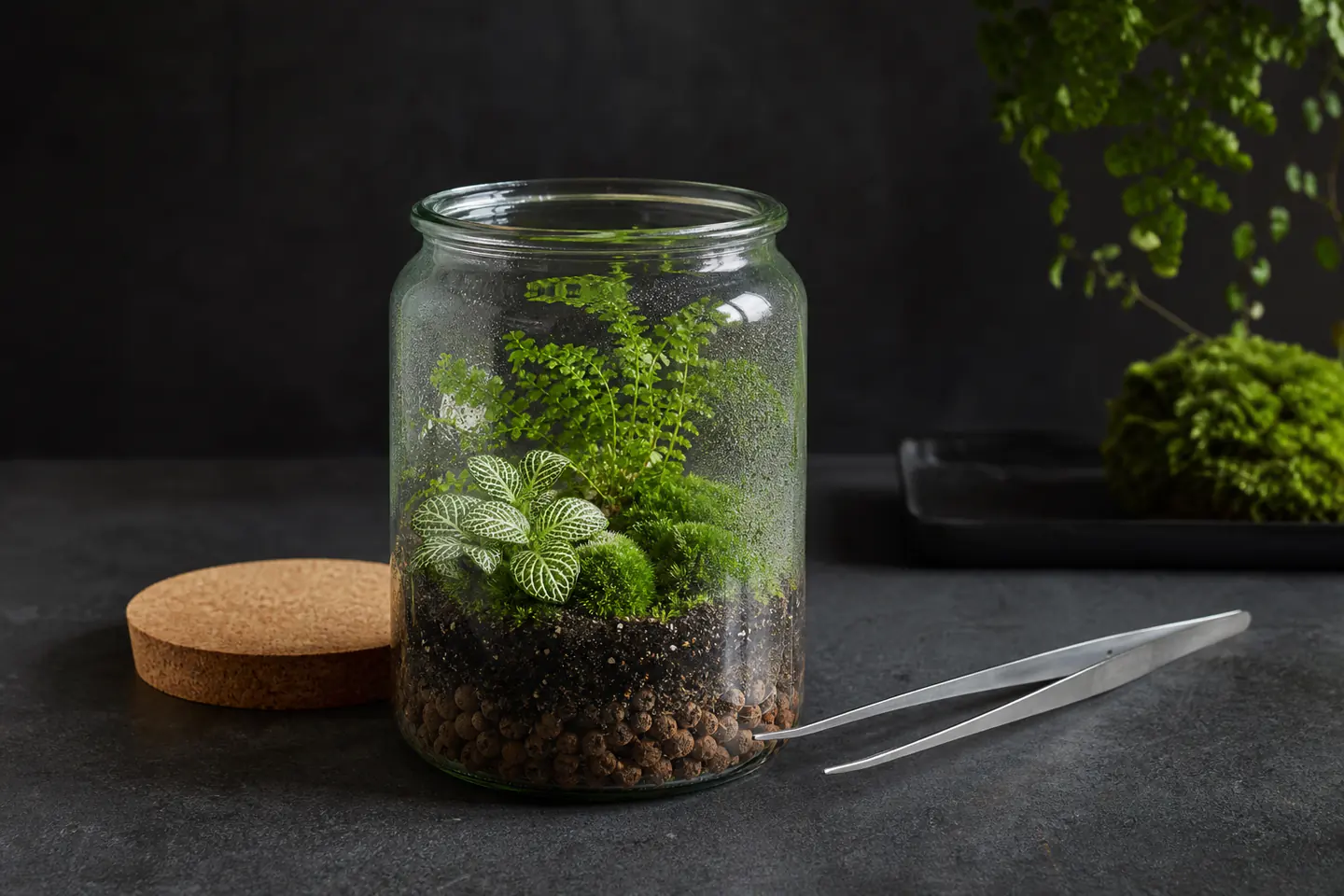
Use a clean wide-mouth jar with a lid, a modest drainage layer, an airy terrarium substrate and two small tropical plants that enjoy humidity. Water lightly, close the jar and place it in bright indirect light where direct sun cannot heat the glass.
- 01
A closed terrarium suits small, slow tropical plants, mosses and ferns. It does not suit cacti or most succulents.
- 02
Start with less water than seems generous. Water is easy to add and awkward to remove from a sealed jar.
- 03
Morning or evening mist on part of the glass is normal. Glass that remains heavily fogged all day suggests excess moisture or heat.
- 04
Choose a mouth wide enough for your hand or simple tools. Narrow bottles turn the first build into a dexterity exercise.
What to expect
A closed jar is low maintenance, not maintenance-free
The jar recycles moisture, but plants still grow, leaves die and the balance changes with room temperature and daylight.
Condensation
Some daily condensation shows that water is cycling. Constant opaque fog and running water point towards too much moisture or direct heat.
Plant fit
A healthy houseplant can still be wrong for a sealed jar. Humidity tolerance, mature size and growth rate matter more than the label “indoor plant”.
Watering
A closed terrarium may need water only a few times a year. The first correction is often ventilation, not another spray.
Mould
New wood, damaged leaves and rich wet substrate can bloom with mould. Remove decaying material and correct moisture before adding a supposed cure.
Pruning
Plants do not stay miniature. Trim before leaves press tightly against wet glass and remove every cutting.
Failure
One plant may decline while another thrives. A terrarium is a planted container, not a permanently self-sustaining ecosystem.
Choose a route
Choose one complete route or build around a jar
Route one: a matched complete kit
The checked complete kit contains a 22 cm glass jar, cork lid, two live plants, bun moss and the substrate components needed for one build. It costs more, but compatibility and quantities are decided in advance. This is the lowest-friction route if you have no suitable container or local source of small plants.
Open the parcel promptly and inspect the live plants. Transit damage, cold or heat can affect a plant even when the hard materials are fine. Do not seal obviously rotting leaves into the jar.
Route two: use a jar you already own
A clean glass storage jar with a wide opening can be the best container. The checked substrate kit and five-plant pack are separate parts of this route, not additions to the complete kit. Five plants will be too many for many jars: choose two or three that share humidity needs and keep or pot the rest elsewhere.
Measure the jar before ordering. Leave room above the mature-looking composition for growth and for air movement. A cork or glass lid does not need to be laboratory airtight.
The layers are buffers, not magic
A shallow layer of LECA or clean gravel can hold accidental excess water below the roots. An airy substrate above it still needs to be only damp, not saturated. Activated charcoal is widely used, but practitioner opinion on whether it is essential is mixed; it cannot rescue overwatering, poor plant choice or direct sun.
Starter routes
Two routes, clearly separated
Buy the complete kit by itself, or use your own jar with the substrate kit and only as many of the separate plants as the container can support. Do not buy all three listings for one small terrarium.
The Urban Botanist 22 cm Closed Terrarium Kit with Two Live Plants
The jar, lid, two plants, moss and substrate arrive as one planned project.
Grow Tropicals Medium Open and Closed Terrarium Kit
It avoids buying full-size bags when a clean wide container is already available.
Grow Tropicals Five Closed Terrarium Plants in 7 cm Pots
The mixed pack gives a build-your-own jar access to small humidity-loving plants.
First build
Build a wide-mouth closed terrarium
Follow a kit’s component order when it differs. Keep every layer modest so the plants have room above the soil.
- 01
Wash and dry the jar
Remove residue and cleaner, rinse thoroughly and let the glass dry. Check for chips or cracks before adding stones or tools.
- 02
Add a small drainage buffer
Place a shallow even layer of supplied LECA or clean gravel. Add the kit’s barrier or charcoal only as directed; do not fill a third of the jar with decorative layers.
- 03
Moisten the substrate lightly
Mix an airy terrarium substrate so it is evenly damp but does not release water when squeezed. Add enough to cover roots without burying plant crowns.
- 04
Place the largest plant first
Remove loose nursery compost, inspect roots and damaged leaves, then make a hole rather than forcing the root ball through the surface. Keep leaves away from the lid where possible.
- 05
Add the second plant and moss
Leave visible gaps for growth. Press moss into contact with the damp surface without packing the whole jar into a solid green carpet.
- 06
Clean, observe and close
Brush soil from leaves and glass, add only a little water if the substrate is not already damp, close the jar and put it in bright indirect light. Record a photograph for comparison.
Care & mould
Read the glass before reaching for water
Condensation is a signal
Check at roughly the same times of day. Light mist that appears and clears is ordinary. If the glass remains opaque or water streams down for most of the day, open the lid for a few hours, wipe excess from the glass and reassess. If the substrate looks pale and dry, leaves lose firmness and no condensation appears for several days, add a very small amount around the edge rather than flooding the centre.
Never place a closed terrarium in direct sun. Glass traps heat, and a jar can overheat even when the room feels comfortable.
Remove decay early
Yellowing from normal leaf turnover is not an emergency, but dead tissue feeds mould. Use clean tools to remove the whole leaf and any fallen fragments. Improve the moisture balance and light before adding more organisms or chemicals.
Springtails are commonly used as a clean-up crew in larger bioactive terrariums because they eat fungal growth and decaying material. They are living animals with their own care needs, not compulsory ingredients for the first small jar and not a substitute for removing a rotting plant.
Keep plants in scale
Trim healthy growth just above a node and remove cuttings. If roots or repeated pruning overwhelm the jar, move the plant to a pot and replace it with a genuinely smaller species. Redesign is part of the hobby.
Skip for now
What can wait
The first jar should be easy to reach and easy to read. Extra tools matter only after the opening or planting density makes ordinary fingers impractical.
- 01
Long terrarium tools
The checked Esschert pair helps position and tamp through a restricted opening, but a wide-mouth first jar should not require specialist dexterity.
- 02
Springtails and isopods
A clean-up crew can help a suitable bioactive build, but it adds livestock care and does not correct standing water or incompatible plants.
- 03
A narrow-neck bottle
Long tools, funnels and careful choreography become necessary. Learn moisture balance in an accessible container first.
- 04
Hardscape collected outdoors
Unknown wood, soil and moss can introduce pests, pollutants and organisms or be collected unlawfully. Use known clean materials and responsible sources.
- 05
An integrated LED lid
A normal position with suitable indirect daylight costs nothing. Add a light only when measured conditions are genuinely too dark.
Upgrade path
Build complexity, not clutter
A larger or more enclosed display increases the consequences of plant choice and moisture mistakes.
First closed jar
£0–£55Wide jar + two compatible plants + simple substrate
Learn condensation, restrained watering, pruning and removal of decay.Designed planting
£20–£80Selected species + hardscape + long tools if needed
Create height, sight lines and texture while planning mature plant size and access.Bioactive display
£40–£120+Deeper substrate + springtails + monitored moisture
Add decomposers and a more active soil system, along with animal-care and sourcing decisions.Large case or vivarium
£100–£500+Ventilation + lighting + drainage access + environmental monitoring
Gain space and control, but maintenance, electricity and failure points increase sharply.Safety
Glass, plants and moisture need sensible boundaries
The main risks are broken glass, poisonous plants, contamination and stagnant wet material.
- Use an undamaged container on a stable surface and support it from underneath when moving it.
- Keep terrarium plants and substrate away from children or pets unless every species and material is confirmed suitable.
- Wear gloves if a plant, soil or mould irritates the skin and wash hands after handling.
- Do not collect protected plants, moss or materials from land without permission.
- Remove foul-smelling, slimy or extensively mouldy material rather than sealing it back inside.
- Never put a sealed glass terrarium in direct sun or beside a strong heat source.
Classes
When a workshop adds value
A class is optional, but it can make sense when the ticket includes a large jar, correctly sized plants and enough substrate that would otherwise need separate delivery.
A useful comparison with a modest kit if the jar and plants are included. Confirm container size before booking.
Usually a larger build with more material and live guidance; value depends heavily on the vessel and plants supplied.
Between Two Thorns listings checked 27 July 2026; dates, locations and included materials change.
Sources
Where the guidance came from
Plant and light guidance uses horticultural sources. Community discussion was used to reflect real disputes around charcoal, drainage, mould and first-jar choices.
-
01
RHS · Terrariums and bottle gardens
Plant choice, bright indirect light, condensation and the very low watering frequency of closed terrariums.
Open source -
02
RHS · Make a mini terrarium jungle
Practical build sequence and care, including keeping the finished jar out of direct sunlight.
Open source -
03
Iowa State University Extension · Create and care for a terrarium
Closed-terrarium watering, excess condensation and direct-sun warnings.
Open source -
04
Missouri Extension · Terrariums
Container, light and plant-care principles, including overheating in direct sun.
Open source -
05
r/terrariums · Beginner starter pack
Experienced practical advice to start small, choose a wide opening, use compatible tropical plants and err towards less water.
Open source -
06
r/terrariums · Are drainage and charcoal necessary?
Community disagreement showing why charcoal is treated as optional rather than a cure-all.
Open source -
07
Between Two Thorns · Houseplant workshops
Current £35 small and £65 standard closed-terrarium class examples.
Open source -
08
Amazon UK · 22 cm complete closed terrarium kit
Exact jar, two-live-plant and moss kit, £54.99 observed price and in-stock status.
Open source -
09
Amazon UK · Medium terrarium substrate kit
Exact build-material kit, £17.95 observed price and current stock.
Open source -
10
Amazon UK · Five closed-terrarium plants
Exact small mixed plant pack, £9.95 observed price and in-stock status.
Open source -
11
Amazon UK · Esschert terrarium tools
Exact two-tool set, £6.96 observed price and in-stock status.
Open source
Guide information and links checked 27 July 2026.