Beginner’s guide · Write & create
Enter at the pressure point,
then make every sentence turn.
A story under 1,000 words needs a live change, selective detail and an ending that alters the reader’s understanding rather than explaining everything.
Quick answer
Complete one complete flash story before expanding the setup
Choose one character, one immediate pressure and one irreversible choice. Draft 700 to 1,200 words without stopping to count, then identify the actual turn, cut setup that the reader can infer, replace explanation with one concrete detail at each crucial point and revise the ending so it changes the meaning of what came before. Cut to the target only after the story works.
- 01
Flash is a complete story at small scale, not an excerpt that stops when the word limit arrives. Record what happened during flash fiction so the next attempt changes one known variable instead of several guesses.
- 02
A precise object, action or line of dialogue can carry backstory more efficiently than explanation. Record what happened during flash fiction so the next attempt changes one known variable instead of several guesses.
- 03
Compression removes repetition and low-value setup; it does not require vague or cryptic prose. Record what happened during flash fiction so the next attempt changes one known variable instead of several guesses.
- 04
A strong ending creates consequence or re-interpretation rather than adding a detached twist. Record what happened during flash fiction so the next attempt changes one known variable instead of several guesses.
What to expect
What flash fiction is really like at the start
The useful beginner controls are preparation, one bounded task and a record of the result; specialist equipment matters only when it solves a repeated limitation.
Opening
The first line needs pressure or orientation but does not have to explain the entire premise. Record what happened during flash fiction so the next attempt changes one known variable instead of several guesses.
Scope
Several locations, time jumps or viewpoints consume words needed for the central change. Record what happened during flash fiction so the next attempt changes one known variable instead of several guesses.
Detail
One selected sensory fact can imply a whole setting when it affects action. Record what happened during flash fiction so the next attempt changes one known variable instead of several guesses.
Ending
An unexplained surprise is not automatically resonance. Record what happened during flash fiction so the next attempt changes one known variable instead of several guesses.
Core method
The core flash fiction method
State the change
Write privately what is different for the character by the final sentence. Record what happened during flash fiction so the next attempt changes one known variable instead of several guesses.
Draft beyond the limit
Allow enough material to discover the story’s centre before compressing. Record what happened during flash fiction so the next attempt changes one known variable instead of several guesses.
Cut by function
Remove repeated emotion, arrival, throat-clearing and detail that does not change action or meaning. Record what happened during flash fiction so the next attempt changes one known variable instead of several guesses.
Sharpen the ending
Echo, reverse or complicate an earlier detail while preserving the consequence. Record what happened during flash fiction so the next attempt changes one known variable instead of several guesses.
Useful products
Products with a clear job in the route
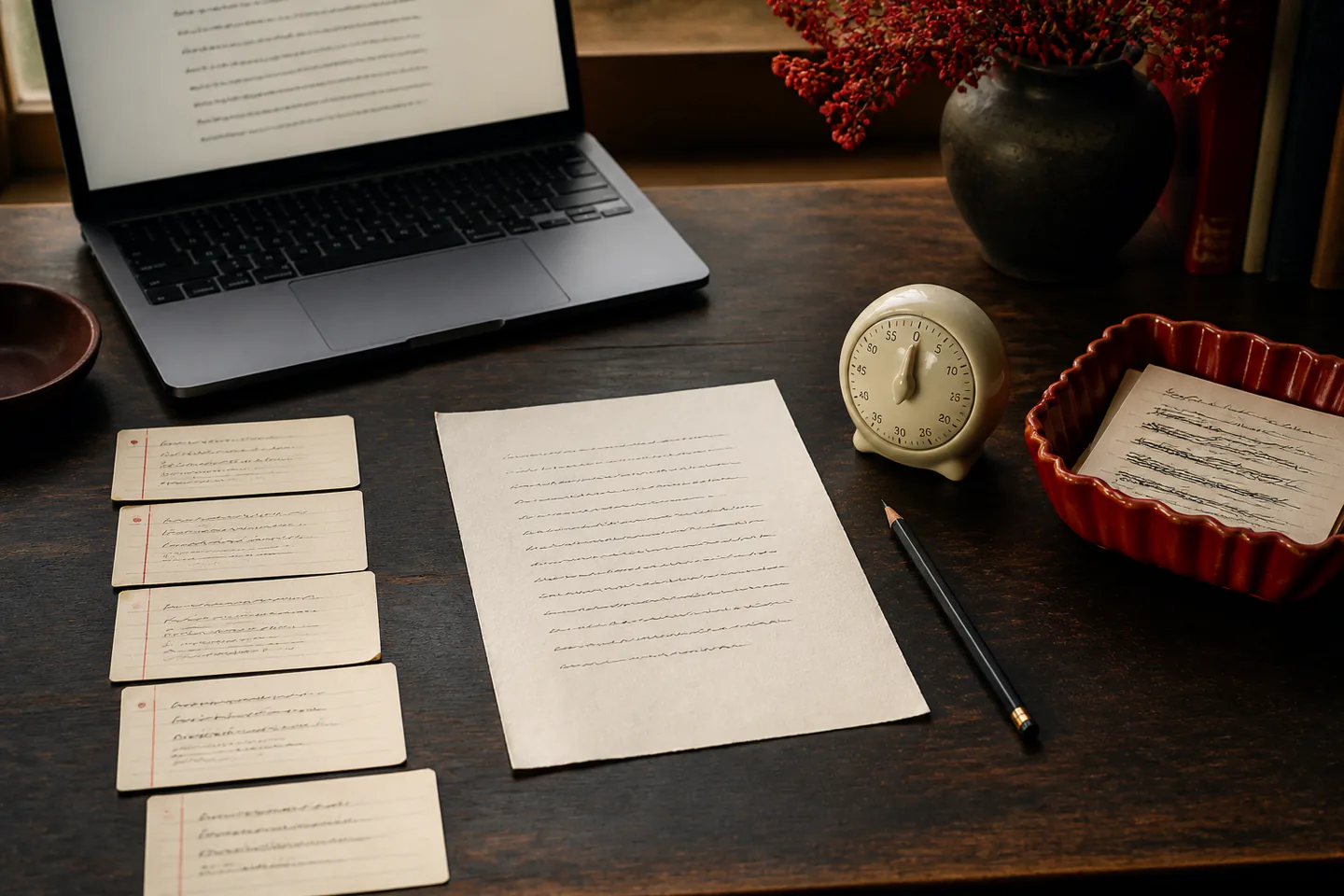
Flash cards make scenes and details movable, the notebook supports portable drafting and blank cards can hold one complete micro-story without another app.
Oxford A6 Ruled Flash Cards, Pack of 80
A small deck supports sorting without turning the plan into a wall of prose.
Silvine A5 Executive Dotted Hardback Notebook
A durable small notebook is quicker to annotate than rebuilding events from memory.
Apostrophe Games Blank Playing Cards, 180 Cards
Cards make sequence, grouping and revision visible without software.
First project
Write a 750-word choice story
Use one place, two people at most and a decision that cannot be cleanly undone.
- 01
Name the pressure
Give the viewpoint character an immediate want and obstacle. Record what happened during flash fiction so the next attempt changes one known variable instead of several guesses.
- 02
Choose three details
Select an object, sound and gesture that can carry setting or history. Record what happened during flash fiction so the next attempt changes one known variable instead of several guesses.
- 03
Draft to the turn
Write forward until the character acts and the situation changes. Record what happened during flash fiction so the next attempt changes one known variable instead of several guesses.
- 04
Cut explanation
Trust concrete action and remove repeated statements of the same emotion. Record what happened during flash fiction so the next attempt changes one known variable instead of several guesses.
- 05
Test the ending
Read aloud and ask what the final image changes about the opening. Record what happened during flash fiction so the next attempt changes one known variable instead of several guesses.
What can wait
What can wait until the first result
Delay anything that adds cost, risk or another variable before the basic workflow has produced something you can review.
- 01
A linked collection
One fully revised story reveals the sustainable process first. Record what happened during flash fiction so the next attempt changes one known variable instead of several guesses.
- 02
Submitting the first draft
Word count and publication format come after the story’s turn works. Record what happened during flash fiction so the next attempt changes one known variable instead of several guesses.
- 03
A surprise for its own sake
A twist without setup or consequence feels arbitrary. Record what happened during flash fiction so the next attempt changes one known variable instead of several guesses.
- 04
Elaborate worldbuilding notes
Only details that affect the brief action need definition. Record what happened during flash fiction so the next attempt changes one known variable instead of several guesses.
Upgrade path
Add the capability you can now name
Each stage should remove a demonstrated constraint rather than make the setup look more advanced.
Use what you own
£0–£20Existing equipment and one written plan
Use one prompt and a 30-minute draft.Repeat the first route
Free to about £15A complete repeatable starter setup
Finish and revise several stories at different lengths.Add one capability
Often £50–£250One selected tool, service or learning resource
Add critique or contest research after the work survives a cold read.Build specialist depth
Club, course or specialist dependentA documented specialist workflow
Build themed sequences and submit with careful rights and publication records.Safety & care
Keep brevity humane and publication records clear
Short forms still need care with real people, sensitive material, rights and submission terms.
- Back up finished drafts and record versions submitted or published.
- Read contest and magazine rights, fees, exclusivity and AI policies before submitting.
- Anonymise or obtain permission for private identifying material drawn from living people.
- Use content notes proportionately when sharing work in a group.
- Take breaks from emotionally difficult material and do not treat public feedback as clinical support.
Outside help
When outside help earns its place
A flash workshop earns its place when complete stories are read closely for scope, omission, sentence function and endings.
Check word limits, critique rules, confidentiality and whether publication rights are retained.
Use outside help after the first flash fiction attempt can reveal the exact technique, access or safety problem that needs live correction.
Representative UK learning and access routes checked 1 September 2026; local prices, permissions, equipment and tutor support vary.
Sources
Where the guidance came from
Authoritative and specialist guidance supports the method and safety boundaries; community discussion contributes recurring beginner problems rather than unsupported claims.
-
01
OpenLearn · Start writing fiction
Free course covering character, setting, point of view and practical fiction exercises.
Open source -
02
National Centre for Writing · Writing Hub
UK craft articles, exercises, events and professional guidance.
Open source -
03
Comma Press · Short story resources
Specialist short-fiction craft and publishing resources.
Open source -
04
SmokeLong Quarterly · Flash in the classroom
Flash-specific teaching, compression and story examples.
Open source -
05
Wigleaf · Top 50
Curated contemporary flash examples useful for structural reading.
Open source -
06
Reddit · r/writing
Long-running community guidance on practice, revision, feedback and publishing questions.
Open source -
07
Amazon UK · A6 Ruled Flash Cards, Pack of 80
Exact Amazon UK product page or ISBN used for this recommendation; current price, seller, specification and availability should be confirmed.
Open source -
08
Amazon UK · A5 Executive Dotted Hardback Notebook
Exact Amazon UK product page or ISBN used for this recommendation; current price, seller, specification and availability should be confirmed.
Open source -
09
Amazon UK · Blank Playing Cards, 180 Cards
Exact Amazon UK product page or ISBN used for this recommendation; current price, seller, specification and availability should be confirmed.
Open source
Guide information and links checked 1 September 2026.