Beginner’s guide · Make & create
Mark the sphere before stitching,
and let every division earn the pattern.
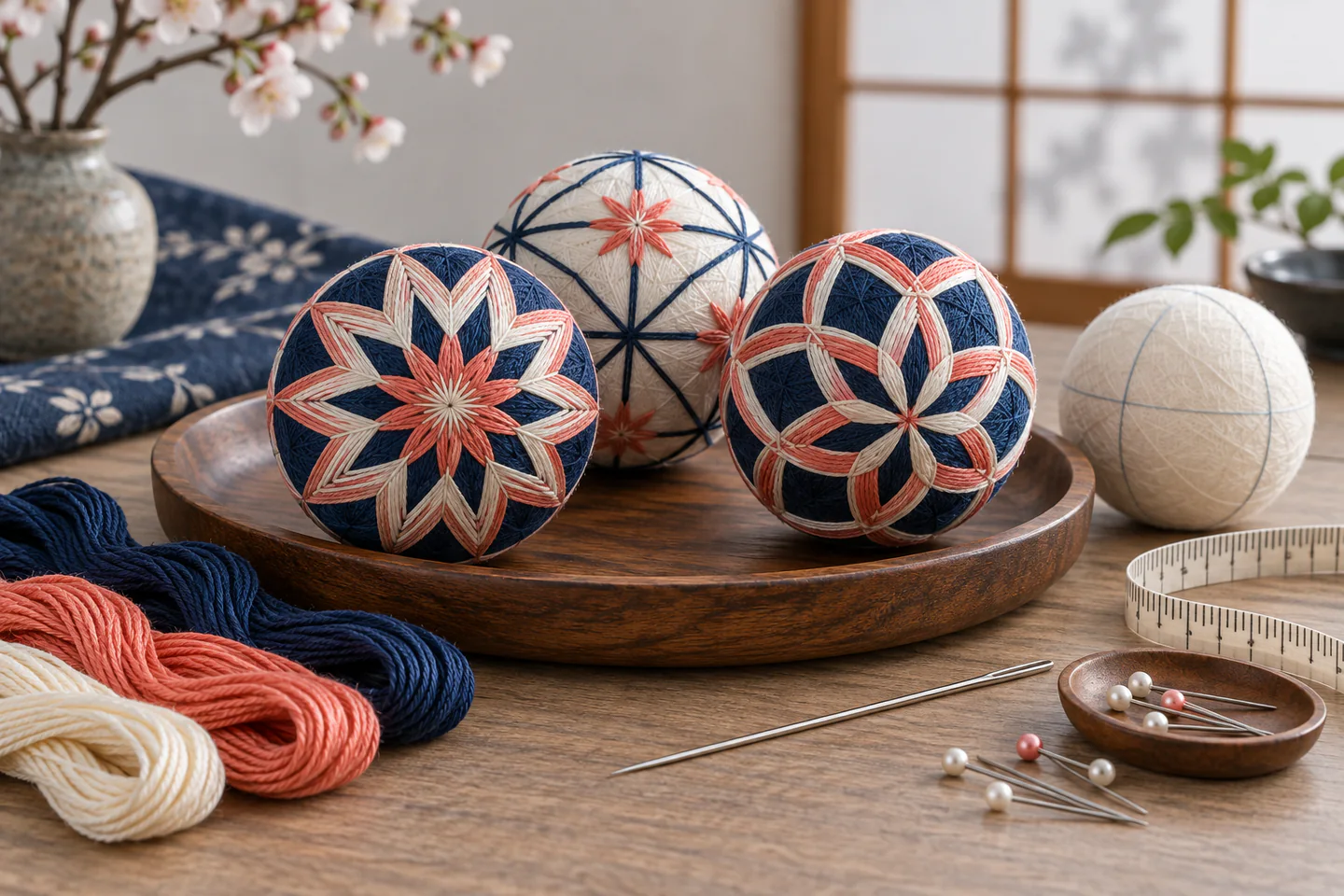
Temari combines a carefully wrapped ball, measured divisions and decorative thread paths. Begin with a simple eight-division design.
Quick answer
Complete one an eight-division geometric temari before expanding the setup
Build or use a firm lightweight core, wrap it evenly in yarn and then in fine sewing thread until the surface is smooth and stable. Use a paper strip and pins to locate poles and an equator, measure every division twice and stitch one simple wrapped-spindle or kiku-inspired practice pattern with limited colours. Remove or account for pins before display.
- 01
The geometric embroidery depends on an accurately wrapped and marked sphere. For a first temari ball making attempt, keep the materials, measurements and sequence written beside the work. Photograph or measure the result before correcting it, because a visible record separates a technique problem from a material or setup problem.
- 02
Paper-strip measurement adapts to the actual ball better than assuming a nominal diameter. For a first temari ball making attempt, keep the materials, measurements and sequence written beside the work. Photograph or measure the result before correcting it, because a visible record separates a technique problem from a material or setup problem.
- 03
Decorative stitches sit on the surface and need firm consistent tension without flattening the core. For a first temari ball making attempt, keep the materials, measurements and sequence written beside the work. Photograph or measure the result before correcting it, because a visible record separates a technique problem from a material or setup problem.
- 04
Traditional context and named divisions deserve accurate sources rather than generic decorative labels. For a first temari ball making attempt, keep the materials, measurements and sequence written beside the work. Photograph or measure the result before correcting it, because a visible record separates a technique problem from a material or setup problem.
What to expect
What temari ball making is really like at the start
The useful beginner controls are setup, repeatable movement and a finished sample. Keeping a round core and equal divisions before decorative stitching is the main skill to observe before adding scale or decoration.
Core
A lumpy or compressible ball shifts while marking and distorts equal divisions. For a first temari ball making attempt, keep the materials, measurements and sequence written beside the work. Photograph or measure the result before correcting it, because a visible record separates a technique problem from a material or setup problem.
Marking
Small pin errors become visible where several threads are meant to meet. For a first temari ball making attempt, keep the materials, measurements and sequence written beside the work. Photograph or measure the result before correcting it, because a visible record separates a technique problem from a material or setup problem.
Thread
Long lengths tangle and abrade while repeatedly passing around the sphere. For a first temari ball making attempt, keep the materials, measurements and sequence written beside the work. Photograph or measure the result before correcting it, because a visible record separates a technique problem from a material or setup problem.
Needles
Long sharp needles can emerge far from the visible entry point. For a first temari ball making attempt, keep the materials, measurements and sequence written beside the work. Photograph or measure the result before correcting it, because a visible record separates a technique problem from a material or setup problem.
Core method
The core temari ball making method
Wrap a stable sphere
Alternate directions constantly and compress only enough to retain a round form. For a first temari ball making attempt, keep the materials, measurements and sequence written beside the work. Photograph or measure the result before correcting it, because a visible record separates a technique problem from a material or setup problem.
Mark with a paper strip
Find poles, equator and equal subdivisions, then compare distances before stitching. For a first temari ball making attempt, keep the materials, measurements and sequence written beside the work. Photograph or measure the result before correcting it, because a visible record separates a technique problem from a material or setup problem.
Lay guide and decorative thread
Secure invisibly, follow one repeat and keep crossing points centred. For a first temari ball making attempt, keep the materials, measurements and sequence written beside the work. Photograph or measure the result before correcting it, because a visible record separates a technique problem from a material or setup problem.
Finish and account for tools
Bury thread tails, remove temporary pins and inspect the ball from every direction. For a first temari ball making attempt, keep the materials, measurements and sequence written beside the work. Photograph or measure the result before correcting it, because a visible record separates a technique problem from a material or setup problem.
Useful products
Products with a clear job in the route
These two products cover distinct jobs in the beginner route; they are not a requirement to buy a bundle. Use materials already owned when they meet the same specification, and confirm every live listing before ordering.
Pllieay Embroidery Starter Kit with Hoops and 100 Threads
The hoops, needles and stranded cotton support several specialist embroidery samples.
Stylecraft Special DK Acrylic Yarn, 100 g
It is easier to undo and inspect than dark, fluffy or highly variable yarn.
First project
Make an eight-division geometric temari
Keep the project small enough to finish, inspect and repeat. The first result is evidence about material compatibility, sequence and control rather than a performance test.
- 01
Prepare the workspace and materials
Alternate directions constantly and compress only enough to retain a round form. For a first temari ball making attempt, keep the materials, measurements and sequence written beside the work. Photograph or measure the result before correcting it, because a visible record separates a technique problem from a material or setup problem.
- 02
Make the first controlled pass
Find poles, equator and equal subdivisions, then compare distances before stitching. For a first temari ball making attempt, keep the materials, measurements and sequence written beside the work. Photograph or measure the result before correcting it, because a visible record separates a technique problem from a material or setup problem.
- 03
Check the central technique
Secure invisibly, follow one repeat and keep crossing points centred. For a first temari ball making attempt, keep the materials, measurements and sequence written beside the work. Photograph or measure the result before correcting it, because a visible record separates a technique problem from a material or setup problem.
- 04
Complete the structure
Bury thread tails, remove temporary pins and inspect the ball from every direction. For a first temari ball making attempt, keep the materials, measurements and sequence written beside the work. Photograph or measure the result before correcting it, because a visible record separates a technique problem from a material or setup problem.
- 05
Finish, measure and record
Let the work settle or dry by the relevant material instructions, then measure, photograph and label the result. Record the one change that would make the next temari ball making attempt more controlled. For a first temari ball making attempt, keep the materials, measurements and sequence written beside the work. Photograph or measure the result before correcting it, because a visible record separates a technique problem from a material or setup problem.
What can wait
What can wait until the first result
Delay anything that adds cost, risk or another variable before the basic workflow has produced something you can review.
- 01
Complex C10 division
Many measured points magnify core and marking errors. For a first temari ball making attempt, keep the materials, measurements and sequence written beside the work. Photograph or measure the result before correcting it, because a visible record separates a technique problem from a material or setup problem.
- 02
Metallic thread
It kinks and exposes uneven tension. For a first temari ball making attempt, keep the materials, measurements and sequence written beside the work. Photograph or measure the result before correcting it, because a visible record separates a technique problem from a material or setup problem.
- 03
Very large ball
Scale makes wrapping and thread management tiring. For a first temari ball making attempt, keep the materials, measurements and sequence written beside the work. Photograph or measure the result before correcting it, because a visible record separates a technique problem from a material or setup problem.
- 04
Toy use
Decorative pins, thread and core materials are not automatically child-safe. For a first temari ball making attempt, keep the materials, measurements and sequence written beside the work. Photograph or measure the result before correcting it, because a visible record separates a technique problem from a material or setup problem.
Upgrade path
Add the capability you can now name
Each stage should remove a demonstrated limitation rather than make the setup look more advanced.
Simple division
Use owned tools where possibleOne small sample and written notes
Learn the central movement and material behaviour.Two-pattern ball
About £20–£80A repeatable complete starter setup
Repeat the result with cleaner finish and fewer corrections.Complex multi-division design
About £50–£180A selected tool or structured class
Add one technique, size or design capability.Documented traditional study
Cost varies widelyA documented specialist workflow
Develop original work with provenance, testing and appropriate safety.Safety & care
Safety, care and respectful practice in temari ball making
The practical risks are manageable when tools, materials and cultural claims remain specific and proportionate.
- Track every long needle and pin in a dedicated tray. For a first temari ball making attempt, keep the materials, measurements and sequence written beside the work. Photograph or measure the result before correcting it, because a visible record separates a technique problem from a material or setup problem.
- Push needles away from the supporting palm and use a thimble where useful. For a first temari ball making attempt, keep the materials, measurements and sequence written beside the work. Photograph or measure the result before correcting it, because a visible record separates a technique problem from a material or setup problem.
- Keep finished decorative balls away from babies and pets. For a first temari ball making attempt, keep the materials, measurements and sequence written beside the work. Photograph or measure the result before correcting it, because a visible record separates a technique problem from a material or setup problem.
- Take hand and eye breaks during dense wrapping and measuring. For a first temari ball making attempt, keep the materials, measurements and sequence written beside the work. Photograph or measure the result before correcting it, because a visible record separates a technique problem from a material or setup problem.
- Credit pattern designers and distinguish personal variations from traditional designs. For a first temari ball making attempt, keep the materials, measurements and sequence written beside the work. Photograph or measure the result before correcting it, because a visible record separates a technique problem from a material or setup problem.
Outside help
When outside help earns its place
A guided session is useful when equipment setup, live hand correction, heat, sharp tools or a specialist press blocks safe progress. A clear source is enough for the smallest temari ball making sample.
Choose one coherent lesson that covers preparation, the central temari ball making technique, finishing and common mistakes.
Ask which tools and materials are included, whether the project can be finished in the session and what safety induction is provided.
Representative UK learning and access routes checked 20 September 2026; local prices, equipment and tutor support vary.
Sources
Where the guidance came from
Authoritative and specialist guidance supports the method, terminology and safety boundaries; community discussion contributes recurring beginner problems rather than unsupported claims.
-
01
Royal School of Needlework · Stitch Bank
Specialist stitch structure, terminology and diagrams.
Open source -
02
Royal School of Needlework
UK specialist teaching and technique context.
Open source -
03
DMC · Stitch guide
Manufacturer diagrams for common hand-embroidery stitches.
Open source -
04
Victoria and Albert Museum · Embroidery
Historical, material and object context for embroidery.
Open source -
05
Embroiderers’ Guild
UK community, education and regional-group routes.
Open source -
06
Reddit · r/Embroidery
Recurring beginner evidence on tension, fabric and finishing.
Open source -
07
Amazon UK · Embroidery Starter Kit with Hoops and 100 Threads
Exact Amazon UK catalogue page or ISBN used for the recommendation; confirm current price, seller, specification and availability.
Open source -
08
Amazon UK · Special DK Acrylic Yarn, 100 g
Exact Amazon UK catalogue page or ISBN used for the recommendation; confirm current price, seller, specification and availability.
Open source
Guide information and links checked 20 September 2026.