Beginner’s guide · Observe & photograph
Notice the street before raising the camera.
Make photographs, not trophies.
Start with a phone or small camera, one familiar public route and a simple visual theme. Work openly, respect refusals and edit for genuine observation rather than confrontation.
Quick answer
Choose a theme before choosing strangers
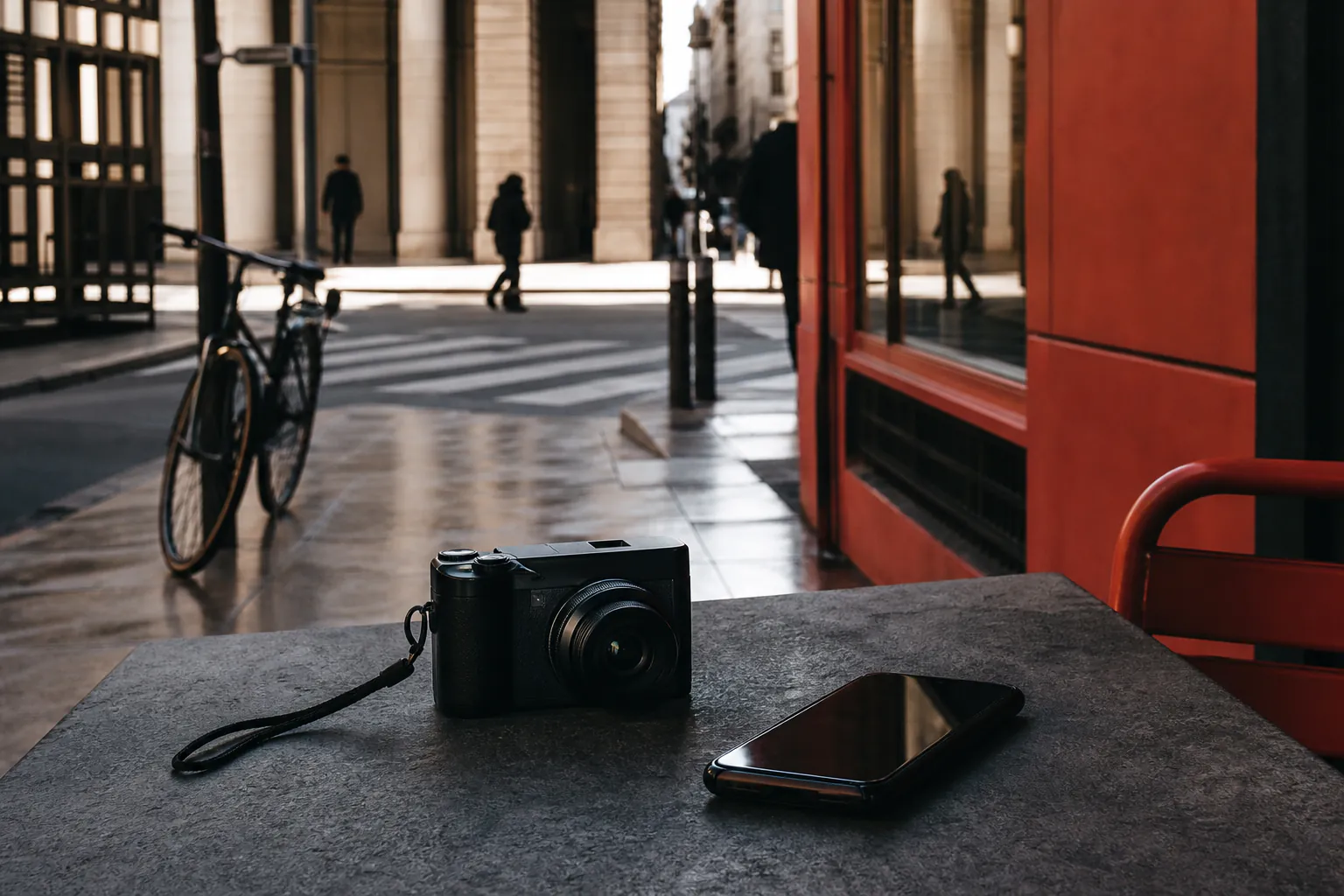
Walk one familiar public route in good daylight with a phone or small camera. Choose a theme such as reflections, repeated colours, hands at work from an appropriate distance, or the relationship between people and signs. Photograph openly from places where you may stand, do not obstruct anyone and move on immediately when a person objects.
- 01
Photography in a public place is generally possible in the UK, but private property can impose conditions and specific situations have additional law. This is not legal advice.
- 02
Legal permission is not the same as ethical necessity. Children, distress, vulnerability and private moments deserve a much higher threshold.
- 03
A smaller camera can reduce fatigue; it should not be used to deceive or pursue people.
- 04
Editing is where isolated frames become a point of view. Select for connection, not only dramatic proximity.
What to expect
The hardest choice happens before and after the shutter
Exposure can become automatic. Deciding whether a moment should be photographed, kept and published remains human work.
Attention
Busy streets reward anticipation. Stand where light, layers and movement can meet instead of chasing every subject.
Distance
A wide lens includes context but requires proximity. A longer lens increases distance but can feel covert and flatten space.
People
Some welcome a question, some prefer not to engage. Read the situation and accept no without argument.
Privacy
Homes, medical situations, grief, children and identifiable vulnerability require restraint beyond a generic public-space rule.
Security
Stay aware of traffic, property access and valuables; never step backwards into a road while framing.
Editing
A single ambiguous gesture can misrepresent a person. Caption and sequence without inventing motives.
Core method
Build a practice around place, permission and visual intent
Learn one route and its boundaries
Walk without photographing first. Note public and private thresholds, narrow pavements, security-sensitive entrances, schools, shelters and places where lingering would cause concern. Choose two safe stopping points and a clear theme. Familiarity frees attention for changing light and relationships rather than navigation.
Prepare a quiet simple camera
Use a phone or small camera with enough battery and storage. Choose one lens, enable a sensible auto-ISO range and practise waking, focusing and changing exposure without staring at menus. Disable intrusive sounds only where lawful and appropriate; the purpose is fluency, not concealment.
Work openly and respond well
Keep a neutral relaxed posture and do not block movement. If someone notices, be honest about the project. Show or delete a frame when that is the respectful choice, regardless of whether deletion is legally required. Do not follow a reluctant subject or turn discomfort into part of the photograph.
Edit for truth and sequence
After the walk, remove technical failures, humiliating frames and images that depend on an invented story. Select five pictures linked by colour, gesture, geometry or route. Check whether a caption states only what is known. Delay public posting when a frame involves a vulnerable or identifiable person.
Useful products
Secure carrying, not a shopping list of cameras
The Peak Design and SmallRig straps are alternative wrist-security routes; choose the one that fits the camera connector and expected load. The compact pouch protects a small camera when it should be put away. A phone already owned is a complete starting camera.
Peak Design Cuff Camera Wrist Strap
It reduces drop risk without adding a large shoulder bag to a short walk.
SmallRig Quick-Release Camera Wrist Strap
It addresses the same practical handling need without changing the camera or photographic approach.
K&F Concept Compact Camera Protective Pouch
It supports discreet safe storage without encouraging a large accessory load.
First project
Photograph one route through one visual idea
Make thirty considered frames around reflections, red objects, waiting or another neutral theme, then edit them to five.
- 01
Walk once without shooting
Find safe stopping points and notice property boundaries and foot traffic.
- 02
Set one theme
Choose a visual relationship that can be found without targeting vulnerability.
- 03
Simplify the camera
Use one lens, an automatic exposure mode you understand and a secure strap.
- 04
Wait for layers to align
Hold a safe position and let movement enter the frame rather than chasing it.
- 05
Respond respectfully
Explain briefly if asked and stop or delete when continuing would cause distress.
- 06
Edit to five
Select a connected honest sequence and keep unchosen frames private or discard them.
What can wait
What can wait until the first result
The next purchase should reduce friction without encouraging more intrusive behaviour.
- 01
A long telephoto lens
Distance is not automatic ethics and compressed surveillance-like frames can remove context.
- 02
Multiple camera bodies
One dependable control layout frees attention for the street.
- 03
A camouflage strategy
Fluency and discretion differ from deception. Work in a way you can explain honestly.
- 04
Immediate social posting
Time improves selection, captioning and privacy judgement.
- 05
A “fearless” persona
Confrontation is not a photographic skill. Leave situations that become tense.
Upgrade path
Upgrade the repeated limitation
Improve access, stamina and editing discipline before image specifications.
Phone walk
FreeOne route + theme + careful edit
Learn attention and ethical decisions.Secure small camera
About £16–£40 accessoriesFamiliar camera + wrist strap
Reduce handling friction and drops.Small prime lens
About £150+One field of view used consistently
Develop distance and framing instinct.Long-term project
Mostly timeRepeated place + notes + consent where needed
Replace isolated novelty with understanding.Safety & care
Respect people beyond the minimum legal threshold
Public-space rules are contextual and can change. When in doubt about a specific publication or situation, seek current professional legal advice.
- Do not obstruct pavements, emergency access, staff, transport or other people’s ordinary movement.
- Stop following or photographing anyone who objects or appears distressed; do not escalate a confrontation.
- Exercise particular restraint around children, healthcare, homelessness, grief, religion and private domestic space.
- Private property owners can set photography conditions, and some activities or publications create additional legal issues.
- Keep captions factual, protect files and consider whether publishing an identifiable image could cause disproportionate harm.
Outside help
When outside help earns its place
A well-run walk can improve sequencing and confidence, but check whether the tutor discusses consent, privacy and conflict rather than celebrating intrusion.
Repeat the same route in different light and edit one small sequence each time.
Check group size, accessibility, public-liability arrangements and the tutor’s people policy.
Representative UK prices and free learning routes checked 3 August 2026; local availability, materials and tutor support vary.
Sources
Where the guidance came from
UK authorities provide public photography and copyright context; photographic ethics guidance supports cautious subject welfare and publication decisions.
-
01
Metropolitan Police · Photography advice
Practical UK police context for photography in public.
Open source -
02
UK IPO · Copyright in digital images and photographs
Official copyright guidance for making, using and publishing photographs.
Open source -
03
Ofcom · Privacy
UK broadcasting privacy principles that illustrate legitimate expectation and harm considerations.
Open source -
04
Royal Photographic Society · Nature photographers code
A useful model for putting subject welfare and location conduct before the image.
Open source -
05
Amazon UK · Peak Design Cuff wrist strap
Exact product page, model or ISBN, observed price and availability checked for this guide.
Open source -
06
Amazon UK · SmallRig quick-release wrist strap
Exact product page, model or ISBN, observed price and availability checked for this guide.
Open source -
07
Amazon UK · K&F Concept compact camera pouch
Exact product page, model or ISBN, observed price and availability checked for this guide.
Open source
Guide information and links checked 3 August 2026.