Beginner’s guide · Cook & bake
Ferment a small known must
then let time do its work.
Start with a documented one-gallon kit or grape-juice recipe, sanitise thoroughly, measure the starting gravity and keep oxygen out after active fermentation.
Quick answer
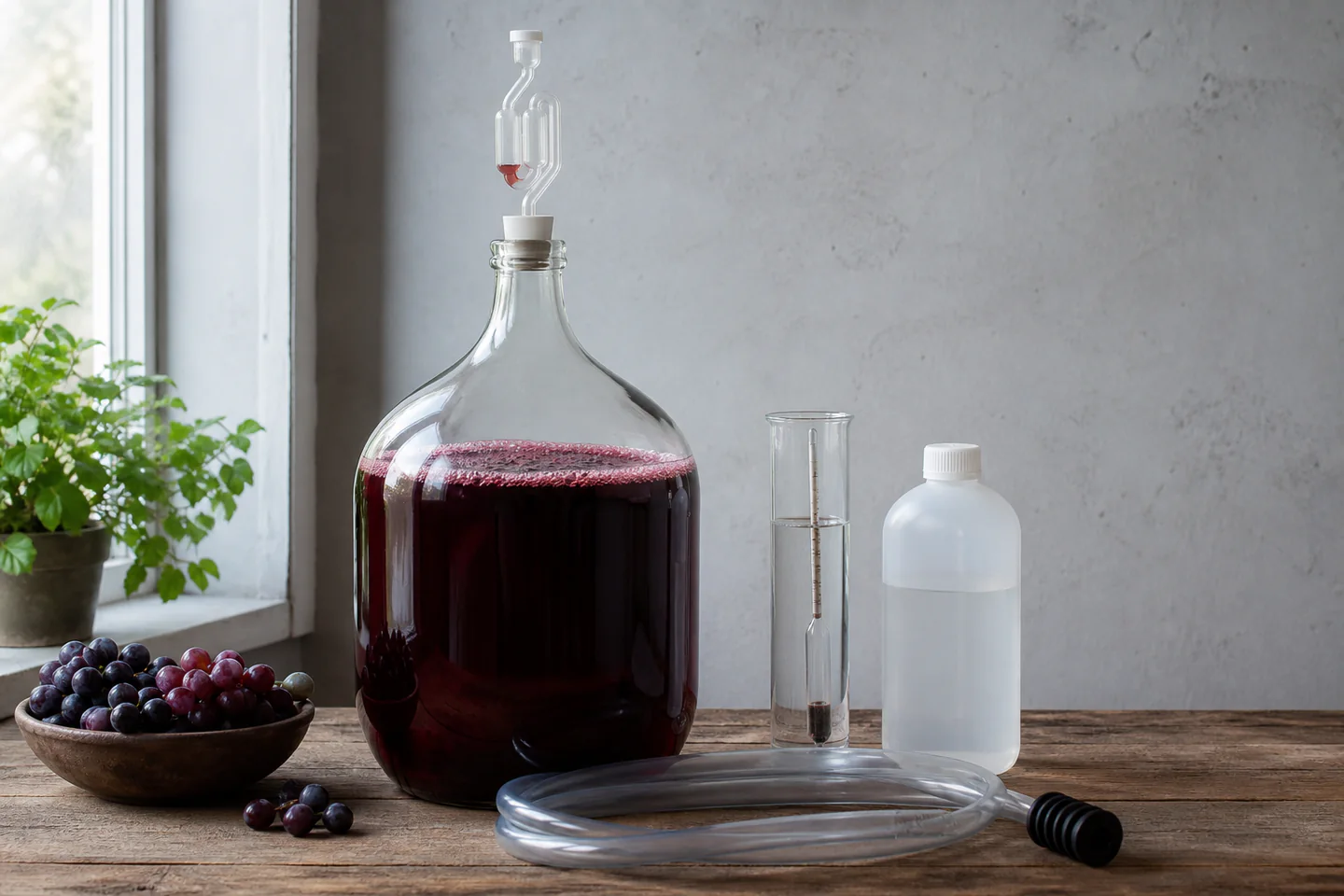
Use a one-gallon documented recipe
Sanitise every contact surface, use known juice or a complete kit, pitch suitable wine yeast, ferment under an airlock, verify completion with stable gravity and rack without splashing.
- 01
Read the complete recipe, inventory every sanitised transfer part and record starting gravity. Keep the first attempt narrow enough that preparation, the main action and the result can all be reviewed together.
- 02
Keep temperature within the yeast’s range and minimise oxygen after vigorous fermentation. Keep the first attempt narrow enough that preparation, the main action and the result can all be reviewed together.
- 03
Use gravity readings and clearing rather than airlock bubbles alone to decide whether fermentation is complete. Keep the first attempt narrow enough that preparation, the main action and the result can all be reviewed together.
- 04
Never bottle sweet or apparently still wine without understanding residual fermentation and pressure. Keep the first attempt narrow enough that preparation, the main action and the result can all be reviewed together.
What to expect
Most of the calendar is waiting
Active bubbling is short compared with clearing, racking, stabilising and ageing.
The first attempt
A kit or preservative-free juice reduces uncertainty about acidity, nutrient and sugar. For home wine making, note what actually happened rather than relying on memory; that turns the next attempt into a controlled change instead of another guess.
What changes
Temperature and yeast health alter speed and aroma; more sugar is not automatically better. For home wine making, note what actually happened rather than relying on memory; that turns the next attempt into a controlled change instead of another guess.
The useful signal
Stable hydrometer readings across several days are stronger evidence than a quiet airlock. For home wine making, note what actually happened rather than relying on memory; that turns the next attempt into a controlled change instead of another guess.
The common trap
Repeated opening and splashing after fermentation invites oxidation and contamination. For home wine making, note what actually happened rather than relying on memory; that turns the next attempt into a controlled change instead of another guess.
Core method
Sanitise, ferment, verify and transfer gently
Prepare deliberately
Read the complete recipe, inventory every sanitised transfer part and record starting gravity. For home wine making, note what actually happened rather than relying on memory; that turns the next attempt into a controlled change instead of another guess.
Control the central variable
Keep temperature within the yeast’s range and minimise oxygen after vigorous fermentation. For home wine making, note what actually happened rather than relying on memory; that turns the next attempt into a controlled change instead of another guess.
Read the result
Use gravity readings and clearing rather than airlock bubbles alone to decide whether fermentation is complete. For home wine making, note what actually happened rather than relying on memory; that turns the next attempt into a controlled change instead of another guess.
Reset before repeating
Clean immediately, log gravity and taste, and change only one recipe factor next batch. For home wine making, note what actually happened rather than relying on memory; that turns the next attempt into a controlled change instead of another guess.
Useful products
Products with a clear role
The shortlist covers the first workable route and one realistic improvement. Each exact Amazon UK page or ISBN was checked; confirm the current seller, specification, edition and availability.
MYPURECORE Two One-Gallon Glass Demijohns with Airlocks and Siphon
One gallon is manageable and leaves a second vessel for racking.
Lalvin ICV-D47 Wine Yeast, 5 g
Published tolerances make the process easier to plan.
Greg Hughes Home Brew Beer
Sanitation, gravity and packaging concepts cross beverage styles.
First project
Ferment one gallon from a kit
A complete small kit provides a known baseline before fruit recipes and adjustments.
- 01
Set up
Read the complete recipe, inventory every sanitised transfer part and record starting gravity. For home wine making, note what actually happened rather than relying on memory; that turns the next attempt into a controlled change instead of another guess.
- 02
Begin
Sanitise every contact surface, use known juice or a complete kit, pitch suitable wine yeast, ferment under an airlock, verify completion with stable gravity and rack without splashing. For home wine making, note what actually happened rather than relying on memory; that turns the next attempt into a controlled change instead of another guess.
- 03
Stay with one method
Keep temperature within the yeast’s range and minimise oxygen after vigorous fermentation. For home wine making, note what actually happened rather than relying on memory; that turns the next attempt into a controlled change instead of another guess.
- 04
Finish and assess
Use gravity readings and clearing rather than airlock bubbles alone to decide whether fermentation is complete. For home wine making, note what actually happened rather than relying on memory; that turns the next attempt into a controlled change instead of another guess.
- 05
Record the next change
Clean immediately, log gravity and taste, and change only one recipe factor next batch. For home wine making, note what actually happened rather than relying on memory; that turns the next attempt into a controlled change instead of another guess.
What can wait
What can wait until the method works
Buying around an unclear problem adds clutter. These upgrades make more sense after the first result exposes a repeatable limitation.
- 01
More capacity
Larger or multiple batches multiply sanitation and patient finishing before the small version is stable. For home wine making, note what actually happened rather than relying on memory; that turns the next attempt into a controlled change instead of another guess.
- 02
Premium equipment
Filters, floor corkers and large fermenters wait until bottling is genuinely enjoyable. For home wine making, note what actually happened rather than relying on memory; that turns the next attempt into a controlled change instead of another guess.
- 03
Extra varieties
Use one grape or kit style before blending fruit, oak and sweetness adjustments. For home wine making, note what actually happened rather than relying on memory; that turns the next attempt into a controlled change instead of another guess.
- 04
Public or commercial claims
Do not assume homemade alcohol is healthier, stronger or safe because it tastes mild. For home wine making, note what actually happened rather than relying on memory; that turns the next attempt into a controlled change instead of another guess.
Upgrade path
Upgrade the repeated limitation
Improve measurement and oxygen control before capacity.
Try it
£35–£80One-gallon kit, demijohn, airlock and sanitiser
The whole process stays manageable.Repeat it
£20–£60Hydrometer, test jar and careful siphon
Completion becomes measurable.Improve the bottleneck
£50–£150Second vessel, bottling wand and sound closures
Racking and packaging expose wine to less oxygen.Go deeper
VariableAcid, sulphite and bench-trial measurement
Adjustments become evidence-led.Safety & care
Alcohol, pressure and glass need respect
Home wine is legal for personal use in the UK, but selling it and distilling alcohol are separate regulated activities.
- Sanitise every item that touches cooled must or wine. Follow current manufacturer, food-safety, access, wildlife or local guidance wherever it applies.
- Use sound pressure-appropriate vessels and never seal active fermentation. Follow current manufacturer, food-safety, access, wildlife or local guidance wherever it applies.
- Verify stable gravity before bottling. Follow current manufacturer, food-safety, access, wildlife or local guidance wherever it applies.
- Lift glass demijohns from the base and protect them from thermal shock. Follow current manufacturer, food-safety, access, wildlife or local guidance wherever it applies.
- Keep alcohol away from children and drink responsibly. Follow current manufacturer, food-safety, access, wildlife or local guidance wherever it applies.
Outside help
When outside help earns its place
A local winemaking club can help identify oxidation, infection and finishing faults by taste.
Use one complete lesson that covers preparation, the central technique, common mistakes and finishing. For a first home wine making attempt, one coherent method is easier to diagnose than fragments collected from several creators.
Outside help earns its place when safe setup, access, identification or live correction removes a real obstacle. Ask what equipment, materials, access and follow-up support are included before booking.
Representative UK learning options checked 31 August 2026; local prices, access, materials and tutor support vary.
Sources
Where the guidance came from
The method is grounded in specialist, manufacturer and public guidance, then checked against recurring beginner problems and the exact products linked here.
-
01
The Craft Brewing Association · Winemaking
UK amateur brewing context.
Open source -
02
Lalvin · ICV-D47
Manufacturer yeast characteristics.
Open source -
03
HMRC · Alcohol duties
UK regulatory context for production and sale.
Open source -
04
WineMaker Magazine · Beginners
Detailed home-wine process reference.
Open source -
05
r/winemaking
Recurring gravity, oxidation and bottling questions.
Open source -
06
Amazon UK · Two One-Gallon Glass Demijohns with Airlocks and Siphon
Exact Amazon UK product page or ISBN used for the recommendation; current price, seller, specification and availability should be confirmed.
Open source -
07
Amazon UK · ICV-D47 Wine Yeast, 5 g
Exact Amazon UK product page or ISBN used for the recommendation; current price, seller, specification and availability should be confirmed.
Open source -
08
Amazon UK · Home Brew Beer
Exact Amazon UK product page or ISBN used for the recommendation; current price, seller, specification and availability should be confirmed.
Open source
Guide information and links checked 31 August 2026.