Beginner’s guide · Make & create
Seal one stencil edge,
before opening the cream.
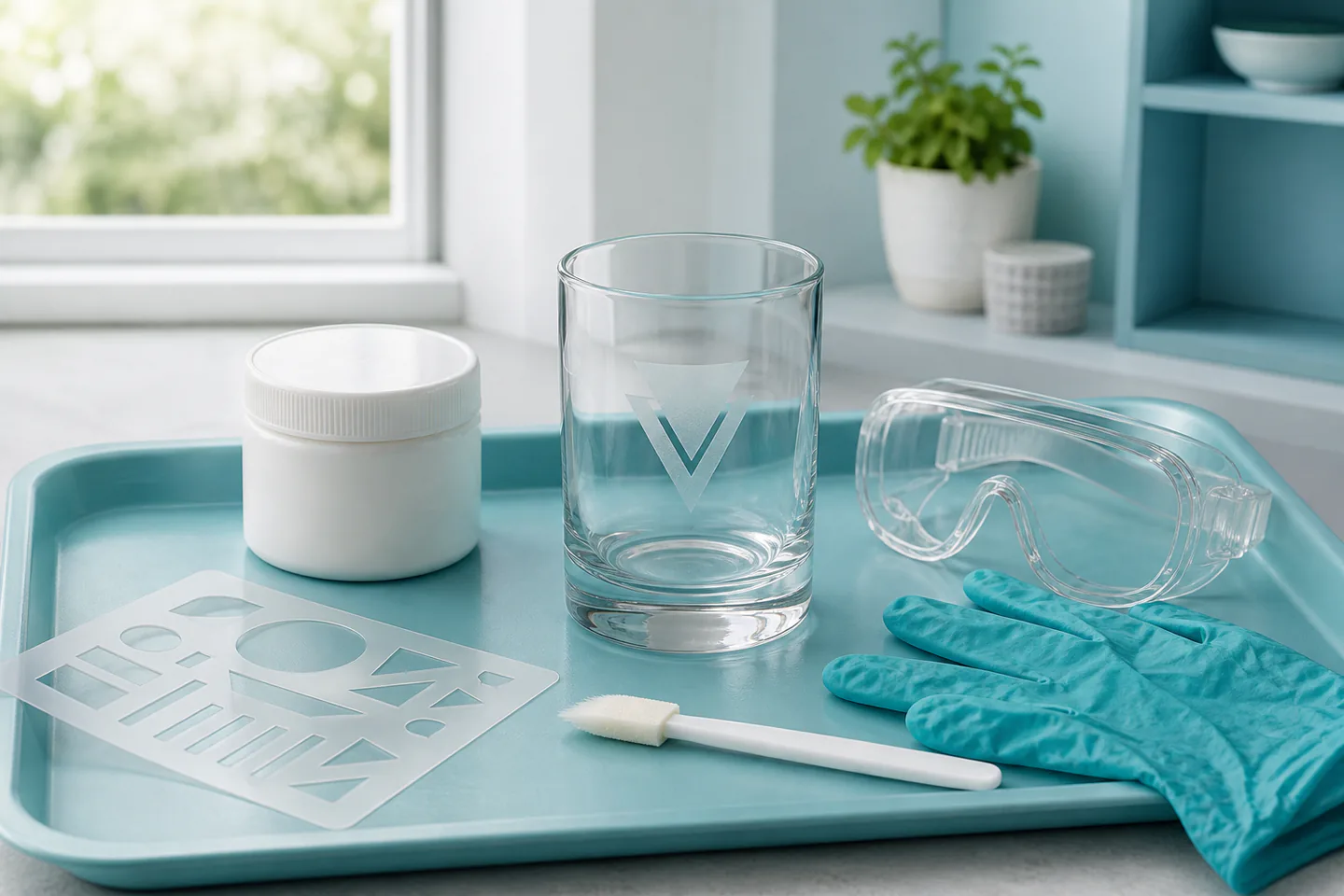
Glass-etching cream creates a permanent frosted design but is chemically hazardous and not suitable for every glass. Use a tiny test piece, full surface masking and the product instructions exactly.
Quick answer
Test the exact glass before the finished piece
Read the current cream label and safety data, put on the specified eye and skin protection, test a small disposable glass area, clean the final glass without residue, burnish a simple vinyl stencil and mask every surrounding surface before applying and rinsing exactly as directed.
- 01
Etching cream is not ordinary paint; contact with skin or eyes can cause serious harm. Keep the first attempt narrow enough that preparation, the main action and the result can all be reviewed together.
- 02
Different glass formulations and surface treatments can resist or change the etch. Keep the first attempt narrow enough that preparation, the main action and the result can all be reviewed together.
- 03
The stencil edge defines the result, so bubbles and gaps matter more than decorative complexity. Keep the first attempt narrow enough that preparation, the main action and the result can all be reviewed together.
- 04
A permanent etched error cannot be wiped off or polished away casually. Keep the first attempt narrow enough that preparation, the main action and the result can all be reviewed together.
What to expect
The material test decides whether the project works
The same cream and timing can behave differently on treated, coloured, borosilicate or unknown glass.
Surface
Fingerprints and anti-smudge cleaners can interfere with contact. For glass etching, note what actually happened rather than relying on memory; that turns the next attempt into a controlled change instead of another guess.
Stencil
Tiny lifted edges allow cream to creep under the design. For glass etching, note what actually happened rather than relying on memory; that turns the next attempt into a controlled change instead of another guess.
Coverage
An even manufacturer-specified layer avoids patchy frosting. For glass etching, note what actually happened rather than relying on memory; that turns the next attempt into a controlled change instead of another guess.
Rinsing
Unprotected sinks and surrounding glass can be damaged by contaminated rinse water. For glass etching, note what actually happened rather than relying on memory; that turns the next attempt into a controlled change instead of another guess.
Core method
Prepare containment before applying chemistry
Read and stage
Confirm first aid, protection, ventilation, tools and a nearby water source before opening the container. For glass etching, note what actually happened rather than relying on memory; that turns the next attempt into a controlled change instead of another guess.
Test the glass
Use a hidden or scrap area to prove compatibility and timing. For glass etching, note what actually happened rather than relying on memory; that turns the next attempt into a controlled change instead of another guess.
Apply and mask the stencil
Clean, dry, burnish and cover every area not intended to etch. For glass etching, note what actually happened rather than relying on memory; that turns the next attempt into a controlled change instead of another guess.
Follow the timed removal
Apply, move and rinse only as the current product instructions state, then clean the work area. For glass etching, note what actually happened rather than relying on memory; that turns the next attempt into a controlled change instead of another guess.
Useful products
Products with a clear job in the setup
Armour Etch is the active chemical; the 3M glasses and OLFA knife solve separate protection and stencil-cutting jobs. Use the cream only when its current UK label and safety information are available.
Armour Etch Glass Etching Cream, 2.8 oz
It is widely documented and has manufacturer instructions.
3M SecureFit 200 Safety Glasses
They are easy to keep at the bench and wear for every cut or chemical setup.
OLFA AK-1 Art Knife with 25 Blades
A sharp, controllable blade makes repeated light passes cleaner than forcing a dull one.
First project
Etch one small geometric patch
A straight-sided motif makes stencil sealing and patchiness easy to inspect.
- 01
Run the compatibility test
Use the same glass type and full protective setup. For glass etching, note what actually happened rather than relying on memory; that turns the next attempt into a controlled change instead of another guess.
- 02
Cut a simple stencil
Avoid tiny islands and keep a generous border. For glass etching, note what actually happened rather than relying on memory; that turns the next attempt into a controlled change instead of another guess.
- 03
Clean and burnish
Remove residue and press every edge firmly. For glass etching, note what actually happened rather than relying on memory; that turns the next attempt into a controlled change instead of another guess.
- 04
Mask and apply
Protect the entire object and follow current timing. For glass etching, note what actually happened rather than relying on memory; that turns the next attempt into a controlled change instead of another guess.
- 05
Rinse, clean and inspect
Prevent runoff touching unmasked surfaces or unsuitable sinks. For glass etching, note what actually happened rather than relying on memory; that turns the next attempt into a controlled change instead of another guess.
What can wait
What can wait until the first result
Extra equipment becomes useful only when the basic method has exposed a specific, repeated limitation.
- 01
Large filled areas
Cream can look uneven across broad surfaces. For glass etching, note what actually happened rather than relying on memory; that turns the next attempt into a controlled change instead of another guess.
- 02
Curved lettering
Small counters and curves lift easily. For glass etching, note what actually happened rather than relying on memory; that turns the next attempt into a controlled change instead of another guess.
- 03
Unknown vintage glass
Value, coatings and composition are uncertain. For glass etching, note what actually happened rather than relying on memory; that turns the next attempt into a controlled change instead of another guess.
- 04
Hydrofluoric acid methods
Industrial acid etching is outside this hobby route and extremely hazardous. For glass etching, note what actually happened rather than relying on memory; that turns the next attempt into a controlled change instead of another guess.
Upgrade path
Upgrade the repeated limitation
Improve stencil cutting and containment rather than chemical strength.
Scrap test
£15–£30Cream, PPE and disposable glass
Prove compatibility and safety routine.Small tumbler design
£20–£50Vinyl stencil and full masking
Learn edge sealing.Cutting machine stencil
£150–£400Compatible cutter and removable vinyl
Repeat more complex masks.Abrasive etching
VariableCabinet, blast media and extraction
Create different finish under specialist controls.Safety & care
Treat etching cream as hazardous chemistry
Ventilation alone does not replace contact protection, containment, first-aid knowledge or correct disposal.
- Read the current product label and safety data before every use. Follow current manufacturer, food-safety, access, wildlife or local guidance wherever it applies.
- Wear the specified eye protection and chemical-resistant gloves and keep skin covered. Follow current manufacturer, food-safety, access, wildlife or local guidance wherever it applies.
- Work beside a suitable water source in a well-lit ventilated area. Follow current manufacturer, food-safety, access, wildlife or local guidance wherever it applies.
- Protect sinks, taps, worktops and all unmasked glass from cream and rinse water. Follow current manufacturer, food-safety, access, wildlife or local guidance wherever it applies.
- Keep the product locked away from children, pets, food and incompatible materials and follow local disposal guidance. Follow current manufacturer, food-safety, access, wildlife or local guidance wherever it applies.
Outside help
When outside help earns its place
Manufacturer instructions are mandatory; a supervised craft session is useful only if it follows them and provides proper containment.
Use the current timing, masking, temperature and rinsing sequence for the exact product.
Ask about SDS access, PPE, ventilation, first aid and disposal.
Representative UK learning options checked 31 August 2026; local prices, access, materials and tutor support vary.
Sources
Where the guidance came from
The active product’s own instructions define the method; UK chemical-safety and health sources support protection, containment and first-aid planning.
-
01
Armour Products · Glass etching cream instructions
Manufacturer preparation, testing, masking, timing and rinsing.
Open source -
02
Armour Products · Rub N Etch instructions
Stencil-specific manufacturer method.
Open source -
03
Armour Products · Glass etching kit instructions
Detailed protection and cleanup instructions.
Open source -
04
HSE · Working with hazardous substances
UK chemical-risk control principles.
Open source -
05
NHS · Chemical burns
Immediate first-aid context for chemical exposure.
Open source -
06
Amazon UK · Glass Etching Cream, 2.8 oz
Exact Amazon UK product page or ISBN used for the recommendation; current price, seller, specification and availability should be confirmed.
Open source -
07
Amazon UK · SecureFit 200 Safety Glasses
Exact Amazon UK product page or ISBN used for the recommendation; current price, seller, specification and availability should be confirmed.
Open source -
08
Amazon UK · AK-1 Art Knife with 25 Blades
Exact Amazon UK product page or ISBN used for the recommendation; current price, seller, specification and availability should be confirmed.
Open source
Guide information and links checked 31 August 2026.