Beginner's guide · Write & create
Notice one ordinary thing.
Let questions accumulate.
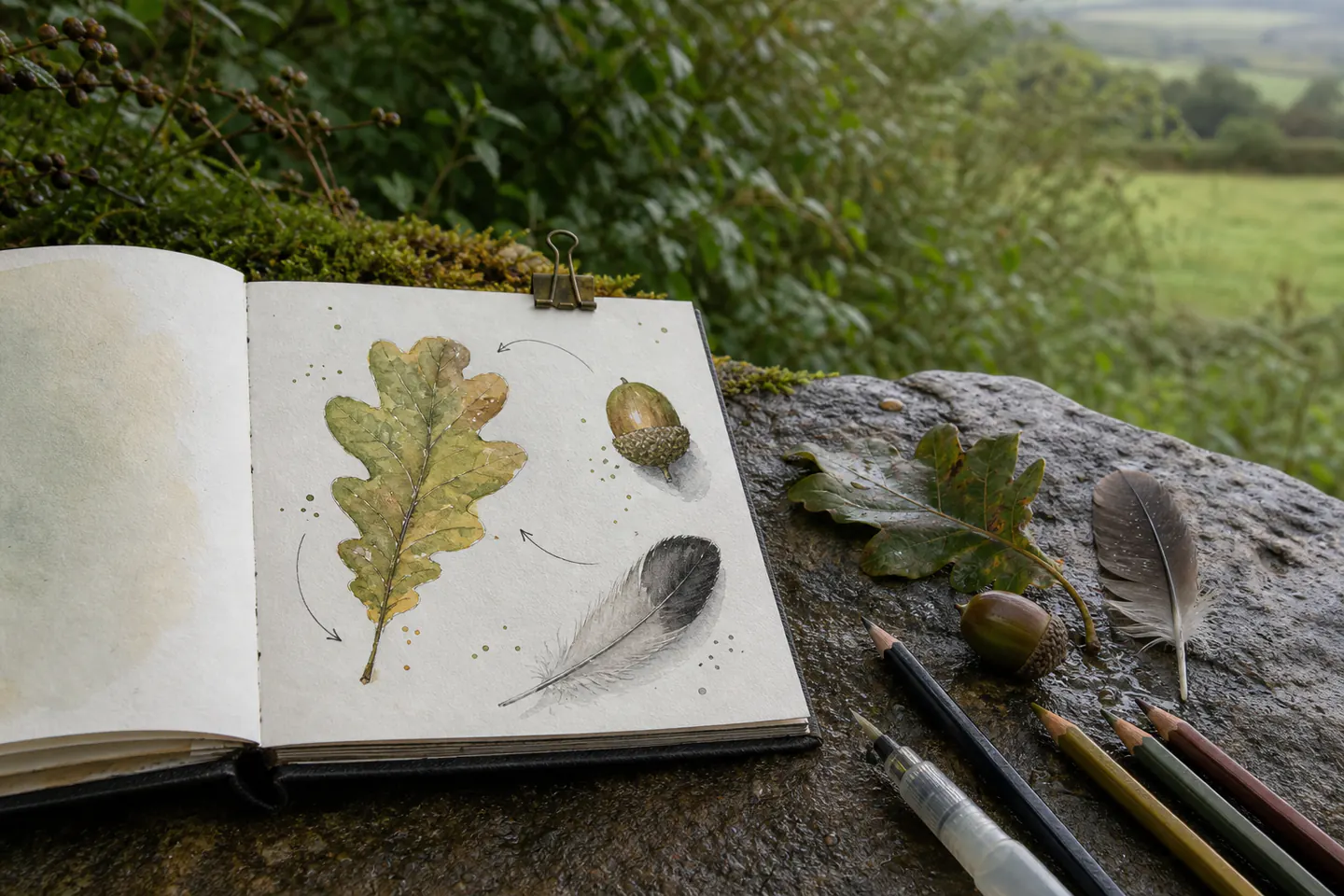
Spend ten minutes with one leaf, cloud, garden bird or street tree. Record date, place and weather, then combine quick shapes, labels, measurements and three prompts: I notice, I wonder, it reminds me of.
Quick answer
Notice one ordinary thing.
Choose one safe subject that can be observed without collecting or disturbance. Write the date, time, place and weather, draw its largest simple shape, add three labels and one measurement or comparison, then complete: “I notice…”, “I wonder…” and “It reminds me of…”. End with a question to check on the next visit.
- 01
A nature journal is an observation record, not a polished botanical-art portfolio. Words, numbers, maps, diagrams and rough shapes are all valid evidence.
- 02
Drawing slows attention because it forces decisions about proportion, connection and pattern. Accuracy improves through comparison, not erasing every uncertain line.
- 03
Species identification can come after the field entry. Record visible evidence first so a guide does not replace observation.
- 04
Return visits make the practice powerful: leaf-out, weather, behaviour, light and human changes become visible on the page.
What to expect
What the first attempts really involve
Outdoor subjects move and identification is often incomplete. The page succeeds when it preserves what was actually seen and what remains uncertain.
Time
Ten focused minutes can reveal more than an hour spent decorating a title. Add colour only if it records useful information.
Scale
A small sketch can include a ruler mark, hand comparison or written dimension when exact proportion is difficult.
Weather
Wind, rain and cold change both the subject and the materials. Pencil and clipped pages often outperform a full paint kit.
Identification
A confident name may be wrong. Write the features that support it and use a question mark until a reliable source resolves it.
Collection
Photographing or sketching in place avoids removing living, protected or habitat-important material.
Fundamentals
Build the first attempt on reliable fundamentals
Use the page as a field instrument
Put date, time, broad location and weather in the same corner every time. Mark the direction of light or wind if relevant. This context turns an isolated drawing into comparable data and helps explain later changes in colour, animal activity or plant development.
Build from large shape to relationship
Draw the outer envelope lightly, then divide it into a few large masses. Compare length with width, angle with vertical and one part with another. Add internal details only after those relationships read. Write corrections beside the drawing instead of repeatedly erasing the evidence of looking.
Mix modes on purpose
Use arrows to connect notes, a magnified detail bubble for texture, a tiny map for location and numbers for counts or intervals. Colour swatches can be more informative than colouring the whole sketch. A written sound pattern or movement diagram can record subjects that never hold still.
Turn uncertainty into the next visit
Circle the strongest question: Does the bird return to the same branch? Does this flower close before rain? Which side of the tree grows lichen? Check a field guide after the raw notes, then revisit under similar or deliberately different conditions. Record what changed and whether the first explanation survived.
Useful products
A field reference, robust paper and optional colour
The Laws Guide offers an observation-led method, the Stillman & Birn book supplies heavier paper for mixed media and the Goldfaber Aqua pencils add portable colour. These are upgrade choices; any existing notebook and ordinary pencil can complete the first month.
John Muir Laws The Laws Guide to Nature Drawing and Journaling
It directly connects drawing decisions with noticing, questioning and natural-history learning.
Stillman & Birn Zeta Series Hardcover Sketchbook, 5.5 × 8.5 inches
It handles more erasing and colour than a basic notebook without becoming an oversized studio pad.
Faber-Castell Goldfaber Aqua Watercolour Pencils, 24 set
Pencils work dry during observation and can be activated later, keeping the first field routine controlled.
First entry
Make a ten-minute ordinary-subject entry
Choose a street tree viewed from the pavement, a houseplant, a common garden invertebrate, clouds from a window or another lawful undisturbed subject.
- 01
Write the context
Record date, time, broad place, temperature impression, cloud, wind and recent weather.
- 02
Observe for one minute
Keep the pencil down and notice the largest shapes, movement, sound and relationship to surroundings.
- 03
Draw the envelope
Sketch the overall height, width and angle with light lines, accepting overlaps and corrections.
- 04
Add three labels
Point to features using concrete words about texture, connection, pattern or change rather than naming the species.
- 05
Make one comparison
Count repeating parts, estimate a ratio or compare size with a finger, coin or familiar object without harming the subject.
- 06
Use the three prompts
Write at least one sentence each for notice, wonder and reminds me of.
- 07
Check one reference
After the field observation, compare one question with a trusted guide and distinguish fact from tentative identification.
- 08
Plan the return
Choose a time or condition for a second entry and write exactly what change will be looked for.
Troubleshooting
Read the result before changing the setup
A page that feels ugly needs more evidence, not decoration
Add labels, counts, arrows, a detail view and a question. The value is in sustained observation; visual polish can develop without becoming the admission test.
A moving subject needs shorthand
Make repeated gesture shapes on the same page, write movement arrows and record one stable feature. Do not chase or restrain wildlife to finish a drawing.
A name that will not resolve should stay uncertain
List the observed features and compare reputable regional keys. “Possibly” and a question mark preserve honesty and create a useful future target.
Wet weather needs a smaller field kit
Use pencil, a clipped book, waterproof cover and sheltered observation. Add watercolour from photographs or notes later rather than exposing materials or the observer unsafely.
Skip for now
What can wait
The practice is built from attention and return. A heavy art kit can shorten field time and turn every page into a performance.
- 01
A full watercolour palette
Three coloured pencils or small swatches are enough to record colour relationships. Paint becomes useful when it no longer distracts from observing.
- 02
Rare-species travel
Common local subjects reveal seasonal patterns and allow repeat visits without expense or habitat pressure.
- 03
Pressing or collecting specimens
Some plants, feathers, nests and natural objects are protected or ecologically important. Observe in place unless collection is clearly lawful and appropriate.
- 04
Perfect identification
Keep observed facts separate from a tentative name. The journal remains valuable even when the species is unresolved.
Upgrade path
What a better setup changes
A better setup should survive weather, accept the chosen medium or support longer comparisons without making the bag too heavy.
Pencil field notes
Already ownedNotebook + pencil + ten-minute prompt
Builds noticing, questions, comparison and a repeatable page habit.Mixed-media field book
About £20–£30Heavier paper + pencil + water brush
Handles small washes and repeated erasing while staying portable.Portable colour
Add about £15–£25Limited water-soluble pencils + brush + cloth
Records colour swatches and subtle change without a wet palette.Long-term study
MinimalIndexed journal + repeated route + weather and species references
Turns isolated pages into evidence of season, behaviour and place.Before upgrading
A useful check before spending more
Pack only what appears in recent pages
If the last five entries used pencil, labels and one colour, carry exactly that. Add a tool after a missed observation shows what it would record.
Separate observation, inference and reference
Use different wording or marks for what was seen, what it might mean and what a source later confirmed. This keeps the journal intellectually honest and easier to revisit.
Safety
Observe without collecting or disturbing
Field attention can hide weather, terrain and wildlife boundaries. Choose a subject and position that can be left unchanged.
- Stay on permitted paths and do not enter private land, water, cliffs or unstable ground for a closer view.
- Do not disturb nests, roosts, dens or feeding animals; move away at the first change in behaviour.
- Do not collect plants, fungi, feathers, eggs or geological material unless ownership and legal status clearly permit it.
- Wash hands after handling soil or lawful found material and never taste an unknown plant or fungus.
- Dress for weather, tell someone about remote routes and carry an emergency light or phone where appropriate.
- Avoid publishing precise locations for sensitive species or vulnerable habitats.
Classes
When outside help is useful
A guided session is helpful for drawing confidence, species questions and observing in a group without habitat damage. The basic prompt works privately from a window or local path.
Look for observation prompts, mixed words and pictures and clear field ethics.
Useful for repeated locations, natural-history knowledge and sustained feedback.
Representative UK nature-journal and field-sketch formats checked 30 July 2026; materials and site entry vary.
Sources
Sources and checking notes
Wild Wonder resources establish accessible observation practices, drawing educators supply evidence-led prompts and UK wildlife bodies define responsible field behaviour.
-
01
Wild Wonder Foundation · Activities
Free nature-journalling activities built around observation, questions and comparison.
Open source -
02
Wild Wonder Foundation · Resources
Curated learning resources and community routes for nature journalling.
Open source -
03
John Muir Laws · Nature journaling
Specialist observation-led instruction and the notice, wonder and reminds framework.
Open source -
04
RSPB · Wildlife watching code
UK guidance on distance, disturbance and responsible observation.
Open source -
05
Natural History Museum · Take part in citizen science
Examples of structured observation and recording that connect notes with wider evidence.
Open source -
06
Amazon UK · The Laws Guide to Nature Drawing and Journaling
Exact John Muir Laws product and direct Amazon UK listing checked for current availability, price context and model identity.
Open source -
07
Amazon UK · Zeta Series Hardcover Sketchbook, 5.5 × 8.5 inches
Exact Stillman & Birn product and direct Amazon UK listing checked for current availability, price context and model identity.
Open source -
08
Amazon UK · Goldfaber Aqua Watercolour Pencils, 24 set
Exact Faber-Castell product and direct Amazon UK listing checked for current availability, price context and model identity.
Open source
Guide information and links checked 30 July 2026.