Beginner’s guide · Cook & bake
Keep the vinegar and sugar measured,
then cook until the spoon leaves a trail.
A tested small-batch chutney turns fruit or vegetables, vinegar and sugar into a hot-filled preserve. Recipe acidity, clean jars and a dated batch record are safety controls.
Quick answer
Complete one small batch before expanding the setup
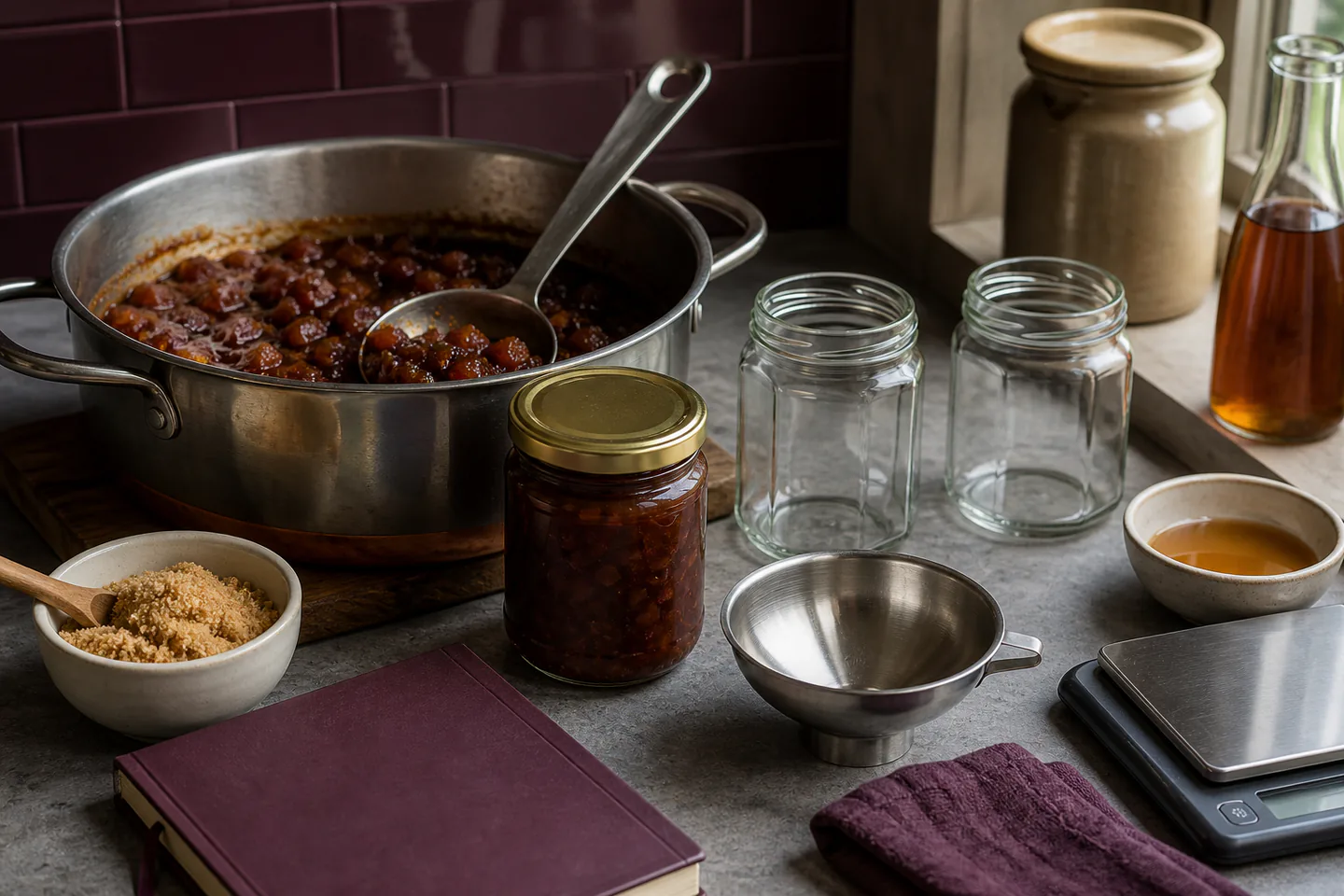
Choose a current tested chutney recipe and do not reduce its vinegar, sugar or cooking time casually. Inspect and disinfect heat-safe jars, prepare a clear hot-fill area, weigh the ingredients, simmer in a wide non-reactive pan until the mixture is uniformly thick and a spoon leaves a channel, then fill hot, close as directed and label the cooled jars with the recipe and date.
- 01
The tested acid and sugar balance is a preservation control, not only a flavour choice. Record what happened during chutney making so the next attempt changes one known variable instead of several guesses.
- 02
Evenly cut ingredients cook and acidify more consistently than mixed large chunks. Record what happened during chutney making so the next attempt changes one known variable instead of several guesses.
- 03
A wide pan improves evaporation but requires frequent stirring near the end. Record what happened during chutney making so the next attempt changes one known variable instead of several guesses.
- 04
A sealed lid does not prove that an altered or contaminated preserve is safe. Record what happened during chutney making so the next attempt changes one known variable instead of several guesses.
What to expect
What chutney making is really like at the start
The useful beginner controls are preparation, one bounded task and a record of the result; specialist equipment matters only when it solves a repeated limitation.
Preparation
Chopping and jar setup take longer than the final filling window. Record what happened during chutney making so the next attempt changes one known variable instead of several guesses.
Reduction
The mixture thickens slowly, then can catch quickly as free water falls. Record what happened during chutney making so the next attempt changes one known variable instead of several guesses.
Hot fill
Jars, funnel, ladle and lids need to be ready before the set is reached. Record what happened during chutney making so the next attempt changes one known variable instead of several guesses.
Maturation
Flavour often rounds over time, but storage advice comes from the tested recipe. Record what happened during chutney making so the next attempt changes one known variable instead of several guesses.
Core method
The core chutney making method
Use a tested formula
Record the recipe source, ingredient weights, vinegar strength and expected yield before making substitutions. Record what happened during chutney making so the next attempt changes one known variable instead of several guesses.
Prepare containers first
Inspect, wash and disinfect jars and prepare new or sound recipe-compatible closures. Record what happened during chutney making so the next attempt changes one known variable instead of several guesses.
Cook evenly
Use a non-reactive pan, maintain the specified simmer and stir more frequently as the mixture thickens. Record what happened during chutney making so the next attempt changes one known variable instead of several guesses.
Fill, cool and label
Remove trapped air as directed, fill at the stated temperature and headspace, close and check the cooled jars. Record what happened during chutney making so the next attempt changes one known variable instead of several guesses.
Useful products
Products with a clear job in the route
The scale protects recipe ratios, the thermometer gives another process reading and the clear jar makes condition and headspace easy to inspect.
Salter 1036 Digital Kitchen Scale
It makes a first batch easier to repeat and diagnose.
Tala Jam and Confectionery Thermometer
It supplements wrinkle and flake tests with a repeatable temperature reading.
Kilner One-Litre Clip-Top Glass Jar
The clear body makes cleanliness, headspace and condition easy to inspect.
First project
Make one tested apple-and-onion chutney batch
Use the published quantities and yield so evaporation, texture and jar fill can be checked against a known process.
- 01
Read the whole method
Confirm jar type, yield, vinegar specification, storage and any maturation time. Record what happened during chutney making so the next attempt changes one known variable instead of several guesses.
- 02
Prepare jars and ingredients
Disinfect containers and cut all produce before heating starts. Record what happened during chutney making so the next attempt changes one known variable instead of several guesses.
- 03
Simmer and stir
Keep the mixture moving from the base as it becomes glossy and thick. Record what happened during chutney making so the next attempt changes one known variable instead of several guesses.
- 04
Test the texture
Look for a clear channel and uniformly softened pieces rather than relying on time alone. Record what happened during chutney making so the next attempt changes one known variable instead of several guesses.
- 05
Fill and record
Hot-fill as directed, cool undisturbed and label recipe, date and batch. Record what happened during chutney making so the next attempt changes one known variable instead of several guesses.
What can wait
What can wait until the first result
Delay anything that adds cost, risk or another variable before the basic workflow has produced something you can review.
- 01
Reducing vinegar
It changes the preservation system and may leave low-acid pockets. Record what happened during chutney making so the next attempt changes one known variable instead of several guesses.
- 02
Oil-packed variations
Low-oxygen oil mixtures have different and potentially serious safety controls. Record what happened during chutney making so the next attempt changes one known variable instead of several guesses.
- 03
Large batches
Evaporation and heat distribution do not scale linearly in a domestic pan. Record what happened during chutney making so the next attempt changes one known variable instead of several guesses.
- 04
Long shelf-life promises
Home storage life should come from the tested recipe and local food-safety advice. Record what happened during chutney making so the next attempt changes one known variable instead of several guesses.
Upgrade path
Add the capability you can now name
Each stage should remove a demonstrated constraint rather than make the setup look more advanced.
Use what you own
£0–£20Existing equipment and one written plan
Use a tested recipe and jars already suitable for preserving.Repeat the first route
About £15–£45 plus ingredientsA complete repeatable starter setup
Repeat one batch size until texture and hot filling are orderly.Add one capability
Often £50–£250One selected tool, service or learning resource
Add a wide preserving pan, funnel or pH measurement only within a validated process.Build specialist depth
Club, course or specialist dependentA documented specialist workflow
Learn recipe development, shelf-life assessment and labelling before selling or distributing widely.Safety & care
Do not improvise the preservation controls
Sealed low-acid food can support serious hazards; cleanliness alone is not a substitute for a validated acid, sugar and heat process.
- Follow a current tested recipe exactly for vinegar strength, sugar, ingredient weights, cooking and storage.
- Use clean disinfected undamaged jars and sound recipe-compatible lids; reject chips, cracks, rust and damaged seals.
- Protect against splashes from hot sticky preserve and move one jar at a time on a dry stable surface.
- Refrigerate or discard any batch when the validated room-temperature safety conditions are not met.
- Never taste a jar that is leaking, bulging, spurting, mouldy or otherwise suspicious.
Outside help
When outside help earns its place
A preserving workshop is most useful when it teaches recipe validation, jar handling and batch records rather than only flavours.
If you plan to sell chutney, contact the local authority food-safety and trading-standards teams before production.
Use outside help after the first chutney making attempt can reveal the exact technique, access or safety problem that needs live correction.
Representative UK learning and access routes checked 1 September 2026; local prices, permissions, equipment and tutor support vary.
Sources
Where the guidance came from
Authoritative and specialist guidance supports the method and safety boundaries; community discussion contributes recurring beginner problems rather than unsupported claims.
-
01
Dover District Council · Chutneys, pickles, oils and jams
UK local-authority safety controls for acidity, jars, hot filling, records and shelf life.
Open source -
02
Food Standards Agency · Food hygiene for home producers
Domestic production hygiene and jar-reuse context.
Open source -
03
GOV.UK · Food standards, labelling and composition
UK composition and labelling framework for preserved foods.
Open source -
04
BBC Good Food · Sterilise jars
Practical jar-cleaning and hot-fill preparation.
Open source -
05
British Dietetic Association · Let’s get cooking
Measured chutney preparation and domestic kitchen method.
Open source -
06
Reddit · r/Canning
Community evidence on unsafe recipe changes, seals and storage misunderstandings.
Open source -
07
Amazon UK · 1036 Digital Kitchen Scale
Exact Amazon UK product page or ISBN used for this recommendation; current price, seller, specification and availability should be confirmed.
Open source -
08
Amazon UK · Jam and Confectionery Thermometer
Exact Amazon UK product page or ISBN used for this recommendation; current price, seller, specification and availability should be confirmed.
Open source -
09
Amazon UK · One-Litre Clip-Top Glass Jar
Exact Amazon UK product page or ISBN used for this recommendation; current price, seller, specification and availability should be confirmed.
Open source
Guide information and links checked 1 September 2026.