Beginner’s guide · Make & create
Build one square 1:12 table
before furnishing the room.
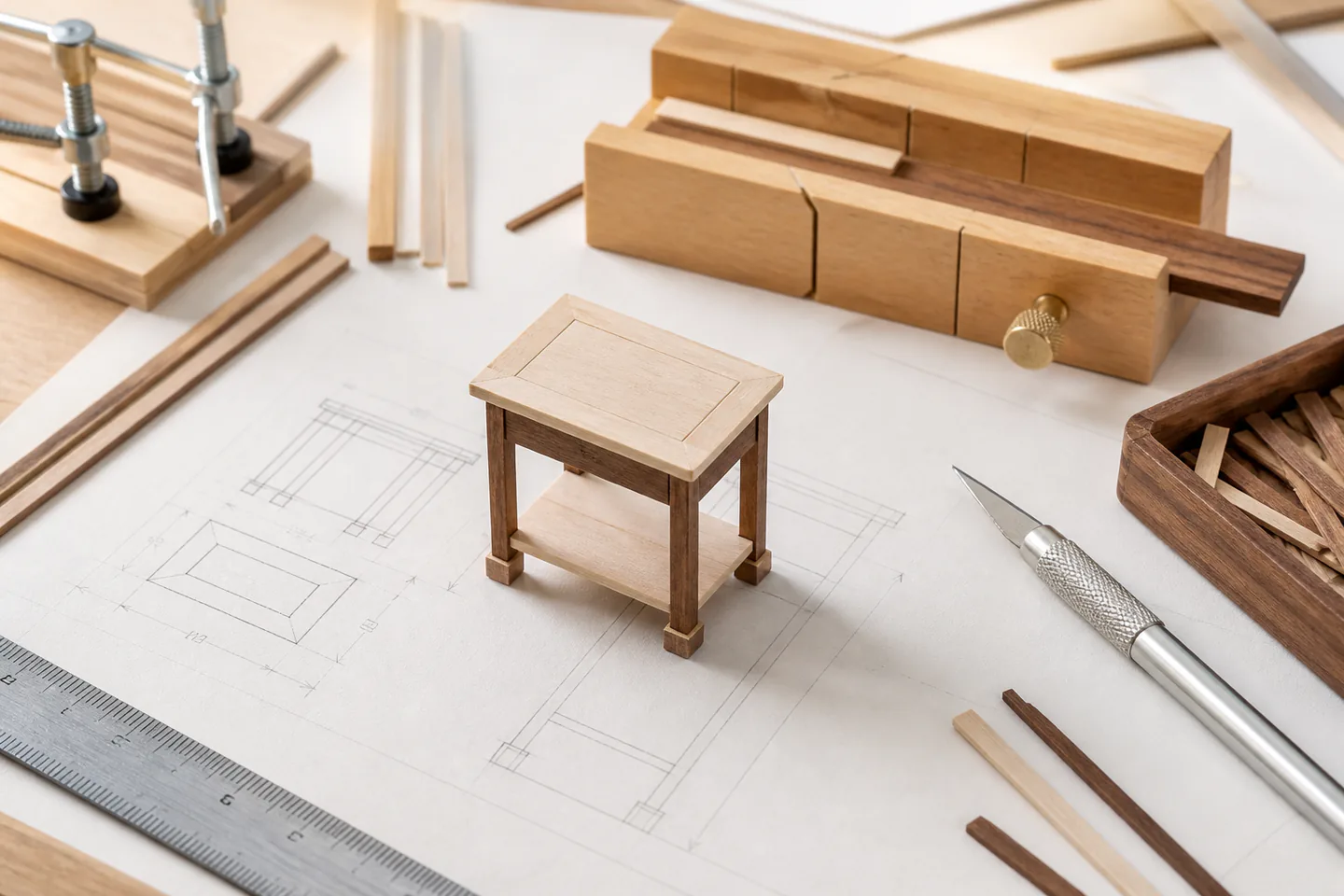
Miniature furniture making turns careful scale drawings, square cuts, tiny repeatable joints and restrained finishing into believable small objects.
Quick answer
Build one small, controlled result first
Choose a simple real table, convert its main dimensions to 1:12 and make a card mock-up. Cut all matching legs together, dry-fit on a flat surface and glue in stages with a square before applying a thin finish.
- 01
Make a dimensioned drawing and card mock-up, select straight stable stripwood and plan the cutting order for repeated parts. Keep the first attempt narrow enough that preparation, the main action and the result can all be reviewed together.
- 02
Use a stop block, mitre box or measured cutting guide so matching legs and rails are genuinely equal rather than adjusted by eye. Keep the first attempt narrow enough that preparation, the main action and the result can all be reviewed together.
- 03
Check scale, squareness, wobble, squeeze-out and visual weight under close light before the glue fully cures. Keep the first attempt narrow enough that preparation, the main action and the result can all be reviewed together.
- 04
Return tiny parts to labelled trays, cap adhesives, replace unsafe blades and keep a cutting list with the finished prototype. Keep the first attempt narrow enough that preparation, the main action and the result can all be reviewed together.
What to expect
Accuracy comes from the sequence, not the size of the toolkit
Preparation, one controlled variable and an honest inspection matter more than collecting specialist equipment.
The first attempt
A four-legged stool or side table teaches nearly every essential problem without hinges, drawers or curved joinery. For miniature furniture making, note what actually happened rather than relying on memory; that turns the next attempt into a controlled change instead of another guess.
The control point
Use a stop block, mitre box or measured cutting guide so matching legs and rails are genuinely equal rather than adjusted by eye. For miniature furniture making, note what actually happened rather than relying on memory; that turns the next attempt into a controlled change instead of another guess.
The useful signal
Check scale, squareness, wobble, squeeze-out and visual weight under close light before the glue fully cures. For miniature furniture making, note what actually happened rather than relying on memory; that turns the next attempt into a controlled change instead of another guess.
The common trap
Decorative mouldings and tiny hardware magnify errors when the basic frame is not square or the material is out of scale. For miniature furniture making, note what actually happened rather than relying on memory; that turns the next attempt into a controlled change instead of another guess.
Core method
Prepare, make, inspect and reset
Prepare deliberately
Make a dimensioned drawing and card mock-up, select straight stable stripwood and plan the cutting order for repeated parts. For miniature furniture making, note what actually happened rather than relying on memory; that turns the next attempt into a controlled change instead of another guess.
Control the central variable
Use a stop block, mitre box or measured cutting guide so matching legs and rails are genuinely equal rather than adjusted by eye. For miniature furniture making, note what actually happened rather than relying on memory; that turns the next attempt into a controlled change instead of another guess.
Read the result
Check scale, squareness, wobble, squeeze-out and visual weight under close light before the glue fully cures. For miniature furniture making, note what actually happened rather than relying on memory; that turns the next attempt into a controlled change instead of another guess.
Reset before repeating
Return tiny parts to labelled trays, cap adhesives, replace unsafe blades and keep a cutting list with the finished prototype. For miniature furniture making, note what actually happened rather than relying on memory; that turns the next attempt into a controlled change instead of another guess.
Useful products
Products with a clear job in the setup
A small model toolkit, sharp craft knife and fine-tip adhesive cover the first measured cutting and assembly jobs.
LIHAO 10-Piece Basic Model Building Tool Set
It covers the repetitive hand work shared by models and miniatures.
Olfa AK-1 Art and Model Knife
A sharp controllable blade makes repeated light passes cleaner than force.
Bearly Art Precision Craft Glue Mini, 2 fl oz
The fine tips reduce squeeze-out on small joints.
First project
Make a 1:12 side table from stripwood
Use a card prototype and matching-part jig so the object reads as furniture rather than a collection of tiny cuts.
- 01
Set up
Make a dimensioned drawing and card mock-up, select straight stable stripwood and plan the cutting order for repeated parts. For miniature furniture making, note what actually happened rather than relying on memory; that turns the next attempt into a controlled change instead of another guess.
- 02
Begin the first attempt
A four-legged stool or side table teaches nearly every essential problem without hinges, drawers or curved joinery. For miniature furniture making, note what actually happened rather than relying on memory; that turns the next attempt into a controlled change instead of another guess.
- 03
Hold one variable steady
Use a stop block, mitre box or measured cutting guide so matching legs and rails are genuinely equal rather than adjusted by eye. For miniature furniture making, note what actually happened rather than relying on memory; that turns the next attempt into a controlled change instead of another guess.
- 04
Inspect the result
Check scale, squareness, wobble, squeeze-out and visual weight under close light before the glue fully cures. For miniature furniture making, note what actually happened rather than relying on memory; that turns the next attempt into a controlled change instead of another guess.
- 05
Reset and record
Return tiny parts to labelled trays, cap adhesives, replace unsafe blades and keep a cutting list with the finished prototype. For miniature furniture making, note what actually happened rather than relying on memory; that turns the next attempt into a controlled change instead of another guess.
What can wait
What can wait until the first result
Delay equipment that solves no repeated problem in the first small project.
- 01
A large first setup
Scale multiplies Decorative mouldings and tiny hardware magnify errors when the basic frame is not square or the material is out of scale. before the basic routine is known. For miniature furniture making, note what actually happened rather than relying on memory; that turns the next attempt into a controlled change instead of another guess.
- 02
Premium specialist equipment
It should solve a limitation you can describe after several miniature furniture making sessions. For miniature furniture making, note what actually happened rather than relying on memory; that turns the next attempt into a controlled change instead of another guess.
- 03
Several methods at once
Changing materials and technique together makes the cause of a result hard to see. For miniature furniture making, note what actually happened rather than relying on memory; that turns the next attempt into a controlled change instead of another guess.
- 04
Buying for a future version
Finish and review the small route before equipping an imagined advanced practice. For miniature furniture making, note what actually happened rather than relying on memory; that turns the next attempt into a controlled change instead of another guess.
Upgrade path
Upgrade the repeated limitation
Add capacity only after the basic process is repeatable.
Try it
About £30–£90Card mock-up, stripwood and sharp knife
Complete one meaningful result and learn the whole sequence.Repeat it
About £30–£90Mitre guide, square and fine clamps
Reduce setup friction and compare several attempts.Improve the bottleneck
£100–£400Small saw, sanding jigs and repeatable fixtures
Address Decorative mouldings and tiny hardware magnify errors when the basic frame is not square or the material is out of scale. with a targeted change.Go deeper
VariableDrawers, turned parts, upholstery and original designs
Add scale, precision or public participation with evidence from practice.Safety & care
Tiny parts still demand full-size tool discipline
Close work brings blades, dust and adhesives nearer to the face and holding hand.
- Cut on a stable mat with a sharp controlled blade and keep fingers outside the planned path. Follow current manufacturer, food-safety, access, wildlife or local guidance wherever it applies.
- Use eye protection for clipped wire or brittle components. Follow current manufacturer, food-safety, access, wildlife or local guidance wherever it applies.
- Ventilate adhesives, finishes and solvent-based stains and use the smallest practical quantity. Follow current manufacturer, food-safety, access, wildlife or local guidance wherever it applies.
- Control fine wood dust with suitable extraction and damp cleanup. Follow current manufacturer, food-safety, access, wildlife or local guidance wherever it applies.
- Keep miniature hardware and offcuts away from children and pets. Follow current manufacturer, food-safety, access, wildlife or local guidance wherever it applies.
Outside help
When outside help earns its place
A dollhouse-miniature club or workshop becomes useful for tiny jigs, scale conventions and specialist joints after the first square object.
Use one complete lesson that covers preparation, the central technique, common mistakes and finishing. For a first miniature furniture making attempt, one coherent method is easier to diagnose than fragments collected from several creators.
Outside help earns its place when safe setup, access, identification or live correction removes a real obstacle. Ask what equipment, materials, access and follow-up support are included before booking.
Representative UK learning options checked 31 August 2026; local prices, access, materials and tutor support vary.
Sources
Where the guidance came from
The method is grounded in specialist, manufacturer and public guidance, then checked against recurring beginner problems and the exact products linked here.
-
01
International Guild of Miniature Artisans
Miniature craftsmanship and learning context.
Open source -
02
Dollshouse and Miniature Scene
UK miniature projects, scales and community.
Open source -
03
Fine Woodworking · Furniture basics
Joinery, grain and finishing principles transferable at scale.
Open source -
04
Olfa · Safety
Manufacturer knife safety guidance.
Open source -
05
Reddit · r/miniatures
Community evidence on scale, materials, tools and glue control.
Open source -
06
Amazon UK · 10-Piece Basic Model Building Tool Set
Exact Amazon UK product page or ISBN used for the recommendation; current price, seller, specification and availability should be confirmed.
Open source -
07
Amazon UK · AK-1 Art and Model Knife
Exact Amazon UK product page or ISBN used for the recommendation; current price, seller, specification and availability should be confirmed.
Open source -
08
Amazon UK · Precision Craft Glue Mini, 2 fl oz
Exact Amazon UK product page or ISBN used for the recommendation; current price, seller, specification and availability should be confirmed.
Open source
Guide information and links checked 31 August 2026.