Beginner’s guide · Explore earth science
Expose only what you can identify,
then stop before the fossil becomes the tool test.
A common robust specimen and hand tools teach matrix reading, magnification, support and reversible conservation before powered scribes or chemical methods.
Quick answer
Complete one prepared specimen before expanding the setup
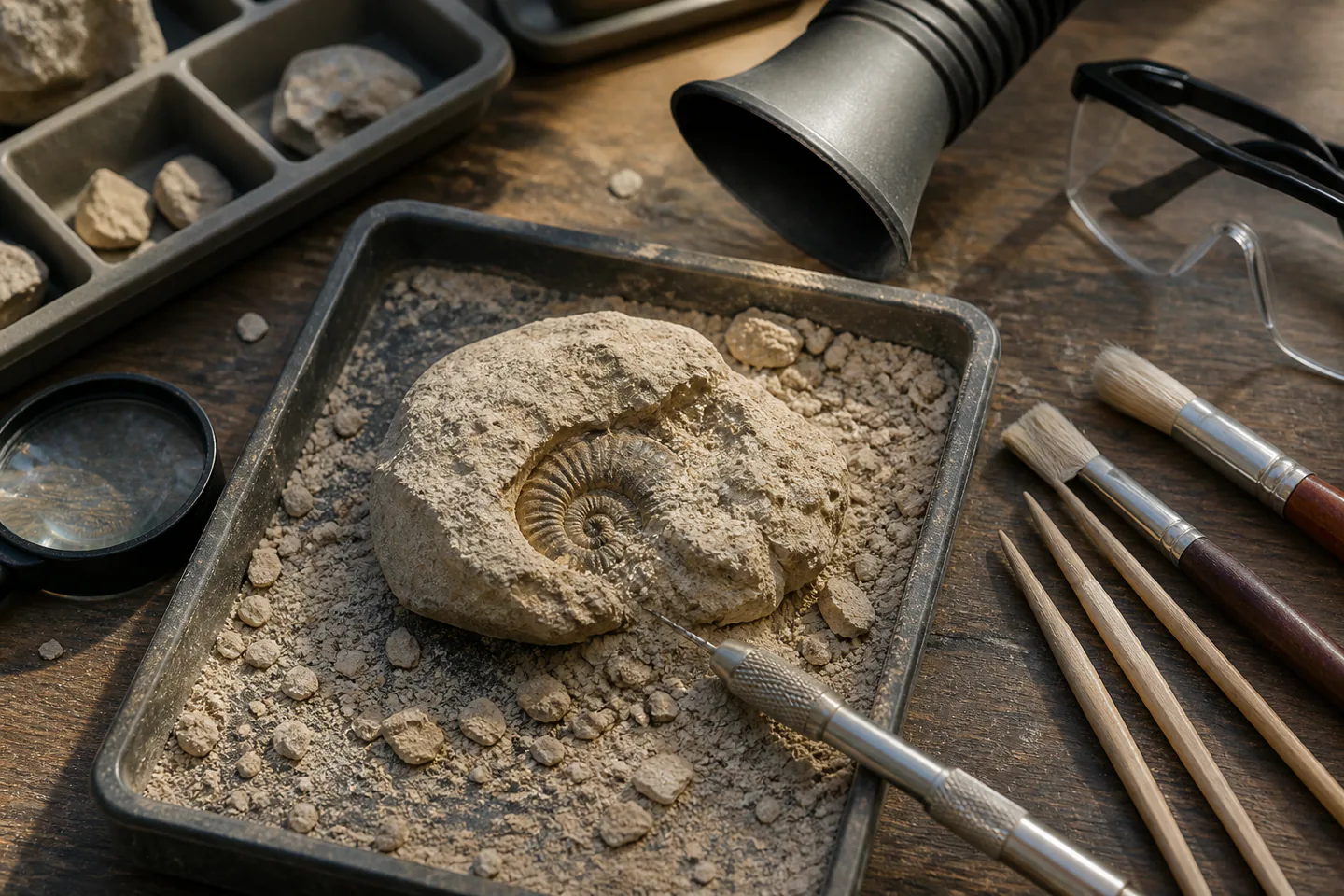
Use a legally acquired common robust fossil with provenance and ask a local geological group to confirm material and preparation route. Photograph and map exposed features, support the specimen in a sand or foam tray, work under magnification with wooden picks, a needle in a pin vice and soft brushes, remove matrix in tiny controlled areas, collect dust at source and stop at uncertainty rather than applying acid, hardener or powered tools.
- 01
Matrix and fossil may differ in hardness, fracture and grain, but the boundary can disappear or change direction. Record what happened during fossil preparation so the next attempt changes one known variable instead of several guesses.
- 02
Preparation removes information irreversibly, so provenance photographs and staged records belong to the process. Record what happened during fossil preparation so the next attempt changes one known variable instead of several guesses.
- 03
Consolidants and adhesives can stain, penetrate and prevent later analysis; reversible conservation requires material knowledge. Record what happened during fossil preparation so the next attempt changes one known variable instead of several guesses.
- 04
Silica-bearing dust and flying chips need source control and task-appropriate protection. Record what happened during fossil preparation so the next attempt changes one known variable instead of several guesses.
What to expect
What fossil preparation is really like at the start
The useful beginner controls are preparation, one bounded task and a record of the result; specialist equipment matters only when it solves a repeated limitation.
Specimen
Cracks, repairs and missing surfaces may be hidden until matrix is removed. Record what happened during fossil preparation so the next attempt changes one known variable instead of several guesses.
Boundary
Colour is not enough to distinguish fossil from mineral staining or matrix. Record what happened during fossil preparation so the next attempt changes one known variable instead of several guesses.
Tool
A sharp controlled hand point can be safer than a blunt tool that needs force. Record what happened during fossil preparation so the next attempt changes one known variable instead of several guesses.
Finish
Over-preparation can erase shell texture, associated fossils and geological context. Record what happened during fossil preparation so the next attempt changes one known variable instead of several guesses.
Core method
The core fossil preparation method
Document and assess
Record provenance, dimensions, visible anatomy, cracks and intended endpoint and seek material identification. Record what happened during fossil preparation so the next attempt changes one known variable instead of several guesses.
Support the work
Use a padded tray, stable lighting, magnification and extraction without clamping the fossil directly. Record what happened during fossil preparation so the next attempt changes one known variable instead of several guesses.
Approach gradually
Begin away from critical features, remove small amounts and change angle rather than force. Record what happened during fossil preparation so the next attempt changes one known variable instead of several guesses.
Stabilise conservatively
Stop at cracks or uncertainty and consult a conservator before adding adhesive, consolidant, water or chemical. Record what happened during fossil preparation so the next attempt changes one known variable instead of several guesses.
Useful products
Products with a clear job in the route
The safety glasses provide baseline impact protection, the magnifier supports boundary inspection and model tools offer picks and files only after each edge and material is assessed.
3M SecureFit 200 Safety Glasses
They are easy to keep at the bench for routine impact risks.
Carson LL-10 10× LumiLoupe Stand Magnifier
A stand leaves delicate paper, specimens or small finds undisturbed.
LIHAO 10-Piece Basic Model Building Tool Set
It covers the first restrained assembly and weathering-support tasks without a large tool collection.
First project
Prepare a small robust fossil with hand tools
Choose an inexpensive common specimen and define a limited window rather than attempting complete exposure.
- 01
Confirm provenance and material
Record where it came from lawfully and ask what fossil and matrix are likely present. Record what happened during fossil preparation so the next attempt changes one known variable instead of several guesses.
- 02
Photograph and map
Mark cracks, exposed surface and the small intended work zone. Record what happened during fossil preparation so the next attempt changes one known variable instead of several guesses.
- 03
Test away from anatomy
Use a wooden pick or needle with minimal pressure under magnification. Record what happened during fossil preparation so the next attempt changes one known variable instead of several guesses.
- 04
Expand the window slowly
Clear dust, relight and inspect after every short pass. Record what happened during fossil preparation so the next attempt changes one known variable instead of several guesses.
- 05
Stop and document
Photograph the result, remaining matrix, damage risk and any conservation question. Record what happened during fossil preparation so the next attempt changes one known variable instead of several guesses.
What can wait
What can wait until the first result
Delay anything that adds cost, risk or another variable before the basic workflow has produced something you can review.
- 01
Pneumatic air scribes
Noise, vibration, compressed air and fast removal demand training and better control. Record what happened during fossil preparation so the next attempt changes one known variable instead of several guesses.
- 02
Acid preparation
Chemistry can dissolve fossil, release fumes and create hazardous waste. Record what happened during fossil preparation so the next attempt changes one known variable instead of several guesses.
- 03
Power grinding
It creates heat, dust and irreversible removal near unknown anatomy. Record what happened during fossil preparation so the next attempt changes one known variable instead of several guesses.
- 04
Gloss coatings
They alter appearance and can obstruct future conservation and study. Record what happened during fossil preparation so the next attempt changes one known variable instead of several guesses.
Upgrade path
Add the capability you can now name
Each stage should remove a demonstrated constraint rather than make the setup look more advanced.
Use what you own
£0–£20Existing equipment and one written plan
Use a documented common specimen and hand tools.Repeat the first route
About £20–£90 plus specimenA complete repeatable starter setup
Repeat limited windows and improve support, light and dust capture.Add one capability
Often £50–£250One selected tool, service or learning resource
Add microscope, micro-jack or approved consolidant with specialist instruction.Build specialist depth
Club, course or specialist dependentA documented specialist workflow
Prepare scientifically important material only within a museum, university or competent conservation workflow.Safety & care
Dust control and reversibility set the boundary
Unknown minerals, silica, adhesives and irreplaceable detail make restraint more important than speed.
- Use local dust extraction and wet methods only when compatible with the specimen; never dry sweep or blow dust.
- Wear task-appropriate eye and respiratory protection based on the material and risk assessment.
- Do not use acids, solvents, consolidants or compressed-air tools without material identification, ventilation and training.
- Treat unknown mineral coatings, old repairs and specimens from mining areas as potentially hazardous until assessed.
- Stop on significant, rare or scientifically important material and seek a museum, university or geological conservator.
Outside help
When outside help earns its place
A geological society, museum or specialist preparation workshop is the right route for microscopes, powered tools, consolidants and valuable specimens.
Ask how provenance, dust, tool choice, conservation materials and stop decisions are documented.
Use outside help after the first fossil preparation attempt can reveal the exact technique, access or safety problem that needs live correction.
Representative UK learning and access routes checked 1 September 2026; local prices, permissions, equipment and tutor support vary.
Sources
Where the guidance came from
Authoritative and specialist guidance supports the method and safety boundaries; community discussion contributes recurring beginner problems rather than unsupported claims.
-
01
Palaeontological Association · Fossil preparation and conservation
Specialist preparation, documentation and conservation context.
Open source -
02
Geological Society · Fieldwork resources
Permission, quarry, cliff, footwear and fieldwork safety principles.
Open source -
03
HSE · Silica
Respirable crystalline silica health risk and control boundary.
Open source -
04
Canadian Conservation Institute · Care of fossils
Preventive conservation and material-care guidance.
Open source -
05
Society for the Preservation of Natural History Collections
Natural-history collection care and professional resources.
Open source -
06
Reddit · r/fossilprep
Community evidence on matrix, hand tools, powered scribes and over-preparation.
Open source -
07
Amazon UK · SecureFit 200 Safety Glasses
Exact Amazon UK product page or ISBN used for this recommendation; current price, seller, specification and availability should be confirmed.
Open source -
08
Amazon UK · LL-10 10× LumiLoupe Stand Magnifier
Exact Amazon UK product page or ISBN used for this recommendation; current price, seller, specification and availability should be confirmed.
Open source -
09
Amazon UK · 10-Piece Basic Model Building Tool Set
Exact Amazon UK product page or ISBN used for this recommendation; current price, seller, specification and availability should be confirmed.
Open source
Guide information and links checked 1 September 2026.