Beginner’s guide · Grow & care
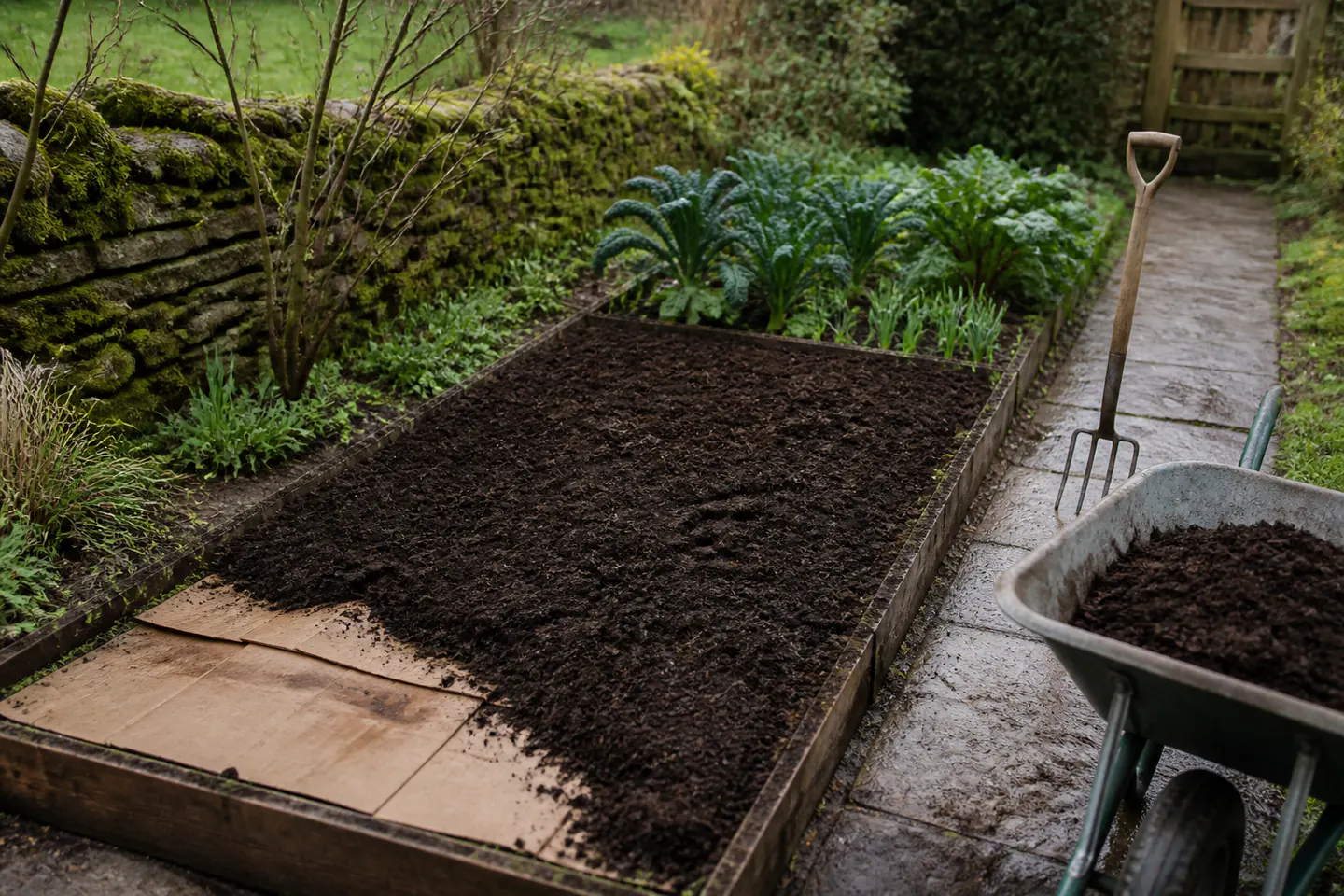
One mulched no-dig bed ready for planting
Feed the surface and disturb the soil only when there is a reason.
No-dig gardening uses surface organic matter and covered paths to reduce routine cultivation. Start with one defined bed, identify the weeds, apply suitable compost and compare the workload honestly.
Quick answer
Trial one bed and calculate compost by volume before ordering
Choose a reachable bed, identify existing weeds and remove woody plants or persistent roots where the method requires it. Mow or cut low, wet plain brown cardboard for initial light exclusion where appropriate, overlap joins and cover immediately with roughly 10–15 cm of clean mature compost for a new bed, following the selected method and weed pressure. Define paths, plant into the compost and keep edges observed.
- 01
No dig is not “do nothing”. Compost sourcing, path care, planting, watering and weed removal remain real work.
- 02
Cardboard is an initial barrier, not a permanent layer. Remove tape, labels and staples and avoid glossy or heavily printed material.
- 03
Deep-rooted perennials, woody regrowth and invasive plants may require targeted removal or longer exclusion before planting.
- 04
Measure length × width × depth and convert to volume; an attractive photo can hide a large compost cost.
What to expect
The result depends on the material and the weeds beneath it
A clean surface can be created quickly, but couch grass, bindweed, horsetail and path edges reveal whether the preparation was sufficient.
Compost
Use mature, plant-safe compost from a traceable source and understand whether it is green waste, manure, homemade or a blend.
Depth
A new weed-suppressing bed generally needs more material than an annual top-dress; calculate before delivery.
Cardboard
Overlap, wet and cover it so wind cannot lift it. It is not suitable over every drainage or habitat situation.
Edges
Light and roots enter at borders. Keep bed edges visible and separate productive beds from unmanaged invasive growth.
Planting
Transplants can go directly into compost; tiny seeds need a fine level surface and consistent moisture.
Comparison
Record compost used, weeds removed, yield and hours. The best method is the one sustainable for the actual site.
Core method
Build the bed as a soil and access system
Map and identify
Mark the bed and paths, check drains, tree roots and services and identify perennial weeds before covering. Remove rubbish and woody crowns. Choose a width reachable from paths so the growing surface is not compacted by feet.
Source and calculate compost
Confirm maturity, ingredients, contamination controls and delivery access with the supplier. Calculate cubic metres from area and planned depth, allow for settling and compare bagged versus bulk cost. Keep fresh manure and unsuitable municipal material away from direct planting.
Cover and mulch
Cut vegetation low. Where the chosen method calls for it, overlap wet plain cardboard beyond every seam, remove synthetic tape and cover immediately with the planned compost depth. Rake the surface level but do not mix it into the soil beneath. Mulch or otherwise manage paths separately.
Plant and observe edges
Set transplants into the compost and water the root zone. Sow small seed into a fine surface. Pull young weeds with minimal disturbance and investigate repeated shoots rather than chopping them indefinitely. Apply a thinner annual compost layer only when crop and soil condition justify it.
Useful products
Two clear method references and one precise planting tool
Charles Dowding’s main No Dig book explains the system, his home-and-garden collaboration broadens practical context and a hori-hori is a later hand tool for planting and targeted root removal—not for routine turning of the bed.
Charles Dowding No Dig
It connects bed establishment with ongoing crop and soil management rather than presenting cardboard as the whole method.
Charles Dowding and Stephanie Hafferty No Dig Organic Home & Garden
It broadens the method beyond a single vegetable-bed recipe and is useful for smaller domestic sites.
Nisaku NJP650 Hori-Hori Weeding and Digging Knife
Its narrow blade can handle several small bed tasks without a large tool set.
First project
Build and monitor one trial bed
A measured trial shows the material cost and weed response before the method is scaled.
- 01
Measure the bed
Record dimensions, access, slope, weeds and current soil condition.
- 02
Calculate material
Convert area and depth into volume and verify the compost source.
- 03
Prepare the surface
Remove rubbish and woody growth and cut other vegetation low.
- 04
Lay and cover
Overlap appropriate cardboard and apply compost evenly before wind dries it.
- 05
Plant without walking on it
Reach from defined paths and keep the surface level.
- 06
Log weeds and hours
Review edges, regrowth, watering and yield through the season.
What can wait
What can wait until the first result
The trial does not need permanent edging, machinery or an annual compost subscription.
- 01
A rotavator
Routine turning conflicts with the method and can spread perennial roots.
- 02
Permanent expensive edging
Test bed dimensions and path access before fixing a layout.
- 03
A bulk delivery without calculation
Too little leaves a weak layer; too much creates storage and contamination problems.
- 04
Fresh manure around crops
Maturity, nutrient strength and food-safety timing need to be understood first.
- 05
Covering unknown hazards
Inspect for waste, drains, invasive plants and services before hiding the surface.
Upgrade path
Upgrade the repeated limitation
Scale by completing one bed at a time and by improving compost supply, paths and watering rather than adding ornamental hardware.
Trial bed
About £40–£180Cardboard if suitable + clean compost
Measure suppression and workload.Annual surface feeding
About £20–£100 per bed1–3 cm mature compost as needed
Maintain fertility and surface condition.Managed paths
About £30–£200Woodchip or suitable cover + clear edges
Reduce mud and weed ingress.Whole-plot system
VariableBulk compost + access + water plan
Scale only after material supply is reliable.Safety & care
Know what is under the mulch and what is in the compost
Hidden waste, invasive weeds, lifting and contaminated organic material are the significant risks.
- Inspect the site for glass, wire, chemicals, drains, services and contaminated soil before covering it.
- Verify compost or manure source, maturity and crop suitability and follow current guidance for edible production.
- Remove tape, plastic and staples from cardboard and avoid glossy or chemically treated sheets.
- Move bulk material in small loads, use appropriate tools and stop for pain, heat or unsafe ground.
- Do not introduce invasive weeds, diseased material or persistent herbicide residues through compost or mulch.
Outside help
When outside help earns its place
A book and one bed are enough to test the method. A demonstration garden is useful when you want to see material depth, path design and established weed control in person.
Use current bed-making, weed and compost demonstrations alongside the book.
Check whether the site resembles your soil, weed pressure and scale.
Representative UK product, club, lesson and venue costs checked 9 August 2026; local prices, access, weather, materials and tutor support vary.
Sources
Where the guidance came from
Established no-dig teaching, RHS soil advice and organic-growing organisations anchor the method; community reports add long-term weed and sourcing experience.
-
01
Charles Dowding · No Dig
Primary method guidance for beds, compost and weeds.
Open source -
02
RHS · No-dig gardening
Independent UK overview of benefits, method and limitations.
Open source -
03
Garden Organic · Soil health
Organic soil and compost context.
Open source -
04
No Dig Organic Gardening Forum
Practitioner questions on beds, weeds and material sourcing.
Open source -
05
Reddit · r/NoDig
Community reports on cardboard, compost, edges and long-term maintenance.
Open source -
06
Amazon UK · Charles Dowding No Dig
Exact product page, model or ISBN, observed price and availability checked for this guide.
Open source -
07
Amazon UK · No Dig Organic Home & Garden
Exact product page, model or ISBN, observed price and availability checked for this guide.
Open source -
08
Amazon UK · Nisaku NJP650 hori-hori
Exact product page, model or ISBN, observed price and availability checked for this guide.
Open source
Guide information and links checked 9 August 2026.