Beginner’s guide · Observe the sky
Draw only what stays visible,
then add the observing conditions.
A small lunar sketch trains attention to light, shadow and changing detail at the eyepiece. Time, instrument, orientation and seeing turn the drawing into an observation.
Quick answer
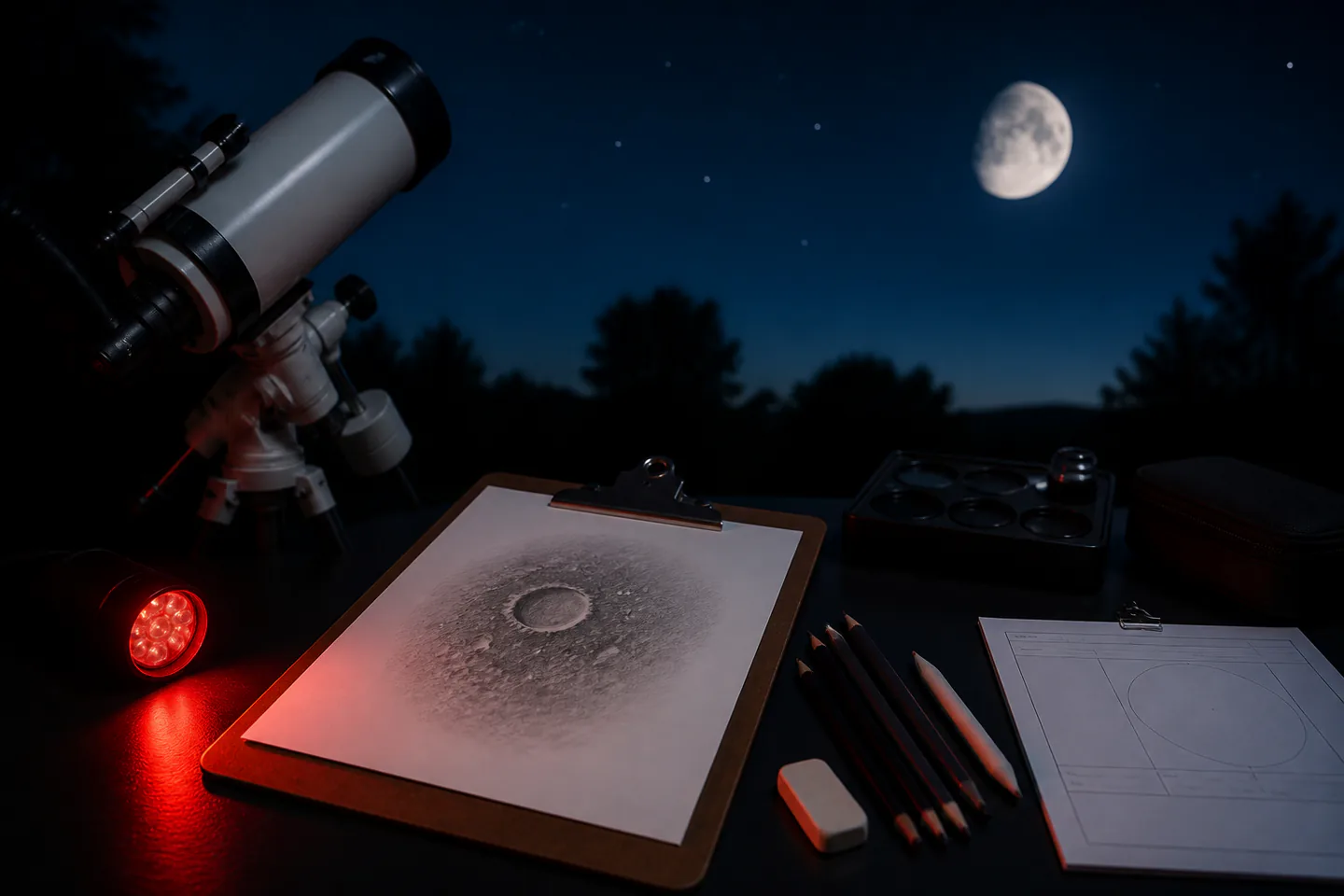
Complete one lunar sketch before expanding the setup
Borrow or use a familiar telescope and choose one small lunar crater near the terminator. Prepare a circle template and record date, time, instrument, magnification, orientation, location and conditions, observe for a minute before drawing, block the brightest and darkest shapes, add only stable detail during a twenty-minute limit and finish the record without inventing texture indoors.
- 01
The sketch records an observation, so date, time, instrument, magnification, orientation and conditions belong with the image. Record what happened during astronomy sketching so the next attempt changes one known variable instead of several guesses.
- 02
A small selected field produces a more accurate first drawing than the whole Moon. Record what happened during astronomy sketching so the next attempt changes one known variable instead of several guesses.
- 03
Planetary rotation and changing seeing mean detail must be checked repeatedly rather than copied from memory. Record what happened during astronomy sketching so the next attempt changes one known variable instead of several guesses.
- 04
Red light should be only bright enough for the page and is not a substitute for safe route lighting. Record what happened during astronomy sketching so the next attempt changes one known variable instead of several guesses.
What to expect
What astronomy sketching is really like at the start
The useful beginner controls are preparation, one bounded task and a record of the result; specialist equipment matters only when it solves a repeated limitation.
Seeing
Atmospheric steadiness reveals detail intermittently even when transparency is good. Record what happened during astronomy sketching so the next attempt changes one known variable instead of several guesses.
Orientation
Telescope designs can invert or mirror the view, so directions must be established for that setup. Record what happened during astronomy sketching so the next attempt changes one known variable instead of several guesses.
Tone
White paper encourages drawing dark marks, while many deep-sky sketches use reversed techniques. Record what happened during astronomy sketching so the next attempt changes one known variable instead of several guesses.
Time
The Moon’s illumination and a planet’s rotation change during a long session. Record what happened during astronomy sketching so the next attempt changes one known variable instead of several guesses.
Core method
The core astronomy sketching method
Prepare the record
Draw the field stop and write equipment, orientation, time and planned target before dark. Record what happened during astronomy sketching so the next attempt changes one known variable instead of several guesses.
Observe before marking
Identify the dominant shape, brightest area, darkest shadow and two anchor points. Record what happened during astronomy sketching so the next attempt changes one known variable instead of several guesses.
Build from large to small
Place proportion and tone first, then add repeatedly visible fine detail. Record what happened during astronomy sketching so the next attempt changes one known variable instead of several guesses.
Close at the eyepiece
Write end time, seeing, transparency and uncertainty before any clean copy. Record what happened during astronomy sketching so the next attempt changes one known variable instead of several guesses.
Useful products
Products with a clear job in the route
The mixed-media sketchbook supports a bound observing record, the red torch provides low task light and the astronomy guide helps choose realistic targets for small telescopes.
Artgecko Artgecko A4 Mixed Media Sketchbook 150 gsm
The page size suits observational drawing and process notes without specialist paper.
Celestron Night Vision Red LED Flashlight 93588
Low red light helps preserve visual adaptation while sketching or checking equipment.
Cambridge University Press Turn Left at Orion, fifth edition
It supports a home-built or borrowed telescope once basic alignment works.
First project
Sketch one lunar crater in twenty minutes
Work near the terminator at modest magnification and prioritise shadow shape over the crater’s name.
- 01
Choose the target before dark
Select one crater or small grouping suited to the phase. Record what happened during astronomy sketching so the next attempt changes one known variable instead of several guesses.
- 02
Record the setup
Write date, times, location, telescope, eyepiece, magnification and orientation. Record what happened during astronomy sketching so the next attempt changes one known variable instead of several guesses.
- 03
Block three values
Place the lit ground, midtone and deepest shadow. Record what happened during astronomy sketching so the next attempt changes one known variable instead of several guesses.
- 04
Add verified detail
Return to the eyepiece between marks and omit features seen only once. Record what happened during astronomy sketching so the next attempt changes one known variable instead of several guesses.
- 05
Finish the observing note
Add seeing, transparency, cloud, interruptions and uncertain marks. Record what happened during astronomy sketching so the next attempt changes one known variable instead of several guesses.
What can wait
What can wait until the first result
Delay anything that adds cost, risk or another variable before the basic workflow has produced something you can review.
- 01
The whole lunar disc
Its scale and detail overwhelm a first timed observation. Record what happened during astronomy sketching so the next attempt changes one known variable instead of several guesses.
- 02
A full pencil set
One medium and one soft pencil can reveal the method. Record what happened during astronomy sketching so the next attempt changes one known variable instead of several guesses.
- 03
Drawing from photographs
That becomes astronomical illustration rather than direct observing practice. Record what happened during astronomy sketching so the next attempt changes one known variable instead of several guesses.
- 04
Solar sketching
Sun observation requires purpose-made safe equipment and expert procedure. Record what happened during astronomy sketching so the next attempt changes one known variable instead of several guesses.
Upgrade path
Add the capability you can now name
Each stage should remove a demonstrated constraint rather than make the setup look more advanced.
Use what you own
£0–£20Existing equipment and one written plan
Use a borrowed telescope, paper and two pencils.Repeat the first route
Owned or borrowed telescope; about £10–£30 materialsA complete repeatable starter setup
Repeat lunar features under different illumination.Add one capability
Often £50–£250One selected tool, service or learning resource
Add planetary blanks, pastel techniques or a driven mount for a specific difficulty.Build specialist depth
Club, course or specialist dependentA documented specialist workflow
Submit systematic observations to a relevant BAA section with its current format.Safety & care
Protect vision and the integrity of the observation
Dark sites, awkward equipment and the Sun create risks beyond ordinary drawing.
- Never point a telescope, finder, binocular or camera at the Sun without a complete purpose-made front-aperture solar system and expert guidance.
- Set up, route cables and check tripod stability in daylight and keep a safe white-light torch for walking and emergencies.
- Use low red light only for the page and avoid dazzling other observers.
- Dress for falling temperature and stop if dew, wind or footing makes equipment unsafe.
- Label any later clean copy or reversed scan so it is not mistaken for the direct eyepiece record.
Outside help
When outside help earns its place
An astronomy society observing evening helps with telescope orientation, target choice, seeing and feedback on what is genuinely visible.
Choose an event that provides supervised telescopes and welcomes visual records rather than requiring imaging equipment.
Use outside help after the first astronomy sketching attempt can reveal the exact technique, access or safety problem that needs live correction.
Representative UK learning and access routes checked 1 September 2026; local prices, permissions, equipment and tutor support vary.
Sources
Where the guidance came from
Authoritative and specialist guidance supports the method and safety boundaries; community discussion contributes recurring beginner problems rather than unsupported claims.
-
01
British Astronomical Association · The art of drawing the Moon
Beginner lunar target, equipment, preparation and drawing guidance.
Open source -
02
British Astronomical Association · Drawing the planets
Planetary observing, tone, rotation and final-record practice.
Open source -
03
British Astronomical Association · Observing and drawing the night sky
Deep-sky techniques, orientation, conditions and record fields.
Open source -
04
British Astronomical Association · Observing guide
Structured visual observation and record guidance.
Open source -
05
Royal Astronomical Society · Getting started in astronomy
UK beginner observing, equipment and club guidance.
Open source -
06
Reddit · r/telescopes
Community evidence on observing, Dobsonian builds, collimation and beginner equipment.
Open source -
07
Amazon UK · Artgecko A4 Mixed Media Sketchbook 150 gsm
Exact Amazon UK product page or ISBN used for this recommendation; current price, seller, specification and availability should be confirmed.
Open source -
08
Amazon UK · Night Vision Red LED Flashlight 93588
Exact Amazon UK product page or ISBN used for this recommendation; current price, seller, specification and availability should be confirmed.
Open source -
09
Amazon UK · Turn Left at Orion, fifth edition
Exact Amazon UK product page or ISBN used for this recommendation; current price, seller, specification and availability should be confirmed.
Open source
Guide information and links checked 1 September 2026.