Beginner’s guide · Make & create
Paint opaque,
but keep the water deliberate.
Begin with a small professional primary set, watercolour paper and two brushes. Flat shapes and a five-value colour study teach gouache better than a large jelly-cup palette.
Quick answer
Paint one simple object with five mixed value steps
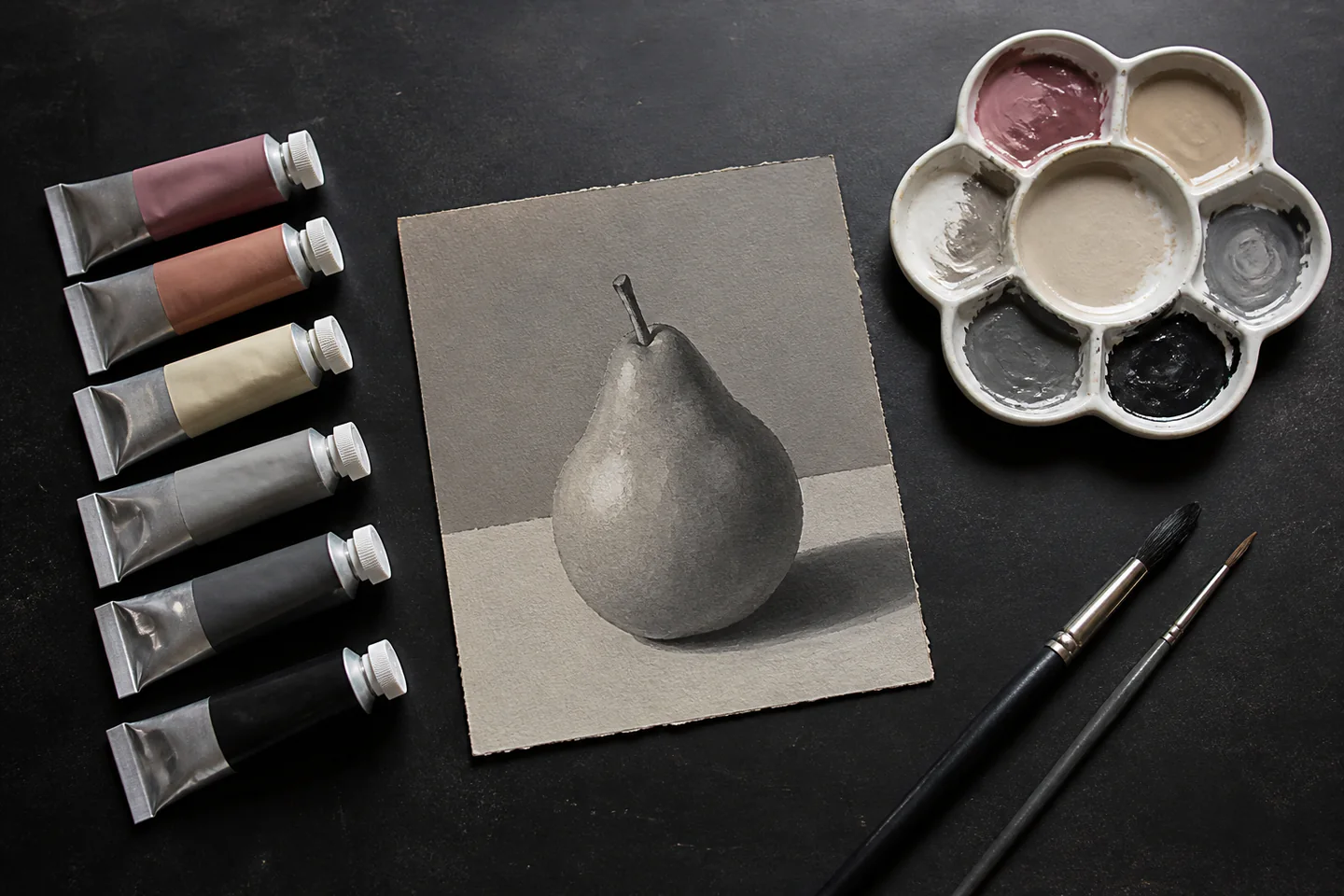
Tape a small sheet of cold-pressed watercolour paper to a board and draw one pear, mug or bottle as three large shapes. Mix five value piles before painting: highlight, light, middle, shadow and darkest accent. Lay the broad middle shapes with creamy paint that flows from the brush but does not behave like coloured water. Let each layer lose its shine before placing a more opaque correction. Reserve tiny detail until the silhouette and value pattern read from across the room.
- 01
Traditional gouache is an opaque water-based paint that can usually be reactivated. It behaves differently from acrylic gouache, which dries water-resistant.
- 02
Too little water drags and lifts the surface; too much behaves like a weak wash. Learn a creamy middle consistency first.
- 03
Gouache often dries lighter in dark mixtures and darker in light mixtures. Make a small dried swatch before relying on a colour.
- 04
A compact professional primary set mixes cleaner, more predictable colour than a huge low-grade set with many chalky or poorly documented pigments.
- 05
Do not pour pigment-rich water into garden soil. Let solids settle, wipe residue and follow local disposal and maker guidance.
What to expect
Gouache is editable, but every correction can wake the layer below
Its matte opacity makes bold shape design possible, while reactivation means a wet brush can muddy a colour that appeared finished.
Consistency
A loaded brush should make an even stroke without cracking, flooding or repeatedly scrubbing the paper.
Dry shift
Judge important mixtures after a test dries, especially near-white highlights and deep darks.
Layering
Use fewer confident strokes over a dry layer. Repeated wet brushing mixes old and new paint on the surface.
Mixing
Prepare enough of a flat colour before filling the shape; remaking it halfway often creates visible patches.
Edges
Paint adjacent wet shapes for soft boundaries and wait between layers for crisp ones.
Scanning
The matte finish photographs well, but uneven lighting and automatic phone processing can still distort colour.
Core method
Mix the value structure before polishing the colour
Choose a compact matched setup
Use a recognised primary or introductory gouache set, synthetic watercolour brushes and a sturdy watercolour sheet. A ceramic plate or stay-wet palette can hold small mixtures. Keep two water containers if space allows: one for the first rinse and one for cleaner colour.
Make consistency and dry-shift swatches
Mix one colour at tea, milk and cream-like consistencies and paint labelled bars. Beside them, make five values from the planned dominant colour and let everything dry fully. The exercise reveals how the exact paint, paper and room behave without risking the finished study.
Block large shapes once
Draw lightly and mix enough paint for the background, object light and object shadow. Use the largest brush that fits the form, place each stroke and leave it. Work around a dry edge for crisp graphic separation or meet it while damp only when a soft transition is planned.
Correct with isolated opaque marks
When the block-in is dry, compare the five values and remix only what is missing. Use a slightly drier creamy layer for the darkest accent, reflected light and highlight. Avoid covering every area twice. Photograph the dry result in neutral light and note which mixtures shifted most.
Useful products
Products with a clear job in the setup
The Winsor & Newton Designers Gouache primary set supplies six concentrated colours rather than dozens of weak options. The Aquafine pad is a stable cold-pressed practice surface and the Winsor & Newton brush pack provides varied synthetic shapes. This is a complete compact route, although existing watercolour brushes and paper can reduce the spend.
Winsor & Newton Designers Gouache Primary Colour Paint Set, 6 × 14 ml
Six documented colours teach mixing and can be replaced individually rather than discarding a giant set.
Daler-Rowney Aquafine Cold-Pressed Watercolour Pad A4, 300 gsm
A4 sheets can be divided into several studies and the 300 gsm weight limits buckling compared with sketch paper.
Winsor & Newton Foundation Water Colour Short Handle Brushes, Six Pack
Synthetic filaments tolerate water-based paint and the shapes support both flat areas and details.
First project
Paint a five-value pear on a coloured ground
The rounded form shows matte layering, dry shift and edge control with very little drawing.
- 01
Make three consistency bars
Test watery, fluid and creamy paint and let them dry.
- 02
Mix five values
Prepare enough colour for highlight through deepest shadow before painting.
- 03
Lay the background
Use a broad brush and stop before repeated strokes lift the surface.
- 04
Block light and shadow
Keep the pear as two large shapes and let them dry.
- 05
Add three accents
Place contact shadow, reflected light and highlight with controlled opacity.
- 06
Review dry
Compare the finished values with the wet mixtures and label the lesson.
What can wait
What can wait until the first result
A larger palette creates more choices without teaching water control, dry shift or clean mixing.
- 01
A 50-colour jelly-cup set
Large open cups can dry, become contaminated and hide whether the pigments mix predictably.
- 02
Tiny detail brushes
Broad confident shapes are the foundation; a medium round can make surprisingly fine marks.
- 03
Canvas panels
Gouache is naturally suited to absorbent paper; flexible or sealed supports need testing.
- 04
Thick impasto
Traditional gouache can crack when applied heavily. Use layers within manufacturer guidance.
- 05
A spray varnish
Coatings can change matte colour and reactivation; frame behind glazing or test a separate sample first.
Upgrade path
Upgrade the repeated limitation
Add individual colours, smoother paper or scan control only when finished studies reveal a repeated need.
Primary study set
About £45–£85Six paints + paper + brushes
Learn consistency, values and dry shift.Personal palette
About £8–£60Selected single tubes and ceramic palette
Mix faster without duplicating unused hues.Illustration surfaces
About £25–£120Hot-pressed paper, board and masking tools
Gain cleaner graphic edges.Reproduction workflow
About £250–£1,200+Controlled lights, camera/scanner and calibrated display
Digitise matte work consistently.Safety & care
Keep pigments controlled and the water out of food areas
Water-based does not mean edible or suitable for skin. Read every pigment label and keep painting utensils permanently separate from kitchen equipment.
- Read paint labels and safety data, avoid ingestion and skin painting and choose safer pigment alternatives where children, pregnancy or other exposure concerns apply.
- Keep brushes, palettes and water jars away from food preparation, wash hands after painting and never point brushes with the mouth.
- Let pigment solids settle, wipe residue and follow local and manufacturer disposal guidance instead of pouring concentrated paint into soil or surface drains.
- Use masking fluids, sprays or fixatives only with their stated ventilation and PPE and never assume they are needed for ordinary gouache.
- Dry and store work flat, clean spills before they spread and supervise children according to product age guidance.
Outside help
When outside help earns its place
Manufacturer demonstrations and the five-value exercise are enough to begin. A workshop becomes useful when a tutor can diagnose consistency and colour mixing on the learner’s own dry painting.
Look for traditional gouache consistency, layering and colour-mixing demonstrations.
Ask whether professional paint, paper and individual critique are included.
Representative UK learning options checked 17 August 2026; local prices, access, materials and tutor support vary.
Sources
Where the guidance came from
Paint and paper makers define material behaviour and safety; specialist art educators and practising communities add mixing, dry-shift and surface evidence.
-
01
Winsor & Newton · Designers Gouache
Manufacturer range, opacity, pigment and handling information.
Open source -
02
Daler-Rowney · Aquafine paper
Paper weight, surface and media suitability.
Open source -
03
Jackson’s Art · Gouache painting guide
Independent specialist explanation of paint types and technique.
Open source -
04
Handprint · Gouache
Detailed independent pigment, opacity and handling context.
Open source -
05
Reddit · r/Gouache
Community experience with sets, consistency, dry shift and surfaces.
Open source -
06
Amazon UK · Designers Gouache Primary Colour Paint Set, 6 × 14 ml
Exact product catalogue page or ISBN used for the recommendation; current price, seller and availability should be confirmed.
Open source -
07
Amazon UK · Aquafine Cold-Pressed Watercolour Pad A4, 300 gsm
Exact product catalogue page or ISBN used for the recommendation; current price, seller and availability should be confirmed.
Open source -
08
Amazon UK · Foundation Water Colour Short Handle Brushes, Six Pack
Exact product catalogue page or ISBN used for the recommendation; current price, seller and availability should be confirmed.
Open source
Guide information and links checked 17 August 2026.