Beginner’s guide · Make & create
Spray one smooth test card
before painting the model.
Airbrushing begins with compatible paint, controlled pressure, a ventilated spray area and a cleaning routine that happens before paint dries.
Quick answer
Build one small, controlled result first
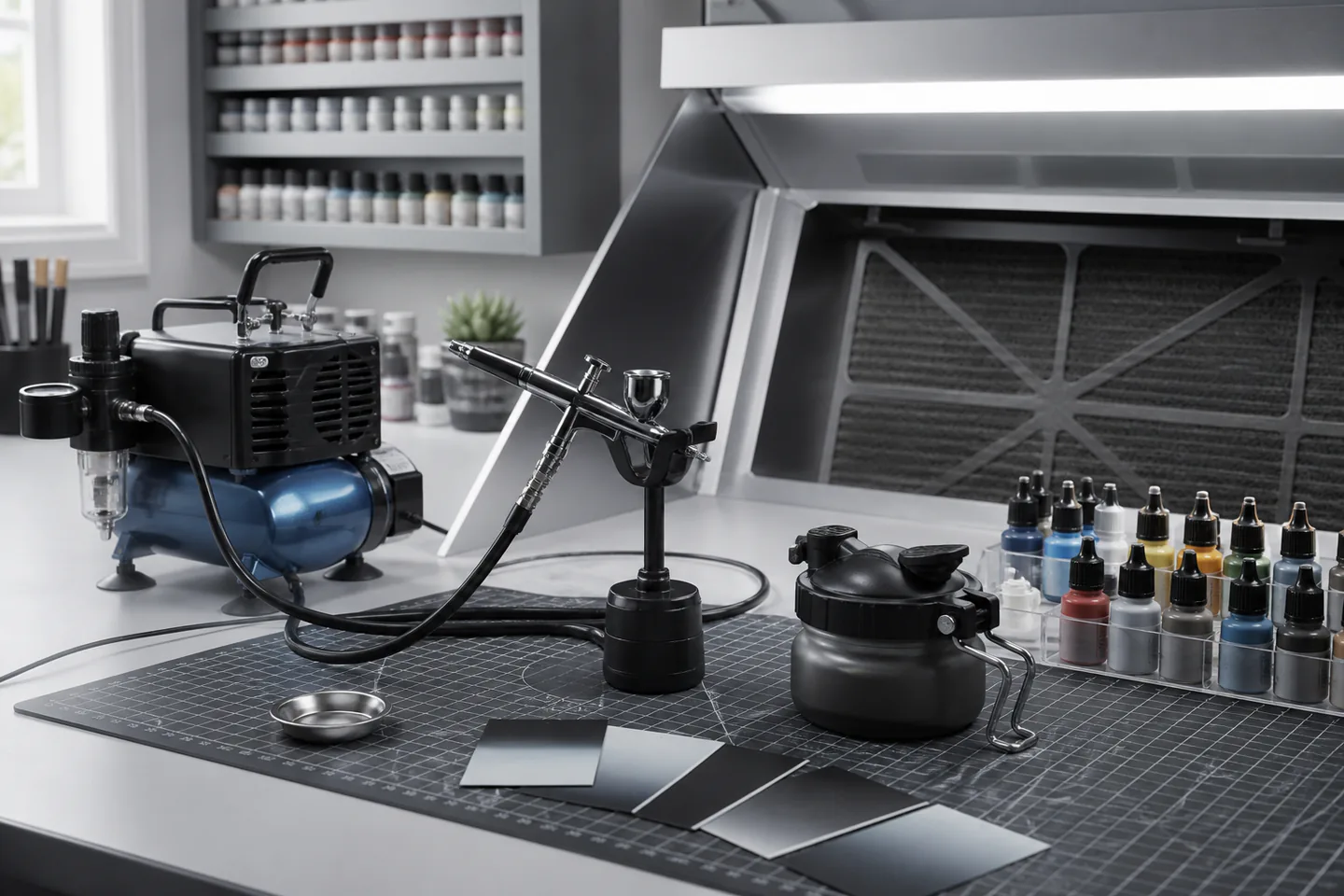
Use a documented airbrush-and-compressor combination, the paint maker’s recommended thinner and a proper spray-capture setup. Practise dots, lines and a smooth gradient on card before approaching a model.
- 01
Read the airbrush, compressor, paint, thinner and extraction instructions together; protect the bench and prepare cleaning materials before opening paint. Keep the first attempt narrow enough that preparation, the main action and the result can all be reviewed together.
- 02
Hold paint mix, pressure and distance steady while learning one trigger movement; make any change on a labelled test card. Keep the first attempt narrow enough that preparation, the main action and the result can all be reviewed together.
- 03
Inspect speckling, spidering, dry grain, overspray and delayed paint flow, then change only the variable most likely to cause that mark. Keep the first attempt narrow enough that preparation, the main action and the result can all be reviewed together.
- 04
Flush promptly with compatible cleaner, wipe the needle carefully and follow the maker’s limited strip-down process rather than repeatedly dismantling the nozzle. Keep the first attempt narrow enough that preparation, the main action and the result can all be reviewed together.
What to expect
Accuracy comes from the sequence, not the size of the toolkit
Preparation, one controlled variable and an honest inspection matter more than collecting specialist equipment.
The first attempt
Water on card can teach trigger and air control; properly thinned water-based paint on test card then reveals atomisation and coverage. For airbrushing, note what actually happened rather than relying on memory; that turns the next attempt into a controlled change instead of another guess.
The control point
Hold paint mix, pressure and distance steady while learning one trigger movement; make any change on a labelled test card. For airbrushing, note what actually happened rather than relying on memory; that turns the next attempt into a controlled change instead of another guess.
The useful signal
Inspect speckling, spidering, dry grain, overspray and delayed paint flow, then change only the variable most likely to cause that mark. For airbrushing, note what actually happened rather than relying on memory; that turns the next attempt into a controlled change instead of another guess.
The common trap
Buying a powerful compressor or fine nozzle does not correct incompatible paint, poor ventilation, damaged seals or delayed cleaning. For airbrushing, note what actually happened rather than relying on memory; that turns the next attempt into a controlled change instead of another guess.
Core method
Prepare, make, inspect and reset
Prepare deliberately
Read the airbrush, compressor, paint, thinner and extraction instructions together; protect the bench and prepare cleaning materials before opening paint. For airbrushing, note what actually happened rather than relying on memory; that turns the next attempt into a controlled change instead of another guess.
Control the central variable
Hold paint mix, pressure and distance steady while learning one trigger movement; make any change on a labelled test card. For airbrushing, note what actually happened rather than relying on memory; that turns the next attempt into a controlled change instead of another guess.
Read the result
Inspect speckling, spidering, dry grain, overspray and delayed paint flow, then change only the variable most likely to cause that mark. For airbrushing, note what actually happened rather than relying on memory; that turns the next attempt into a controlled change instead of another guess.
Reset before repeating
Flush promptly with compatible cleaner, wipe the needle carefully and follow the maker’s limited strip-down process rather than repeatedly dismantling the nozzle. For airbrushing, note what actually happened rather than relying on memory; that turns the next attempt into a controlled change instead of another guess.
Useful products
Products with a clear job in the setup
Choose an airbrush, compressor and extraction route as a compatible system from a supported manufacturer. Basic model tools, a protected mat and task-appropriate eye protection remain useful around the paint bench.
LIHAO 10-Piece Basic Model Building Tool Set
It covers the repetitive hand work shared by models and miniatures.
Fiskars A3 Self-Healing Cutting Mat
The larger area keeps patterns and thin materials flat.
3M SecureFit 200 Safety Glasses
Comfortable glasses are easier to keep on for every cut and cleanup.
First project
Make a labelled control sheet
Practise air-only movement, dots, parallel lines, a dagger stroke and a gradient, recording paint, thinner, pressure and distance.
- 01
Set up
Read the airbrush, compressor, paint, thinner and extraction instructions together; protect the bench and prepare cleaning materials before opening paint. For airbrushing, note what actually happened rather than relying on memory; that turns the next attempt into a controlled change instead of another guess.
- 02
Begin the first attempt
Water on card can teach trigger and air control; properly thinned water-based paint on test card then reveals atomisation and coverage. For airbrushing, note what actually happened rather than relying on memory; that turns the next attempt into a controlled change instead of another guess.
- 03
Hold one variable steady
Hold paint mix, pressure and distance steady while learning one trigger movement; make any change on a labelled test card. For airbrushing, note what actually happened rather than relying on memory; that turns the next attempt into a controlled change instead of another guess.
- 04
Inspect the result
Inspect speckling, spidering, dry grain, overspray and delayed paint flow, then change only the variable most likely to cause that mark. For airbrushing, note what actually happened rather than relying on memory; that turns the next attempt into a controlled change instead of another guess.
- 05
Reset and record
Flush promptly with compatible cleaner, wipe the needle carefully and follow the maker’s limited strip-down process rather than repeatedly dismantling the nozzle. For airbrushing, note what actually happened rather than relying on memory; that turns the next attempt into a controlled change instead of another guess.
What can wait
What can wait until the first result
Delay equipment that solves no repeated problem in the first small project.
- 01
A large first setup
Scale multiplies Buying a powerful compressor or fine nozzle does not correct incompatible paint, poor ventilation, damaged seals or delayed cleaning. before the basic routine is known. For airbrushing, note what actually happened rather than relying on memory; that turns the next attempt into a controlled change instead of another guess.
- 02
Premium specialist equipment
It should solve a limitation you can describe after several airbrushing sessions. For airbrushing, note what actually happened rather than relying on memory; that turns the next attempt into a controlled change instead of another guess.
- 03
Several methods at once
Changing materials and technique together makes the cause of a result hard to see. For airbrushing, note what actually happened rather than relying on memory; that turns the next attempt into a controlled change instead of another guess.
- 04
Buying for a future version
Finish and review the small route before equipping an imagined advanced practice. For airbrushing, note what actually happened rather than relying on memory; that turns the next attempt into a controlled change instead of another guess.
Upgrade path
Upgrade the repeated limitation
Add capacity only after the basic process is repeatable.
Try it
About £90–£220 for a usable setupSupported airbrush, compressor and test card
Complete one meaningful result and learn the whole sequence.Repeat it
About £90–£220 for a usable setupSpray capture, cleaning pot and known paint system
Reduce setup friction and compare several attempts.Improve the bottleneck
£100–£400Nozzle or compressor change for a proven job
Address Buying a powerful compressor or fine nozzle does not correct incompatible paint, poor ventilation, damaged seals or delayed cleaning. with a targeted change.Go deeper
VariableDedicated booth and repeatable finishing workflow
Add scale, precision or public participation with evidence from practice.Safety & care
Control airborne paint before improving finish
Ventilation, product safety data and suitable respiratory protection take priority over a cleaner model surface.
- Do not spray solvent, two-part, automotive or unknown coatings in a casual indoor setup. Follow current manufacturer, food-safety, access, wildlife or local guidance wherever it applies.
- Use capture ventilation and respiratory protection selected from the paint safety data, not smell alone. Follow current manufacturer, food-safety, access, wildlife or local guidance wherever it applies.
- Keep compressor intakes, hoses and electrical parts clean, dry and unobstructed. Follow current manufacturer, food-safety, access, wildlife or local guidance wherever it applies.
- Never point an airbrush at skin or eyes and relieve pressure before disassembly. Follow current manufacturer, food-safety, access, wildlife or local guidance wherever it applies.
- Store paints and cleaners sealed, labelled and away from flames, food, children and pets. Follow current manufacturer, food-safety, access, wildlife or local guidance wherever it applies.
Outside help
When outside help earns its place
A model club or airbrush workshop is valuable when it provides a functioning booth and live diagnosis of paint consistency and trigger control.
Use one complete lesson that covers preparation, the central technique, common mistakes and finishing. For a first airbrushing attempt, one coherent method is easier to diagnose than fragments collected from several creators.
Outside help earns its place when safe setup, access, identification or live correction removes a real obstacle. Ask what equipment, materials, access and follow-up support are included before booking.
Representative UK learning options checked 31 August 2026; local prices, access, materials and tutor support vary.
Sources
Where the guidance came from
The method is grounded in specialist, manufacturer and public guidance, then checked against recurring beginner problems and the exact products linked here.
-
01
Iwata · Getting started
Manufacturer beginner airbrush and compressor guidance.
Open source -
02
Iwata · Airbrush cleaning
Manufacturer cleaning sequence and cautions.
Open source -
03
Health and Safety Executive · Spraying
UK spray-paint respiratory-risk context.
Open source -
04
Vallejo · Safety
Water-based model-paint safety information.
Open source -
05
Reddit · r/airbrush
Recurring community evidence on compressors, thinning, clogs and cleaning.
Open source -
06
Amazon UK · 10-Piece Basic Model Building Tool Set
Exact Amazon UK product page or ISBN used for the recommendation; current price, seller, specification and availability should be confirmed.
Open source -
07
Amazon UK · A3 Self-Healing Cutting Mat
Exact Amazon UK product page or ISBN used for the recommendation; current price, seller, specification and availability should be confirmed.
Open source -
08
Amazon UK · SecureFit 200 Safety Glasses
Exact Amazon UK product page or ISBN used for the recommendation; current price, seller, specification and availability should be confirmed.
Open source
Guide information and links checked 31 August 2026.