Beginner’s guide · Photograph & film
Lock the frame
and let time change one subject.
Long-exposure photography uses stable support, deliberate shutter time and highlight control to render movement without sacrificing a readable scene.
Quick answer
Control light and position before buying another lens
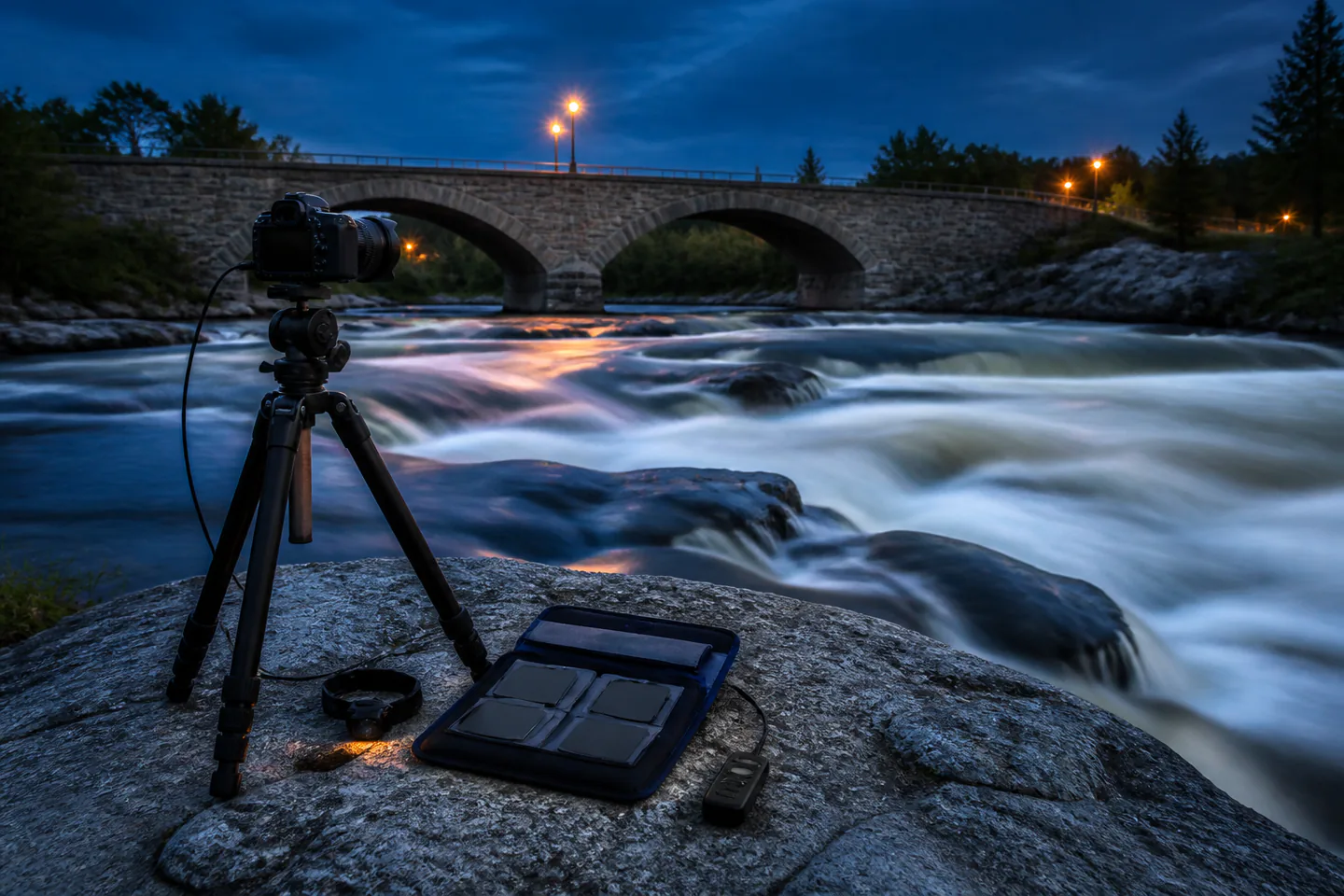
Begin at blue hour with a static scene and moving water or traffic. Mount the camera or phone securely, use a timer, focus before the light falls and lengthen exposure in measured steps while protecting important highlights.
- 01
Scout access and footing in daylight, clean the lens, secure the support and decide which moving element should change while the frame remains static. Keep the first attempt narrow enough that preparation, the main action and the result can all be reviewed together.
- 02
Hold composition, focus and aperture steady while varying only shutter time or the phone’s supported long-exposure control. Keep the first attempt narrow enough that preparation, the main action and the result can all be reviewed together.
- 03
Inspect full-size sharp edges, clipped lights, vibration, unwanted moving objects and whether motion strengthens the subject rather than erasing it. Keep the first attempt narrow enough that preparation, the main action and the result can all be reviewed together.
- 04
Remove filters, dry damp equipment, restore normal camera settings and record exposure, support, weather and the preferred amount of motion. Keep the first attempt narrow enough that preparation, the main action and the result can all be reviewed together.
What to expect
A repeatable setup teaches more than a lucky frame
The useful result comes from controlled light, stable framing and reviewing failures at full size.
The first attempt
Blue hour supplies enough ambient light for several-second experiments without immediately requiring a strong neutral-density filter. For long-exposure photography, note what actually happened rather than relying on memory; that turns the next attempt into a controlled change instead of another guess.
The control point
Hold composition, focus and aperture steady while varying only shutter time or the phone’s supported long-exposure control. For long-exposure photography, note what actually happened rather than relying on memory; that turns the next attempt into a controlled change instead of another guess.
The useful signal
Inspect full-size sharp edges, clipped lights, vibration, unwanted moving objects and whether motion strengthens the subject rather than erasing it. For long-exposure photography, note what actually happened rather than relying on memory; that turns the next attempt into a controlled change instead of another guess.
The common trap
Very dark filters complicate focus, colour and calculation before stability and composition are under control. For long-exposure photography, note what actually happened rather than relying on memory; that turns the next attempt into a controlled change instead of another guess.
Core method
Plan the light, stabilise the camera and compare frames
Prepare deliberately
Scout access and footing in daylight, clean the lens, secure the support and decide which moving element should change while the frame remains static. For long-exposure photography, note what actually happened rather than relying on memory; that turns the next attempt into a controlled change instead of another guess.
Control the central variable
Hold composition, focus and aperture steady while varying only shutter time or the phone’s supported long-exposure control. For long-exposure photography, note what actually happened rather than relying on memory; that turns the next attempt into a controlled change instead of another guess.
Read the result
Inspect full-size sharp edges, clipped lights, vibration, unwanted moving objects and whether motion strengthens the subject rather than erasing it. For long-exposure photography, note what actually happened rather than relying on memory; that turns the next attempt into a controlled change instead of another guess.
Reset before repeating
Remove filters, dry damp equipment, restore normal camera settings and record exposure, support, weather and the preferred amount of motion. For long-exposure photography, note what actually happened rather than relying on memory; that turns the next attempt into a controlled change instead of another guess.
Useful products
Products with a clear job in the setup
A stable tripod and compatible release solve camera movement; a head torch supports setup but must stay away from traffic, homes, wildlife and the exposure.
K&F Concept 64-Inch Travel Camera Tripod
It addresses vibration before any optical filter is added.
Pixel TW-283 Wireless Timer Shutter Release
It supports repeat timing and bulb exposures when the exact cable matches.
BORUIT Red and White LED Head Torch
It improves footing without relying on a phone torch.
First project
Make a six-frame blue-hour sequence
Keep one composition and compare how changing shutter time alters only the moving element.
- 01
Set up
Scout access and footing in daylight, clean the lens, secure the support and decide which moving element should change while the frame remains static. For long-exposure photography, note what actually happened rather than relying on memory; that turns the next attempt into a controlled change instead of another guess.
- 02
Begin the first attempt
Blue hour supplies enough ambient light for several-second experiments without immediately requiring a strong neutral-density filter. For long-exposure photography, note what actually happened rather than relying on memory; that turns the next attempt into a controlled change instead of another guess.
- 03
Hold one variable steady
Hold composition, focus and aperture steady while varying only shutter time or the phone’s supported long-exposure control. For long-exposure photography, note what actually happened rather than relying on memory; that turns the next attempt into a controlled change instead of another guess.
- 04
Inspect the result
Inspect full-size sharp edges, clipped lights, vibration, unwanted moving objects and whether motion strengthens the subject rather than erasing it. For long-exposure photography, note what actually happened rather than relying on memory; that turns the next attempt into a controlled change instead of another guess.
- 05
Reset and record
Remove filters, dry damp equipment, restore normal camera settings and record exposure, support, weather and the preferred amount of motion. For long-exposure photography, note what actually happened rather than relying on memory; that turns the next attempt into a controlled change instead of another guess.
What can wait
What can wait until the first result
Delay specialist optics until framing, light or working distance is the proven limitation.
- 01
A large first setup
Scale multiplies Very dark filters complicate focus, colour and calculation before stability and composition are under control. before the basic routine is known. For long-exposure photography, note what actually happened rather than relying on memory; that turns the next attempt into a controlled change instead of another guess.
- 02
Premium specialist equipment
It should solve a limitation you can describe after several long-exposure photography sessions. For long-exposure photography, note what actually happened rather than relying on memory; that turns the next attempt into a controlled change instead of another guess.
- 03
Several methods at once
Changing materials and technique together makes the cause of a result hard to see. For long-exposure photography, note what actually happened rather than relying on memory; that turns the next attempt into a controlled change instead of another guess.
- 04
Buying for a future version
Finish and review the small route before equipping an imagined advanced practice. For long-exposure photography, note what actually happened rather than relying on memory; that turns the next attempt into a controlled change instead of another guess.
Upgrade path
Upgrade the repeated limitation
Upgrade the constraint visible in repeated photographs.
Try it
Free with support; about £40–£150 for gearExisting device, timer and firm support
Complete one meaningful result and learn the whole sequence.Repeat it
Free with support; about £40–£150 for gearReliable tripod and remote release
Reduce setup friction and compare several attempts.Improve the bottleneck
£100–£400One high-quality filter matched to a known need
Address Very dark filters complicate focus, colour and calculation before stability and composition are under control. with a targeted change.Go deeper
VariableTide, traffic, weather and advanced interval planning
Add scale, precision or public participation with evidence from practice.Safety & care
Choose the safe viewpoint before the dramatic exposure
Attention narrows behind a camera, while darkness, roads, water and tripods create hazards.
- Scout access, edges and footing in daylight and obey closures and private-property rules. Follow current manufacturer, food-safety, access, wildlife or local guidance wherever it applies.
- Never stand in a road, railway environment, unstable water edge or unsafe height for a composition. Follow current manufacturer, food-safety, access, wildlife or local guidance wherever it applies.
- Keep tripod legs and bags visible and out of public routes. Follow current manufacturer, food-safety, access, wildlife or local guidance wherever it applies.
- Avoid shining lights at drivers, homes, wildlife or other photographers. Follow current manufacturer, food-safety, access, wildlife or local guidance wherever it applies.
- Dry equipment, manage condensation and store batteries according to manufacturer guidance. Follow current manufacturer, food-safety, access, wildlife or local guidance wherever it applies.
Outside help
When outside help earns its place
A guided photo walk can help with safe locations and exposure review, but a familiar blue-hour viewpoint is enough for the first sequence.
Use one complete lesson that covers preparation, the central technique, common mistakes and finishing. For a first long-exposure photography attempt, one coherent method is easier to diagnose than fragments collected from several creators.
Outside help earns its place when safe setup, access, identification or live correction removes a real obstacle. Ask what equipment, materials, access and follow-up support are included before booking.
Representative UK learning options checked 31 August 2026; local prices, access, materials and tutor support vary.
Sources
Where the guidance came from
The method is grounded in specialist, manufacturer and public guidance, then checked against recurring beginner problems and the exact products linked here.
-
01
Nikon · Long-exposure photography
Manufacturer shutter, support and scene guidance.
Open source -
02
Canon · Long exposure
Manufacturer long-exposure methods.
Open source -
03
Royal Photographic Society · Landscape
UK field-photography practice and learning.
Open source -
04
Metropolitan Police · Photography advice
UK public-photography context.
Open source -
05
Reddit · r/longexposure
Community evidence on tripods, filters, scenes and common failures.
Open source -
06
Amazon UK · 64-Inch Travel Camera Tripod
Exact Amazon UK product page or ISBN used for the recommendation; current price, seller, specification and availability should be confirmed.
Open source -
07
Amazon UK · TW-283 Wireless Timer Shutter Release
Exact Amazon UK product page or ISBN used for the recommendation; current price, seller, specification and availability should be confirmed.
Open source -
08
Amazon UK · Red and White LED Head Torch
Exact Amazon UK product page or ISBN used for the recommendation; current price, seller, specification and availability should be confirmed.
Open source
Guide information and links checked 31 August 2026.