Beginner’s guide · Make & create
Make something
with your hands.
Start with real clay, a small hand-building kit and a plan for firing. You can learn the useful fundamentals at home without buying a wheel or installing a kiln.
Quick answer
The quickest useful answer
Buy one bag of stoneware clay, a short tool set, two boards and a clean-up bucket. Hand-build a small pot at home, dry it slowly, then pay a local studio to fire it.
- 01
Hand-building teaches the same clay control a wheel depends on.
- 02
A kiln is a service you can buy; it is not starter equipment.
- 03
Keep clay wet during clean-up so fine dust does not become airborne.
What to expect
What the process really involves
Shaping is only the first part. Finished ceramics must dry completely and usually go through two firings, so the object you make today will not be ready tomorrow.
Shape
Pinch, coil or slab-build a small form.
Dry
Cover loosely and turn it over several days.
Bisque
A studio fires the bone-dry clay once.
Glaze
Use a glaze compatible with the clay and studio.
Final fire
The second firing makes the finish durable.
Starter kit
A starter kit without the filler
Three bought items cover a useful first setup. Use ordinary clean-up supplies from home; specialist ribs, a wheel and glaze can wait until you know what limitation you are solving.
Industrial Plasters Ltd School Clay Buff Stoneware Clay, 12.5 kg
Real kiln-fired buff stoneware with enough material for several small hand-built projects.
Kemper Pottery Tool Kit, 8-piece
It covers the small group of tool jobs that beginners repeatedly use.
9 mm Hardwood Plywood Board, 600 × 600 mm
It protects a table and lets you move soft work without handling it.
What to consider later
What can wait
These are real future upgrades, not forbidden purchases. Looking ahead is useful; buying before you understand the limitation usually is not.
- 01
A pottery wheel
A budget VEVOR-style wheel can provide cheap practice with small forms, but owner reports repeatedly mention awkward height, inconsistent low-speed control, limited torque and uncertain spare parts. A supported wheel such as a Shimpo RK-55 is a much more durable long-term step, at a very different price.
- 02
A home kiln
A kiln adds electrical requirements, ventilation, loading, firing schedules, maintenance and fire safety. Pay a studio to fire first; consider ownership only when repeated access is the real bottleneck.
- 03
Specialist tools
The basic Kemper set already covers the repeated jobs. A softer Mudtools rib or a favourite trimming tool becomes worthwhile when you can describe what the basic version is failing to do.
- 04
Your own glaze collection
Choose the firing service first. The clay body, glaze and firing cone must agree, and some studios accept only their own materials. Stable commercial glazes are easier later, but no random Amazon jar is a safe universal recommendation.
First project
Make a small pinch-pot cup
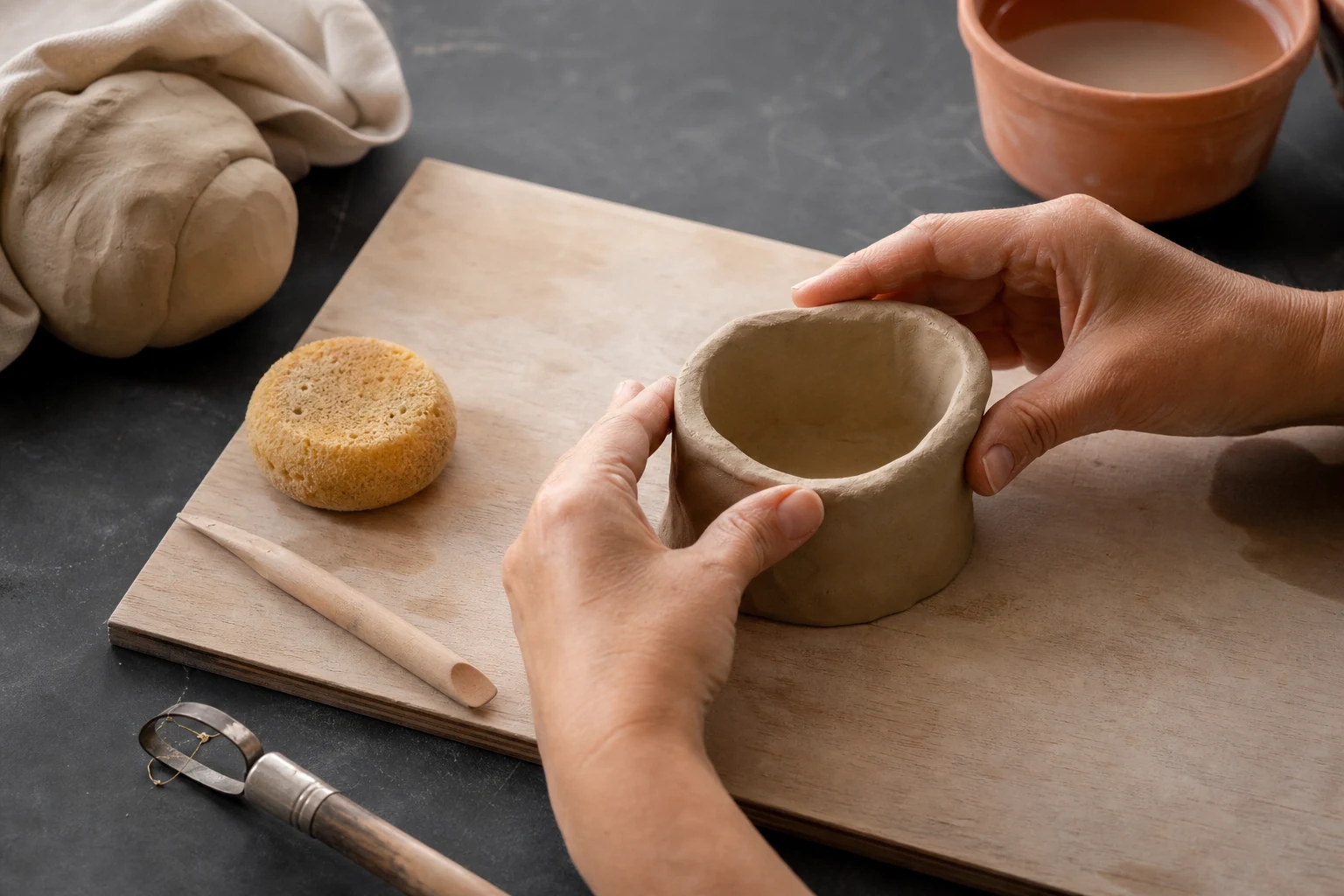
A small open form teaches even walls, compression, joining and slow drying without needing a wheel.
- 01
Form
Roll a ball, press one thumb into it and pinch around the wall.
- 02
Compress
Smooth and firm the base so it is not thicker than the walls.
- 03
Refine
Use a rib or damp finger; avoid adding lots of water.
- 04
Dry
Cover loosely, turn after it firms up, and let it become bone dry.
Upgrade path
What better equipment changes
Buy capability only when the limitation is clear.
Try it
£35–£70Hand-building kit at home
Learn how real clay behaves and complete a first form.Make regularly
£15–£45/monthHome tools + pay-as-you-fire studio
Finish useful work without owning a kiln.Practise throwing
Budget to £1,200+Budget practice wheel or supported studio wheel
A cheap wheel buys practice time; a supported wheel adds smooth control, capacity, parts and longevity.Full studio
£2,000+Wheel, kiln, ventilation and suitable power
Complete process control with serious space and safety demands.Safety
Keep the mess wet
The practical beginner rule is simple: avoid airborne clay dust and keep clay out of household drains.
- Wipe tables and floors damp; do not dry sweep.
- Do not sand dry clay indoors.
- Let waste clay settle in a bucket instead of washing it down the sink.
- Use only studio-approved clay and glazes for firing.
- Do not claim a piece is food-safe unless the materials and firing are appropriate.
Classes & studios
When outside help becomes useful
You can learn hand-building at home. A studio becomes useful for firing, wheel access, glaze compatibility and quick feedback on faults.
Best when you want to make at home and outsource only the kiln.
Useful for trying a full-size wheel before buying one.
Worth considering if repeated feedback matters more than starting immediately.
Representative UK course prices checked 23 July 2026; local studios vary.
Sources
See what shaped the advice.
Check every source.
Specialist specifications, safety guidance, exact retailer pages and recurring practitioner experience were checked for this revision.
-
01
HSE · Pottery COSHH guidance
Silica control and keeping pottery materials wet or damp to prevent dust
Open source -
02
Ceramic Arts Network · Studio safety
Wet cleaning rather than sweeping and control of dust-generating work
Open source -
03
r/Pottery · VEVOR owner experience
Mixed long-term reports covering price, control, height, splash pans and parts support
Open source -
04
r/Pottery · cheap Amazon wheels
Recurring experience that budget wheels can handle small work but vary in torque, speed and build
Open source -
05
VEVOR UK · 11-inch 350W wheel
Manufacturer specifications for the budget-wheel class
Open source -
06
Potterycrafts · Shimpo RK-55
Supported-wheel specifications, capacity, warranty and spare-parts comparison
Open source -
07
AMACO · Potter’s Choice
Manufacturer cone 5–6 firing range and application information
Open source -
08
r/Pottery · beginner trimming tools
Recurring support for a basic Kemper kit and selective Mudtools upgrades
Open source -
09
Amazon UK · School Clay
Exact stoneware clay product page
Open source -
10
Amazon UK · Kemper kit
Exact eight-piece tool-set page
Open source -
11
Amazon UK · work board
Exact plywood board page
Open source -
12
Amazon UK · Mudtools rib
Exact optional specialist rib page
Open source -
13
Amazon UK · budget pottery wheel
Exact budget-wheel product page used as an example for later, not a starter essential
Open source
Guide information and links checked 23 July 2026.