Beginner's guide · Grow & care
Sow one variety.
Label every decision.
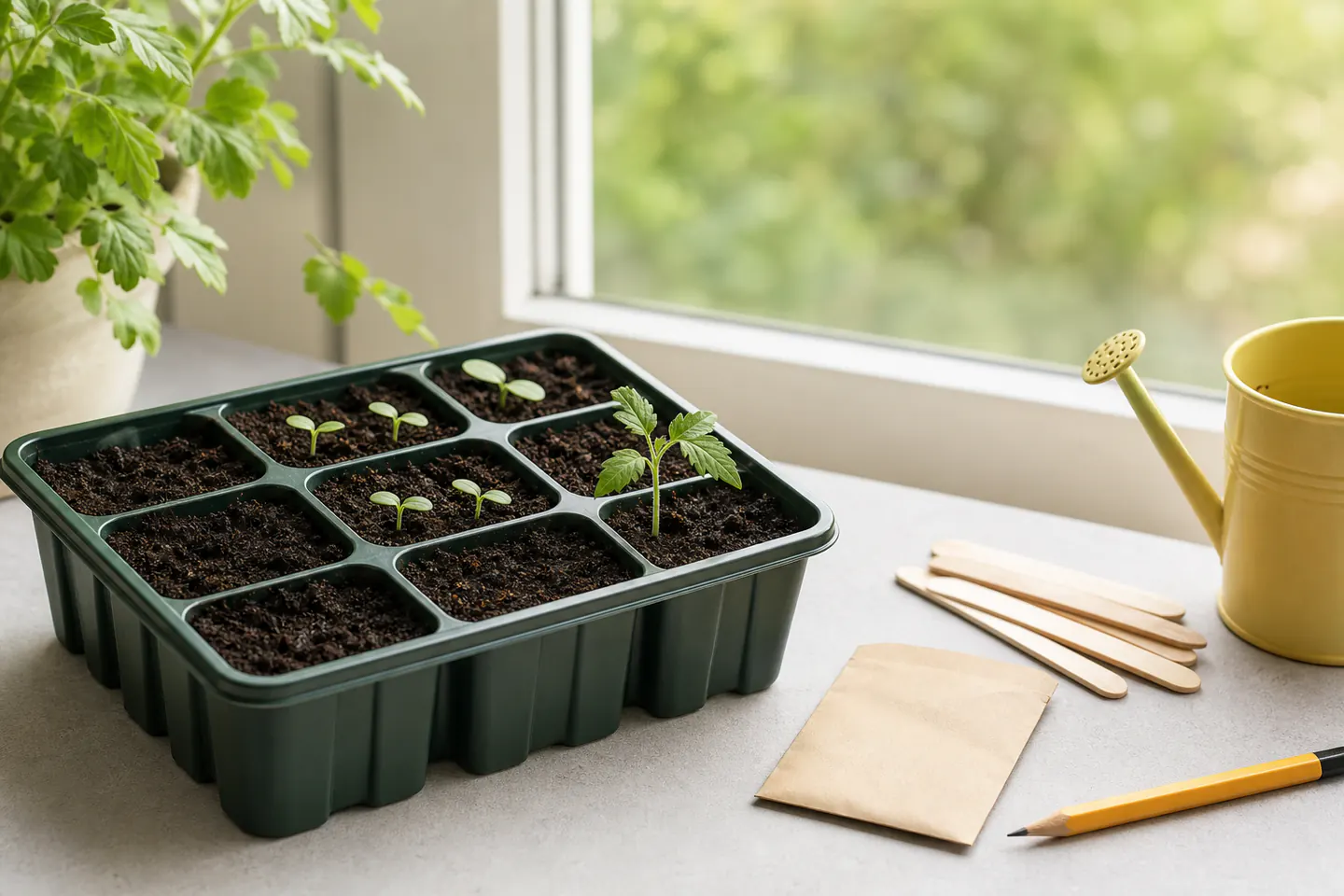
Start six to twelve cells of one forgiving seed at the date, depth and temperature printed on its packet. Use clean seed compost, even moisture and strong light after germination, then thin, pot on and harden off rather than keeping seedlings under a lid.
Quick answer
Sow one variety.
Choose one easy seed whose packet matches the current season and available growing space. Fill clean cells with fresh seed-sowing compost, water it evenly, sow at the packet depth, label the variety and date and maintain the stated germination temperature. As soon as seedlings emerge, remove unnecessary covers and give strong light, airflow and moisture without saturation.
- 01
The seed packet is species-specific evidence for timing, depth, temperature and spacing. Generic internet advice must not override it without a credible reason.
- 02
Warmth helps germination for some crops, while light becomes critical after emergence. A hot mat under unlit seedlings can create tall weak growth quickly.
- 03
A clear lid slows drying before germination but also traps humidity. Vent and remove it as seedlings emerge to reduce damping-off conditions.
- 04
Sowing extra seeds is sensible; crowding every successful seedling in one cell is not. Thin or pot on at the appropriate stage while handling leaves rather than fragile stems.
What to expect
What the first attempts really involve
Seeds contain different dormancy and temperature requirements, and packets vary in age and storage. The process becomes understandable when variety, date and conditions remain labelled.
Timing
Starting too early can produce large indoor plants before outdoor conditions are safe. Work backwards from the packet's planting window and local frost pattern.
Depth
Some seeds need light and sit on the surface; others need covering. A universal “twice the seed size” rule is only a rough fallback.
Moisture
Dry compost interrupts germination, while saturated airless compost encourages rot. Evenly moist is a controlled state, not standing water.
Light
A bright-looking room may still produce stretched seedlings. Watch internode length, leaning and leaf colour rather than judging with human eyesight alone.
Transition
Indoor leaves are not prepared for full sun, wind and cold. Hardening off is a gradual exposure process, not one day outside.
Fundamentals
Build the first attempt on reliable fundamentals
Choose a seed that fits the destination
Confirm eventual plant size, indoor or outdoor destination, sowing month and whether heat is required. Fast salad leaves, herbs or compact flowers can be forgiving, but the packet and local conditions decide. Avoid sowing a whole packet simply because the cells are available; unused seed can remain labelled and dry.
Create clean, even cells
Wash reusable trays, use fresh seed compost and fill without compressing it into a brick. Level the surface and pre-moisten so small seeds are not washed into corners afterwards. Sow the stated number and depth, then label variety, source and date before different trays become indistinguishable.
Control germination, then change the environment
Use the packet's temperature range and cover only as needed to retain moisture. Check daily. At the first emergence, move the tray to strong suitable light, begin gentle airflow and remove or open the lid. Rotate only if light is uneven, and do not leave seedlings cooking against cold glass under midday sun.
Thin, pot on and harden off
When seedlings reach the stated stage, keep the strongest correctly spaced plant or move them with minimal root disturbance. Hold seed leaves, not the delicate stem. Pot into fresh suitable compost, maintain light and begin hardening off through increasing sheltered outdoor periods before final planting when frost and soil conditions allow.
Useful products
Reusable deep cells, seed compost and labels that preserve evidence
The Garland deep-root trays give a reusable module system, John Innes seed compost supplies a purpose-made starting medium and wooden labels keep variety and date attached to the experiment. The ROOT!T heat mat belongs only to seeds whose packet specifies warmer germination than the available room.
Garland Deep Root Success Kit, 28 cells, pack of two
Individual cells make germination and root development easier to track than one crowded pot.
Westland John Innes Seed Sowing Compost, 10 litres
It avoids using coarse or heavily fed general garden compost for a small indoor tray.
Tildenet Wooden Plant Labels
Labels prevent the most avoidable seed-starting error and make comparison possible.
First sowing
Start twelve cells of one packet
Choose a packet that names the current sowing window and destination. Use fewer cells if the mature plants will exceed the available space.
- 01
Read the whole packet
Record sowing window, depth, temperature, germination estimate, spacing and final growing position before opening it.
- 02
Clean the equipment
Wash used trays and tools, clear old roots and use fresh seed compost in a clean work area.
- 03
Pre-moisten and fill
Wet the compost evenly, let excess drain and fill cells gently without compressing away air.
- 04
Sow deliberately
Place the stated number of seeds at the correct depth and keep several cells as a manageable comparison.
- 05
Label immediately
Write variety, packet source and sowing date in durable pencil or weatherproof ink and keep the packet.
- 06
Maintain germination conditions
Provide the specified warmth and moisture, checking daily without repeatedly digging for seeds.
- 07
Respond to emergence
Remove covers, increase light and airflow and keep compost moist but not saturated as soon as seedlings appear.
- 08
Thin and transition
Retain healthy spacing, pot on at the right stage and harden seedlings gradually before outdoor planting.
Troubleshooting
Read the result before changing the setup
No germination needs a packet-led check
Review seed age, sowing depth, temperature, moisture and any dormancy treatment. Wait through the stated window before disturbing the cells, then run a small controlled repeat rather than changing everything.
Tall leaning seedlings need more usable light
Increase suitable light intensity or reduce distance from a safe grow light, avoid excessive warmth and rotate for uneven window light. Burying an unsuitable stem deeply is not a universal rescue.
Seedlings collapsing at the base suggests damping off
Remove affected plants, improve airflow, avoid saturation and clean equipment before the next batch. Do not reuse contaminated compost.
Purple or stalled growth needs species and temperature context
Check cold roots, nutrient stage, waterlogging, pH and light before feeding. Seed compost is deliberately low in nutrients, but young seedlings can also be harmed by fertiliser applied too early.
Skip for now
What can wait
One labelled variety reveals the process. Automation and a wall of trays magnify errors before timing, moisture and light are understood.
- 01
A heat mat for every seed
Some species germinate well or better at cooler temperatures. Use additional heat only to reach the packet's stated range and monitor it.
- 02
Large mixed seed bundles
Unclear varieties and incompatible timings make results difficult to interpret. Choose named seed from a reputable source.
- 03
Fertiliser at sowing
Fresh seed compost and the seed's reserves cover early stages for many plants. Feed only when the crop and stage call for it.
- 04
Sowing the entire packet
It creates crowding and more plants than the destination can support. Keep seed stored as the packet recommends for a repeat or later succession.
Upgrade path
What a better setup changes
A better setup improves temperature or light only after those conditions are measured against the chosen seed.
First labelled tray
About £12–£40Clean cells + seed compost + labels + one packet
Teaches timing, depth, moisture, germination and thinning with visible records.Controlled germination warmth
Add about £15–£40Thermostatically monitored mat or propagator for suitable crops
Reaches a required root-zone temperature when the room cannot.Reliable seedling light
Often £30–£100Suitable grow light + timer + adjustable safe distance
Reduces stretching for repeated early or low-light sowing.Succession system
Mostly extra compost and seedSeveral dated small batches + potting-on space + hardening area
Produces a useful harvest or flowering window without one overcrowded sowing.Before upgrading
A useful check before spending more
Record rates, not impressions
Write seeds sown, seedlings emerged and plants established. That distinguishes germination from later care and makes seed age, method and timing comparable.
Plan the destination before repeating
Count pot, bed or allotment space and the time until planting conditions are safe. A successful tray can become a welfare and space problem if there is nowhere appropriate to grow it on.
Safety
Keep growing media, electrics and plants managed
Seed starting involves damp media, possible allergens and sometimes heated or lit equipment close to water.
- Wear gloves or wash hands after compost and keep growing media away from food preparation.
- Follow packet warnings; some seeds and resulting plants are toxic or treated and must stay away from children and pets.
- Keep heat mats, lights, plugs and extension connections outside watering and condensation paths.
- Use RCD protection where appropriate and follow equipment load, clearance and timer instructions.
- Lift trays with both hands, empty standing water and clean spills to prevent slips and mould.
- Do not introduce diseased seedlings, invasive species or contaminated compost outdoors; follow local guidance.
Classes
When outside help is useful
A class is useful for crops with special dormancy, an allotment plan or diagnosing repeated losses. An ordinary labelled packet can be started independently.
Look for practical sowing, pricking out and hardening off with local timing.
Useful when it connects seed starting to bed planning, succession and plant care.
Representative UK garden-centre and horticultural-course formats checked 30 July 2026; seeds and materials vary.
Sources
Sources and checking notes
RHS guidance anchors sowing depth, heat, hardening off and seedling terms; practical horticultural resources and current product listings support the home workflow.
-
01
RHS · Seed sowing techniques
UK beginner guidance on indoor and outdoor sowing, warmth and hardening off.
Open source -
02
RHS · Sowing in pots
Step-by-step pot and compost method with packet-led depth advice.
Open source -
03
RHS · Seed sowing glossary
Clear definitions for hardening off, pricking out and thinning.
Open source -
04
RHS · Germination requirements
Species variation, light and germination requirement reference.
Open source -
05
Garden Organic · Seed sowing
Practical organic growing guidance on compost, trays, timing and aftercare.
Open source -
06
Amazon UK · Deep Root Success Kit, 28 cells, pack of two
Exact Garland product and direct Amazon UK listing checked for current availability, price context and model identity.
Open source -
07
Amazon UK · John Innes Seed Sowing Compost, 10 litres
Exact Westland product and direct Amazon UK listing checked for current availability, price context and model identity.
Open source -
08
Amazon UK · Wooden Plant Labels
Exact Tildenet product and direct Amazon UK listing checked for current availability, price context and model identity.
Open source -
09
Amazon UK · Small Propagation Heat Mat
Exact ROOT!T product and direct Amazon UK listing checked for current availability, price context and model identity.
Open source
Guide information and links checked 30 July 2026.