Beginner’s guide · Cook & bake
Build flavour first.
Measure safety as you go.
A small cooked vinegar sauce is the quickest start. Fermented chilli sauce adds depth, but needs accurate salt, submersion, pH checks and a process that never relies on appearance alone.
Quick answer
Choose cooked or fermented before buying anything
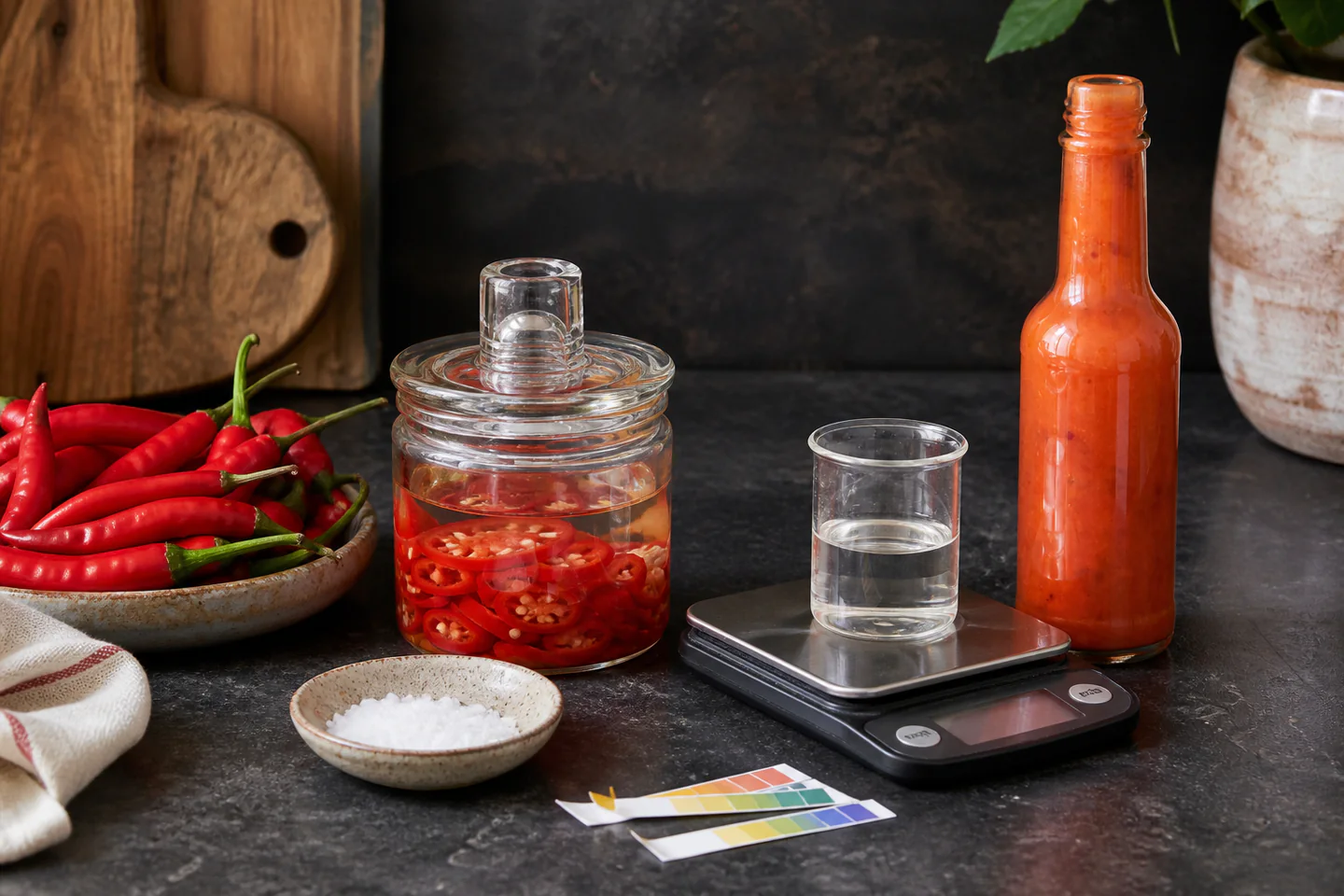
For the simplest first result, simmer chillies with vinegar using a tested recipe, blend carefully and refrigerate. If fermenting, weigh salt, keep solids submerged, monitor pH with suitable strips and refrigerate the finished sauce.
- 01
Wear gloves and avoid touching eyes when preparing hot chillies. Keep the first attempt narrow enough that preparation, the main action and the result can all be reviewed together.
- 02
Use a tested acidified or fermented method rather than improvising shelf stability. Keep the first attempt narrow enough that preparation, the main action and the result can all be reviewed together.
- 03
Weigh salt against the stated water or total-mash basis; those percentages are not interchangeable. Keep the first attempt narrow enough that preparation, the main action and the result can all be reviewed together.
- 04
Make a mild small batch so flavour can be judged beneath the heat. Keep the first attempt narrow enough that preparation, the main action and the result can all be reviewed together.
What to expect
Heat is only one part of a good sauce
A sauce that is merely painful is easy; a sauce with aroma, acidity, salt and a useful texture takes adjustment.
Cooked route
Fast and predictable, with vinegar providing immediate acidity, but flavour is brighter and less fermented. For hot-sauce making, note what actually happened rather than relying on memory; that turns the next attempt into a controlled change instead of another guess.
Fermented route
Takes days or weeks and can taste deeper, but requires submersion, gas management and measured acidity. For hot-sauce making, note what actually happened rather than relying on memory; that turns the next attempt into a controlled change instead of another guess.
Texture
Seeds, skins and high-solids mash can make a sauce coarse or prone to separation. For hot-sauce making, note what actually happened rather than relying on memory; that turns the next attempt into a controlled change instead of another guess.
Yield
Fresh produce loses volume during trimming, cooking, straining and blending, so tiny bottles are sensible. For hot-sauce making, note what actually happened rather than relying on memory; that turns the next attempt into a controlled change instead of another guess.
Core method
Control salt, acid and blending
Select a route
Write cooked-vinegar or fermented at the top of the recipe and follow one complete method. For hot-sauce making, note what actually happened rather than relying on memory; that turns the next attempt into a controlled change instead of another guess.
Measure accurately
Use weight for chillies, water and salt; use pH tools intended for acidic food when the method calls for them. For hot-sauce making, note what actually happened rather than relying on memory; that turns the next attempt into a controlled change instead of another guess.
Blend safely
Cool hot mixtures enough for the blender, vent the lid as instructed and avoid inhaling chilli aerosols. For hot-sauce making, note what actually happened rather than relying on memory; that turns the next attempt into a controlled change instead of another guess.
Bottle and store
Use clean bottles, label the date and recipe, and refrigerate unless a validated process explicitly supports ambient storage. For hot-sauce making, note what actually happened rather than relying on memory; that turns the next attempt into a controlled change instead of another guess.
Useful products
Tools that make the process measurable
These products earn a place by controlling a specific variable. Ordinary kitchen equipment can cover the rest; check capacities, materials and current availability before ordering.
Kilner One-Litre Fermentation Jar Set
A small purpose-built vessel simplifies gas release and submersion.
Salter 1036 Digital Kitchen Scale
Salt concentration cannot be judged reliably by spoon volume.
Fermentaholics Kombucha pH Test Strip Roll
A suitable range is easier to interpret than universal strips.
First project
Make a small refrigerated sauce
Use one chilli variety, restrained heat and a tested recipe. The result should teach balance and consistency without pretending to be commercially shelf stable.
- 01
Choose
Select a cooked route for speed or a fermented route for a slower, measured project. For hot-sauce making, note what actually happened rather than relying on memory; that turns the next attempt into a controlled change instead of another guess.
- 02
Prepare
Glove up, ventilate the room, trim produce and weigh every ingredient. For hot-sauce making, note what actually happened rather than relying on memory; that turns the next attempt into a controlled change instead of another guess.
- 03
Process
Cook with measured vinegar or ferment under brine according to the chosen complete recipe. For hot-sauce making, note what actually happened rather than relying on memory; that turns the next attempt into a controlled change instead of another guess.
- 04
Blend
Blend carefully, adjust only within the recipe’s safe acid and salt framework, then strain if wanted. For hot-sauce making, note what actually happened rather than relying on memory; that turns the next attempt into a controlled change instead of another guess.
- 05
Bottle
Fill clean small bottles, refrigerate, label and record pH, yield, flavour and texture. For hot-sauce making, note what actually happened rather than relying on memory; that turns the next attempt into a controlled change instead of another guess.
What can wait
What can wait until the first result
Novelty packaging and extreme chillies can wait until a useful base sauce is repeatable.
- 01
Superhot varieties
They make flavour adjustment and safe handling harder. For hot-sauce making, note what actually happened rather than relying on memory; that turns the next attempt into a controlled change instead of another guess.
- 02
Ambient storage
Home recipes are not automatically shelf stable. For hot-sauce making, note what actually happened rather than relying on memory; that turns the next attempt into a controlled change instead of another guess.
- 03
Large woozy-bottle packs
Confirm the recipe and actual yield first. For hot-sauce making, note what actually happened rather than relying on memory; that turns the next attempt into a controlled change instead of another guess.
- 04
Many flavour additions
Garlic, fruit and sweeteners change fermentation and preservation behaviour. For hot-sauce making, note what actually happened rather than relying on memory; that turns the next attempt into a controlled change instead of another guess.
Upgrade path
Upgrade the repeated limitation
Improve measurement and repeatability before chasing more heat.
Try it
£20–£40Scale, tested recipe and refrigerated cooked sauce
You learn acid, salt and texture quickly.Ferment it
£25–£60Vented jar, weight and suitable pH check
Fermented flavour becomes controllable.Refine texture
£20–£100Better blender, fine strainer and consistent recipe
Seeds and skins stop dominating the finish.Validate further
VariableCalibrated meter and recognised preservation training
Measurements become more defensible, without making casual recipes commercial products.Safety & care
Treat preservation claims seriously
A pleasant smell or bubbling jar does not prove a sauce is safe or shelf stable.
- Use gloves, eye care and ventilation for hot chillies. Follow current manufacturer, food-safety, access, wildlife or local guidance wherever it applies.
- Follow tested acidification or fermentation guidance and refrigerate conservative home batches. Follow current manufacturer, food-safety, access, wildlife or local guidance wherever it applies.
- Keep fermenting solids submerged and discard mouldy, rotten or doubtful batches. Follow current manufacturer, food-safety, access, wildlife or local guidance wherever it applies.
- Never blend sealed hot liquid or lean over chilli steam. Follow current manufacturer, food-safety, access, wildlife or local guidance wherever it applies.
- Do not sell or gift a sauce as shelf stable without meeting applicable food-business and validation requirements. Follow current manufacturer, food-safety, access, wildlife or local guidance wherever it applies.
Outside help
When outside help earns its place
A class is optional, but useful when tasting a known-good example or seeing sanitation and consistency demonstrated would shorten the learning curve.
Use one complete lesson that covers preparation, the central technique, common mistakes and finishing. For a first hot-sauce making attempt, one coherent method is easier to diagnose than fragments collected from several creators.
Outside help earns its place when safe setup, access, identification or live correction removes a real obstacle. Ask what equipment, materials, access and follow-up support are included before booking.
Representative UK learning options checked 31 August 2026; local prices, access, materials and tutor support vary.
Sources
Where the guidance came from
The method is grounded in specialist, manufacturer and public guidance, then checked against recurring beginner problems and the exact products linked here.
-
01
Food Standards Agency · Home food facts
UK domestic food-safety baseline.
Open source -
02
National Center for Home Food Preservation · Pickling
Tested acidified-food principles.
Open source -
03
Penn State Extension · Fermented hot sauce
Extension guidance on controlled chilli fermentation.
Open source -
04
FermentWorks · Fermented hot sauce
Specialist process and troubleshooting context.
Open source -
05
r/fermentation
Recurring questions about brine, kahm yeast, mould and pH.
Open source -
06
Amazon UK · One-Litre Fermentation Jar Set
Exact Amazon UK product page or ISBN used for the recommendation; current price, seller, specification and availability should be confirmed.
Open source -
07
Amazon UK · 1036 Digital Kitchen Scale
Exact Amazon UK product page or ISBN used for the recommendation; current price, seller, specification and availability should be confirmed.
Open source -
08
Amazon UK · Kombucha pH Test Strip Roll
Exact Amazon UK product page or ISBN used for the recommendation; current price, seller, specification and availability should be confirmed.
Open source
Guide information and links checked 31 August 2026.