Beginner’s guide · Make & create
Draw with thread
and counted space.
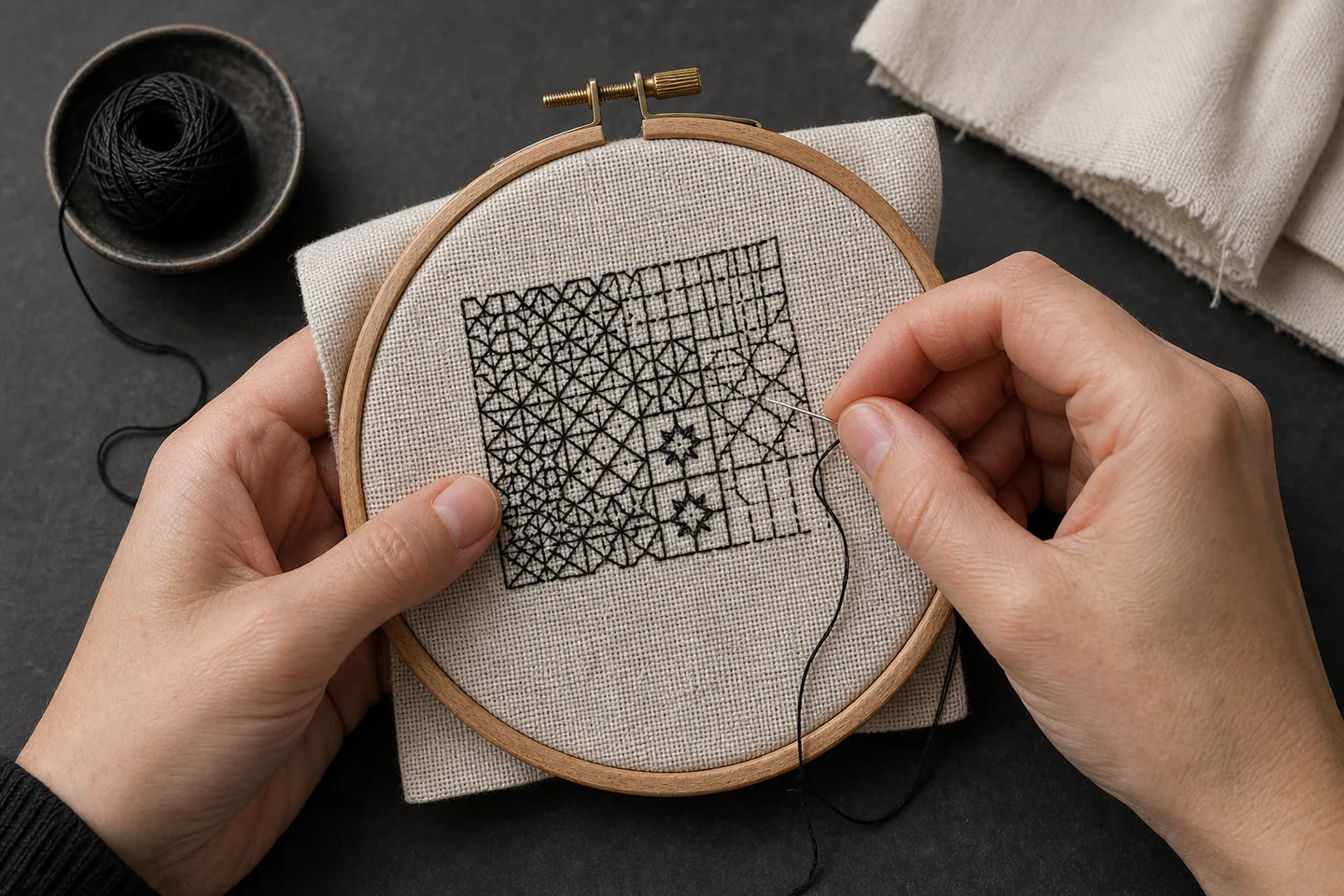
Start with black stranded cotton on evenweave or Aida and a small geometric sampler. The rhythm comes from counted paths, careful reversals and changing density rather than colour.
Quick answer
Use a counted sampler with bold repeats
Begin on 14-count Aida or clearly visible evenweave with stranded cotton and a blunt tapestry needle. Work double running stitch or backstitch through a small repeat before attempting intricate historical fills.
- 01
Count from a reliable centre or grid line and recount before starting a new repeat. Note the material, setting or measurement used so the result can be repeated or changed for a reason.
- 02
Use one or two strands as the pattern specifies; density changes dramatically with strand count. Note the material, setting or measurement used so the result can be repeated or changed for a reason.
- 03
Keep every line relaxed so the fabric holes remain open and the geometry stays square. Note the material, setting or measurement used so the result can be repeated or changed for a reason.
- 04
Plan a route through the motif rather than jumping long distances across the back. Note the material, setting or measurement used so the result can be repeated or changed for a reason.
- 05
Mark progress on a paper or digital chart after completing each short section. Note the material, setting or measurement used so the result can be repeated or changed for a reason.
What to expect
Simple lines expose small counting errors
Blackwork uses few materials, but its clarity means one misplaced stitch can disrupt an entire repeated pattern.
Counting
The design is built against fabric threads or Aida blocks. Establishing a centre and checking repeats prevents cumulative drift. For blackwork embroidery, check this deliberately while the work is still easy to alter; correcting it after the next stage usually costs more time or materials.
Reversibility
Traditional double running can make front and back similar, but a perfectly reversible back is optional for most decorative beginners. For blackwork embroidery, check this deliberately while the work is still easy to alter; correcting it after the next stage usually costs more time or materials.
Density
Light and dark effects come from how many lines occupy an area, not from pressing harder or using heavy thread everywhere. For blackwork embroidery, check this deliberately while the work is still easy to alter; correcting it after the next stage usually costs more time or materials.
Visibility
Black thread on pale fabric is clear, yet fine counts still demand strong neutral light and comfortable magnification when needed. For blackwork embroidery, check this deliberately while the work is still easy to alter; correcting it after the next stage usually costs more time or materials.
Core method
Build the pattern from dependable anchors
Prepare the fabric
Find and mark the centre with a removable method, mount the cloth straight in a hoop and check that the weave is not stretched unevenly. For blackwork embroidery, check this deliberately while the work is still easy to alter; correcting it after the next stage usually costs more time or materials.
Read the chart
Treat each chart square as the stated number of fabric threads or Aida blocks. Identify the smallest repeat and its direction before stitching. For blackwork embroidery, check this deliberately while the work is still easy to alter; correcting it after the next stage usually costs more time or materials.
Choose a path
Use backstitch for the simplest route or double running when the pattern suits an outward-and-return journey. Avoid long exposed carries. For blackwork embroidery, check this deliberately while the work is still easy to alter; correcting it after the next stage usually costs more time or materials.
Create shading
Add secondary lines only after the main outline is correct. Compare the overall balance from a normal viewing distance. For blackwork embroidery, check this deliberately while the work is still easy to alter; correcting it after the next stage usually costs more time or materials.
Useful products
Products with a clear job in the setup
The easiest first purchase is a true blackwork sampler plus a reliable reference and needles that suit counted fabric.
Anchor / Coats Crafts Blackwork Sampler Embroidery Kit
A sampler teaches repeats and density without pretending ordinary surface embroidery is blackwork.
Goldleaf Needlework Stained Glass Rose Blackwork Kit
The stained-glass divisions make it easier to check one contained area at a time.
Search Press Blackwork Embroidery in Colour
It broadens the technique after the first sampler rather than adding another generic bundle of threads.
First project
Stitch one repeat from centre to edge
A small sampler reveals counting and tension problems without turning every correction into a long unpicking session.
- 01
Mark the centre
Fold or count the fabric to locate its centre, then align that point with the chart and mount the fabric squarely. For blackwork embroidery, check this deliberately while the work is still easy to alter; correcting it after the next stage usually costs more time or materials.
- 02
Test strand count
Work a short line with the specified number of strands and confirm that it looks crisp without widening the holes. For blackwork embroidery, check this deliberately while the work is still easy to alter; correcting it after the next stage usually costs more time or materials.
- 03
Complete the outline
Follow one repeat in short counted sections, checking its width and height against the chart before extending it. For blackwork embroidery, check this deliberately while the work is still easy to alter; correcting it after the next stage usually costs more time or materials.
- 04
Return and fill
Complete missing segments on the return journey or add interior density only after the main geometry matches. For blackwork embroidery, check this deliberately while the work is still easy to alter; correcting it after the next stage usually costs more time or materials.
- 05
Finish gently
Secure tails beneath existing stitches, remove temporary marks as directed and press from the reverse over a clean towel. For blackwork embroidery, check this deliberately while the work is still easy to alter; correcting it after the next stage usually costs more time or materials.
What can wait
What can wait until the first result
Blackwork rewards accuracy more than a large colour collection or premium display equipment.
- 01
Very fine linen
High thread counts create beautiful detail but make early counting and corrections unnecessarily demanding. For blackwork embroidery, check this deliberately while the work is still easy to alter; correcting it after the next stage usually costs more time or materials.
- 02
Huge historical panel
Large repeating patterns magnify one early offset; complete a sampler and a pictorial motif first. For blackwork embroidery, check this deliberately while the work is still easy to alter; correcting it after the next stage usually costs more time or materials.
- 03
Perfectly reversible backs
Reversibility is an interesting constraint, not a requirement for a framed first piece. Prioritise a clean front and secure short carries. For blackwork embroidery, check this deliberately while the work is still easy to alter; correcting it after the next stage usually costs more time or materials.
Upgrade path
Upgrade the repeated limitation
Upgrade when a real limit appears: visibility, chart complexity or finishing quality.
Try it
£12–£35Sampler kit and one reliable stitch reference
Counting, line weight and a manageable repeat are learned together.Improve visibility
£15–£60 extraTask light, magnifier and finer evenweave
Smaller details become comfortable without squinting or losing position.Design your own
£15–£50Graph paper or chart software plus selected threads
Pattern density and negative space become creative choices.Refine presentation
VariableCareful mounting or conservation framing
Crisp geometry remains square and protected on display.Safety & care
Keep the cloth visible and the body relaxed
The main practical risks are eyestrain, repetitive tension and avoidable dye transfer.
- Use strong neutral lighting and magnification rather than leaning close to the fabric for long periods. Follow the current instructions supplied with the exact material or tool.
- Take hand and shoulder breaks before tension becomes inconsistent or painful. Follow the current instructions supplied with the exact material or tool.
- Test dark thread for colourfastness before washing a finished pale-ground sampler. Follow the current instructions supplied with the exact material or tool.
- Store needles securely and keep counted work away from food, drink and pet hair. Follow the current instructions supplied with the exact material or tool.
Outside help
When outside help earns its place
A charted kit is enough to begin. Tutor feedback is valuable when double-running routes, historical reversibility or self-designed fills become the focus.
Use one complete lesson that includes preparation, the working method, troubleshooting and finishing. Avoid combining measurements from several creators on the first attempt.
Ask whether materials, safe tool use, individual correction and a finished take-home result are included before booking.
Representative UK learning options checked 29 August 2026; local prices, access, materials and tutor support vary.
Sources
Where the guidance came from
The method is grounded in specialist and manufacturer guidance, then checked against recurring beginner problems and the exact products linked here.
-
01
Royal School of Needlework · Blackwork
Technique reference for blackwork structure and stitch use.
Open source -
02
Victoria and Albert Museum · Blackwork
Museum context for the history and visual language of blackwork.
Open source -
03
The Embroiderers’ Guild
UK learning context and embroidery practice.
Open source -
04
DMC · Embroidery guides
Thread, fabric and stitch guidance from a major manufacturer.
Open source -
05
RSN Stitch Bank · Double running stitch
Construction reference for a core blackwork stitch.
Open source -
06
Amazon UK · Blackwork Sampler Embroidery Kit
Exact product catalogue page or ISBN used for the recommendation; current price, seller, specification and availability should be confirmed.
Open source -
07
Amazon UK · Stained Glass Rose Blackwork Kit
Exact product catalogue page or ISBN used for the recommendation; current price, seller, specification and availability should be confirmed.
Open source -
08
Amazon UK · Blackwork Embroidery in Colour
Exact product catalogue page or ISBN used for the recommendation; current price, seller, specification and availability should be confirmed.
Open source
Guide information and links checked 29 August 2026.