Beginner’s guide · Make & create
Baste six shapes,
join one quiet flower.
Start with one-inch paper hexagons, small fabric scraps and a fine hand-sewing needle. Accurate basting and tiny edge stitches matter before planning a full quilt.
Quick answer
Make seven hexagons before imagining a quilt
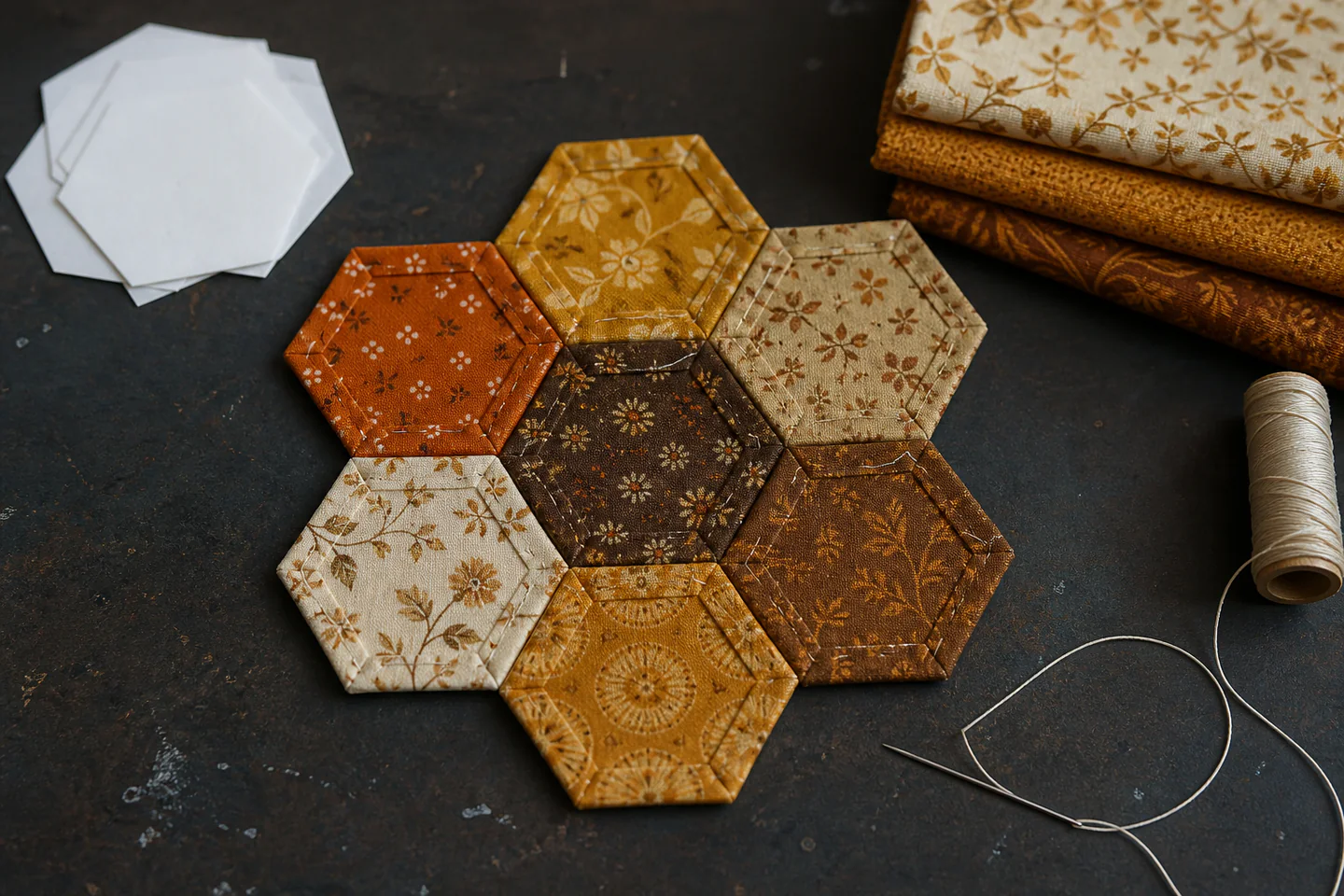
Use pre-cut one-inch hexagon papers and scraps of stable quilting cotton. Centre each paper on the wrong side, fold the seam allowance over one edge at a time and baste with thread or a small amount of removable fabric glue. Place two wrapped shapes right sides together and whip stitch only through the folded fabric edges. Join six outer hexagons around one centre, press lightly and leave the papers in until every surrounding edge is secured.
- 01
Use templates from one source so nominally similar hexagons actually match. Record what you used on the first attempt so the result can be repeated or changed for a reason.
- 02
Cut a consistent seam allowance wide enough to hold each folded edge. Record what you used on the first attempt so the result can be repeated or changed for a reason.
- 03
Keep glue away from the fold line or use removable basting stitches. Record what you used on the first attempt so the result can be repeated or changed for a reason.
- 04
Take small edge stitches that do not pierce the paper template. Record what you used on the first attempt so the result can be repeated or changed for a reason.
- 05
Remove a paper only after all of that shape’s edges are enclosed by neighbours. Record what you used on the first attempt so the result can be repeated or changed for a reason.
What to expect
Accuracy is distributed across many small repeats
No single stitch is difficult, but inconsistent templates, seam allowances and corner folds accumulate into gaps or a motif that will not lie flat.
Templates
Paper weight must hold an edge without being so thick that corners become bulky. Reuse only templates that remain undistorted. In english paper piecing, this is worth checking deliberately rather than trying to correct it after the next stage.
Fabric
Stable woven cotton is forgiving. Slippery, thick or loosely woven scraps make the first joins harder. In english paper piecing, this is worth checking deliberately rather than trying to correct it after the next stage.
Basting
Thread basting costs time but is easy to reverse; glue basting is faster only when used sparingly and removed correctly. In english paper piecing, this is worth checking deliberately rather than trying to correct it after the next stage.
Joining
Tight stitches can draw the edges into a ridge. Match corners first and let the fold lines meet naturally. In english paper piecing, this is worth checking deliberately rather than trying to correct it after the next stage.
Scale
A quilt contains hundreds or thousands of shapes. One small object tests whether the repetitive handwork is enjoyable. In english paper piecing, this is worth checking deliberately rather than trying to correct it after the next stage.
Core method
Preserve the shape from paper to final join
Prepare consistent pieces
Use one template size and cut fabric with an even seam allowance around every side. In english paper piecing, this is worth checking deliberately rather than trying to correct it after the next stage.
Baste lightly
Fold opposite edges in a repeatable order, control the corner tails and secure without bending the paper. In english paper piecing, this is worth checking deliberately rather than trying to correct it after the next stage.
Join from corner to corner
Align points, clip if useful and whip stitch along the folded edges without pulling the thread into a cord. In english paper piecing, this is worth checking deliberately rather than trying to correct it after the next stage.
Press and remove papers
Press according to the fabric, take papers out only from enclosed shapes and retain sound templates for reuse. In english paper piecing, this is worth checking deliberately rather than trying to correct it after the next stage.
Useful products
Products with a clear job in the setup
The 400-paper pack is the focused template route. The Sewline pen controls removable glue basting, while the acrylic hexagon rulers help cut consistent fabric allowances. Thread basting can replace the glue pen.
Sourcing Map 400 One-Inch Hexagon Paper Templates
Pre-cut pieces remove hand-cutting variation and are reusable while they remain flat.
Sewline Fabric Glue Pen with Refill
The pen tip limits excess glue and the refill makes the tool reusable.
Generic Acrylic Hexagon Quilting Template Set
Transparent edges make motif placement on patterned fabric easier to preview.
First project
Join a seven-hexagon flower
The motif includes straight joins, six outer corners and a clear test of whether every paper and fold agrees.
- 01
Select seven scraps
Choose stable cotton with enough contrast to keep the centre and outer ring easy to identify. In english paper piecing, this is worth checking deliberately rather than trying to correct it after the next stage.
- 02
Cut even allowances
Use one template as reference and leave the same fabric margin around every side. In english paper piecing, this is worth checking deliberately rather than trying to correct it after the next stage.
- 03
Baste each hexagon
Fold in one consistent order and keep corner bulk pointing the same way where practical. In english paper piecing, this is worth checking deliberately rather than trying to correct it after the next stage.
- 04
Join the centre ring
Match one outer hexagon to the centre and sew from corner to corner with relaxed whip stitches. In english paper piecing, this is worth checking deliberately rather than trying to correct it after the next stage.
- 05
Close neighbouring sides
Add the remaining pieces, checking the front after every seam for gaps or puckering. In english paper piecing, this is worth checking deliberately rather than trying to correct it after the next stage.
- 06
Press and retain papers
Press gently, remove only fully enclosed papers and mount the flower on a card or fabric square. In english paper piecing, this is worth checking deliberately rather than trying to correct it after the next stage.
What can wait
What can wait until the first result
A full quilt magnifies every material and workflow decision. First learn whether making, storing and joining many small pieces is satisfying.
- 01
Full-size hexagon quilt
It commits to hundreds of repeats before stitch tension and preferred basting are known. In english paper piecing, this is worth checking deliberately rather than trying to correct it after the next stage.
- 02
Very small shapes
Tiny pieces increase corner bulk and make every stitch more visible. In english paper piecing, this is worth checking deliberately rather than trying to correct it after the next stage.
- 03
Slippery silk scraps
They shift around the paper and need different handling. In english paper piecing, this is worth checking deliberately rather than trying to correct it after the next stage.
- 04
Large template collection
Choose a project before buying several incompatible sizes and shapes. In english paper piecing, this is worth checking deliberately rather than trying to correct it after the next stage.
- 05
Rotary cutting system
Scissors and a small template are enough for one flower; add cutters only for repeated preparation. In english paper piecing, this is worth checking deliberately rather than trying to correct it after the next stage.
Upgrade path
Upgrade the repeated limitation
Scale only after the first motif lies flat and the chosen basting method releases cleanly.
Seven-hex flower
About £10–£25Paper templates, scraps and needle
Learn basting and joining.Coaster or pouch panel
About £20–£50Repeated motifs and backing fabric
Finish edges into an object.Cushion front
About £40–£100Planned palette and organised templates
Manage a larger layout.Quilt project
About £100–£500+Bulk papers, fabric plan and storage
Sustain hundreds of accurate joins.Safety & care
Keep sharp preparation tools separate from lap sewing
Hand sewing is portable; rotary cutters, irons and loose needles are not. Divide preparation and joining into safe work zones.
- Use a thimble if the needle presses into the finger and replace bent or burred needles. Follow the current instructions supplied with the exact material, tool or living specimen.
- Store pins, clips and papers in closed containers and count tools before leaving a shared seating area. Follow the current instructions supplied with the exact material, tool or living specimen.
- Cut away from the body on a proper mat and keep the non-cutting hand outside the ruler edge. Follow the current instructions supplied with the exact material, tool or living specimen.
- Place the iron on a stable heatproof surface and follow fabric and glue temperature limits. Follow the current instructions supplied with the exact material, tool or living specimen.
- Check glue and marker instructions, ventilation and wash-out behaviour before using them on a valued fabric. Follow the current instructions supplied with the exact material, tool or living specimen.
Outside help
When outside help earns its place
A well-made tutorial is enough for the first controlled result. In-person help becomes worthwhile when curved shapes, fussy cutting or assembling a large top becomes the obstacle.
Use one complete method from start to finish instead of combining several creators’ measurements.
Ask whether materials, preparation, troubleshooting and flat joins and clean paper removal are included.
Representative UK learning options checked 28 August 2026; local prices, access, materials and tutor support vary.
Sources
Where the guidance came from
The method is grounded in specialist and public guidance, then checked against recurring beginner questions and the exact products linked here.
-
01
The Quilters’ Guild · patchwork and quilting
UK quilting terminology, learning and guild resources.
Open source -
02
International Quilt Museum
Historical and material context for pieced quilts.
Open source -
03
Sewline · glue pen guidance
Manufacturer information for temporary fabric glue use.
Open source -
04
Love Patchwork & Quilting · EPP
Beginner English paper-piecing method and projects.
Open source -
05
Reddit · r/EPP_addict
Community evidence on templates, basting, joining and scale.
Open source -
06
Amazon UK · 400 One-Inch Hexagon Paper Templates
Exact product catalogue page or ISBN used for the recommendation; current price, seller, specification and availability should be confirmed.
Open source -
07
Amazon UK · Fabric Glue Pen with Refill
Exact product catalogue page or ISBN used for the recommendation; current price, seller, specification and availability should be confirmed.
Open source -
08
Amazon UK · Acrylic Hexagon Quilting Template Set
Exact product catalogue page or ISBN used for the recommendation; current price, seller, specification and availability should be confirmed.
Open source
Guide information and links checked 28 August 2026.