Beginner’s guide · Cook & bake
Keep one small culture
active and predictable.
Start milk kefir with live grains, one glass jar and a repeatable daily rhythm. Temperature and grain-to-milk ratio change the result more than specialist equipment.
Quick answer
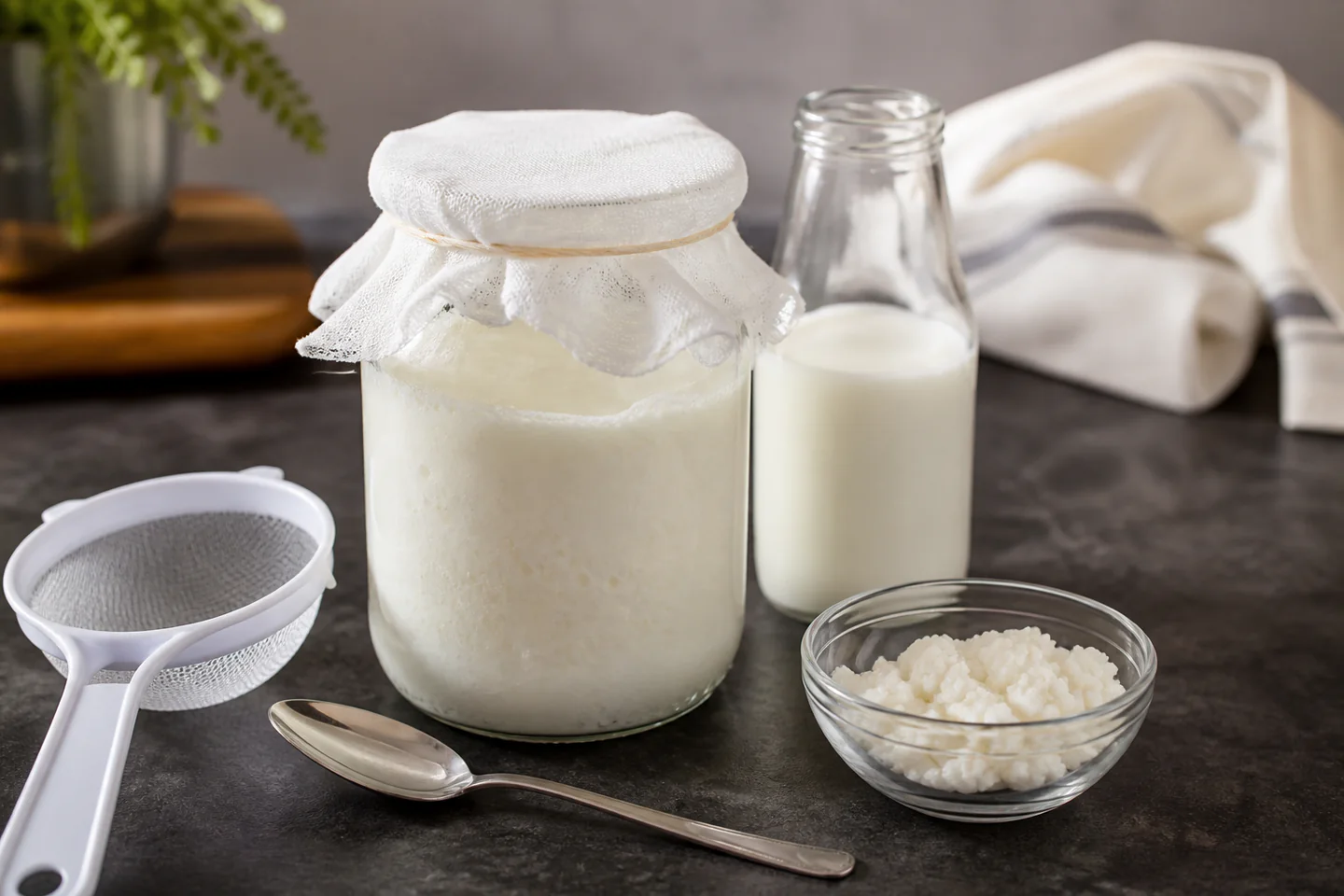
Start with live milk-kefir grains
Use pasteurised milk, a clean glass jar and a small quantity of active grains. Ferment loosely covered at ordinary room temperature, strain when pleasantly tart, refrigerate the drink and feed the grains with fresh milk.
- 01
Change only milk volume or fermentation time between batches. Keep the first attempt narrow enough that preparation, the main action and the result can all be reviewed together.
- 02
Use a non-reactive strainer and clean utensils without obsessively sterilising healthy grains. Keep the first attempt narrow enough that preparation, the main action and the result can all be reviewed together.
- 03
Treat whey pockets as a timing signal, not an automatic failure. Keep the first attempt narrow enough that preparation, the main action and the result can all be reviewed together.
- 04
Keep a backup portion chilled once the culture is established. Keep the first attempt narrow enough that preparation, the main action and the result can all be reviewed together.
What to expect
The culture follows temperature, not the clock
Kefir is a living mixed culture. A warm kitchen, more grains or less milk shortens fermentation, while cold conditions slow it.
Texture
A drinkable yoghurt texture is common; a spoon-standing set is not the only successful result. For kefir making, note what actually happened rather than relying on memory; that turns the next attempt into a controlled change instead of another guess.
Flavour
Fresh kefir should be tangy and dairy-like. Putrid, coloured or visibly mouldy batches are discarded. For kefir making, note what actually happened rather than relying on memory; that turns the next attempt into a controlled change instead of another guess.
Separation
Clear whey and white curds mean fermentation has advanced; stir or strain sooner next time. For kefir making, note what actually happened rather than relying on memory; that turns the next attempt into a controlled change instead of another guess.
Rhythm
Daily batches are convenient, but refrigeration can pause the routine when life gets busy. For kefir making, note what actually happened rather than relying on memory; that turns the next attempt into a controlled change instead of another guess.
Core method
Build a repeatable grain-care routine
Choose the culture
Buy genuine reusable milk-kefir grains rather than assuming a single-use powdered starter behaves identically. For kefir making, note what actually happened rather than relying on memory; that turns the next attempt into a controlled change instead of another guess.
Set the ratio
Begin with the supplier’s modest milk volume, then increase only after the grains are producing reliably. For kefir making, note what actually happened rather than relying on memory; that turns the next attempt into a controlled change instead of another guess.
Strain gently
Pour through a clean non-reactive strainer and move the grains straight into fresh milk. For kefir making, note what actually happened rather than relying on memory; that turns the next attempt into a controlled change instead of another guess.
Store deliberately
Refrigerate finished kefir promptly and date it; pause grains in fresh milk in the fridge for short breaks. For kefir making, note what actually happened rather than relying on memory; that turns the next attempt into a controlled change instead of another guess.
Useful products
Tools that make the process measurable
These products earn a place by controlling a specific variable. Ordinary kitchen equipment can cover the rest; check capacities, materials and current availability before ordering.
Live Kefir Company Live Milk Kefir Grains with Instructions
Live grains allow repeated batches and visible adaptation to the kitchen.
Kilner One-Litre Clip-Top Glass Jar
Clear walls make thickening and separation easy to observe.
Salter 1036 Digital Kitchen Scale
Consistent quantities reveal whether time or temperature caused the change.
First project
Make one small plain batch
The first goal is a clean, pleasantly tart drink and grains that remain active—not flavouring, second fermentation or maximum thickness.
- 01
Prepare
Wash the jar and utensils, rinse away detergent and organise fresh pasteurised milk. For kefir making, note what actually happened rather than relying on memory; that turns the next attempt into a controlled change instead of another guess.
- 02
Combine
Add the activated grains and the supplier’s recommended small milk volume. For kefir making, note what actually happened rather than relying on memory; that turns the next attempt into a controlled change instead of another guess.
- 03
Observe
Leave loosely covered away from direct sun and check for thickening and a clean tart aroma. For kefir making, note what actually happened rather than relying on memory; that turns the next attempt into a controlled change instead of another guess.
- 04
Strain
Strain before heavy separation, transfer the grains to fresh milk and chill the finished drink. For kefir making, note what actually happened rather than relying on memory; that turns the next attempt into a controlled change instead of another guess.
- 05
Review
Record room temperature, time, milk volume, taste and separation before changing one variable. For kefir making, note what actually happened rather than relying on memory; that turns the next attempt into a controlled change instead of another guess.
What can wait
What can wait until the first result
Extra accessories cannot compensate for tired grains or an inconsistent routine.
- 01
Flavour bottles
Learn plain fermentation before creating pressure with fruit or sugar. For kefir making, note what actually happened rather than relying on memory; that turns the next attempt into a controlled change instead of another guess.
- 02
Large batches
Scale only when the grains recover quickly and the drink is being used. For kefir making, note what actually happened rather than relying on memory; that turns the next attempt into a controlled change instead of another guess.
- 03
Multiple cultures
Water kefir and kombucha require different organisms and routines. For kefir making, note what actually happened rather than relying on memory; that turns the next attempt into a controlled change instead of another guess.
- 04
Health claims
Treat kefir as food, not a diagnosis or guaranteed treatment. For kefir making, note what actually happened rather than relying on memory; that turns the next attempt into a controlled change instead of another guess.
Upgrade path
Upgrade the repeated limitation
Upgrade only the part of the daily routine that repeatedly causes waste or friction.
Try it
£15–£35Live grains, jar and strainer
You learn the culture’s daily rhythm.Make it repeatable
£5–£20Second jar and measured milk volume
One batch can chill while the next ferments.Pause cleanly
MinimalLabelled fridge jar and backup grains
Breaks stop threatening the whole culture.Explore flavour
£10–£30Pressure-safe bottles and controlled second fermentation
Flavour and fizz become deliberate after plain kefir is stable.Safety & care
Keep dairy handling ordinary and careful
The important controls are sound milk, clean equipment, sensible temperature and prompt refrigeration.
- Use pasteurised milk unless you fully understand the additional microbiological risk of raw milk. Follow current manufacturer, food-safety, access, wildlife or local guidance wherever it applies.
- Discard coloured growth, putrid odours or a batch contaminated by dirty utensils. Follow current manufacturer, food-safety, access, wildlife or local guidance wherever it applies.
- Do not tightly seal active fermentation in unsuitable glass. Follow current manufacturer, food-safety, access, wildlife or local guidance wherever it applies.
- Keep finished kefir refrigerated and use conservative storage times. Follow current manufacturer, food-safety, access, wildlife or local guidance wherever it applies.
- Anyone pregnant, immunocompromised or managing a medical condition should seek appropriate professional advice about unpasteurised fermented foods. Follow current manufacturer, food-safety, access, wildlife or local guidance wherever it applies.
Outside help
When outside help earns its place
A class is optional, but useful when tasting a known-good example or seeing sanitation and consistency demonstrated would shorten the learning curve.
Use one complete lesson that covers preparation, the central technique, common mistakes and finishing. For a first kefir making attempt, one coherent method is easier to diagnose than fragments collected from several creators.
Outside help earns its place when safe setup, access, identification or live correction removes a real obstacle. Ask what equipment, materials, access and follow-up support are included before booking.
Representative UK learning options checked 31 August 2026; local prices, access, materials and tutor support vary.
Sources
Where the guidance came from
The method is grounded in specialist, manufacturer and public guidance, then checked against recurring beginner problems and the exact products linked here.
-
01
Food Standards Agency · Chilling food correctly
UK food refrigeration guidance.
Open source -
02
Live Kefir Company · Milk kefir guidance
Supplier instructions and UK culture context.
Open source -
03
Cultures for Health · Milk kefir
Detailed culture care and troubleshooting reference.
Open source -
04
Kefir Kitchen · UK grains
UK availability and starter context.
Open source -
05
r/Kefir
Recurring real-world questions about activation, separation and storage.
Open source -
06
Amazon UK · Live Milk Kefir Grains with Instructions
Exact Amazon UK product page or ISBN used for the recommendation; current price, seller, specification and availability should be confirmed.
Open source -
07
Amazon UK · One-Litre Clip-Top Glass Jar
Exact Amazon UK product page or ISBN used for the recommendation; current price, seller, specification and availability should be confirmed.
Open source -
08
Amazon UK · 1036 Digital Kitchen Scale
Exact Amazon UK product page or ISBN used for the recommendation; current price, seller, specification and availability should be confirmed.
Open source
Guide information and links checked 31 August 2026.