Beginner’s guide · Observe nature
Read the whole trail,
not one perfect print.
Tracks, feeding signs, droppings and paths become evidence when size, gait, habitat, freshness and direction agree. A field notebook is more useful than a quick guess.
Quick answer
Complete one track record before expanding the setup
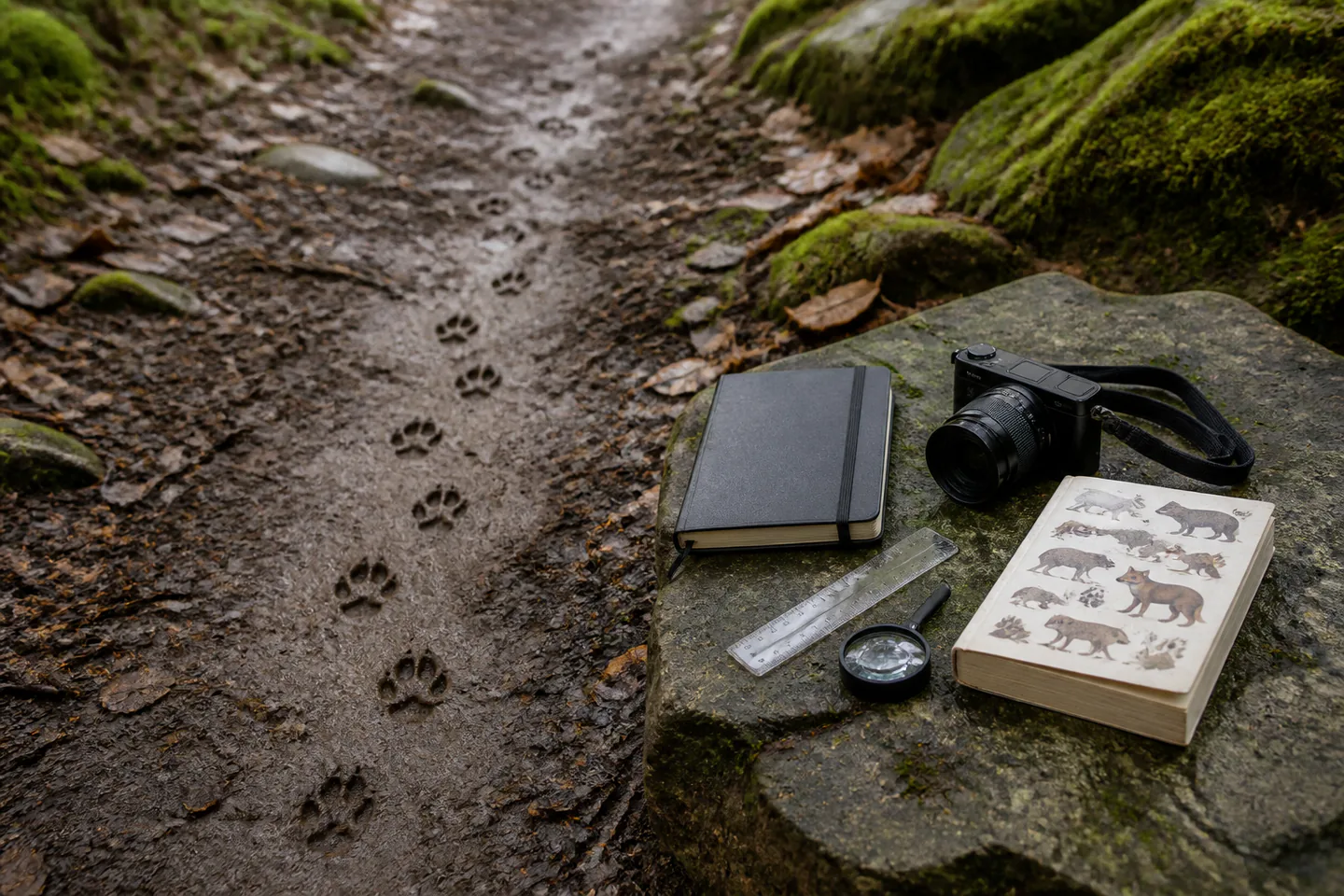
Choose a familiar permitted muddy or sandy path after rain and walk slowly in daylight. Photograph each sign with a scale before touching anything, measure width, length, stride and trail pattern, record direction, substrate, habitat and freshness, look for independent feeding or movement clues and submit uncertain records with photographs to a recognised recorder rather than forcing a species name.
- 01
A single footprint can be distorted; a sequence reveals gait, direction and consistency. Record what happened during wildlife tracking so the next attempt changes one known variable instead of several guesses.
- 02
Substrate changes apparent toe, claw and pad shapes and can enlarge or erase edges. Record what happened during wildlife tracking so the next attempt changes one known variable instead of several guesses.
- 03
Droppings and dens can carry disease or mark an occupied refuge and should be observed without handling or probing. Record what happened during wildlife tracking so the next attempt changes one known variable instead of several guesses.
- 04
A good record includes uncertainty and enough context for another person to verify it. Record what happened during wildlife tracking so the next attempt changes one known variable instead of several guesses.
What to expect
What wildlife tracking is really like at the start
The useful beginner controls are preparation, one bounded task and a record of the result; specialist equipment matters only when it solves a repeated limitation.
Slipping, overprinting and melting edges create shapes unlike textbook examples. Record what happened during wildlife tracking so the next attempt changes one known variable instead of several guesses.
Trail
Walk, trot, bound and gallop produce different spacing from the same animal. Record what happened during wildlife tracking so the next attempt changes one known variable instead of several guesses.
Sign
Feeding remains, hair, paths and scent marks can support or contradict a footprint guess. Record what happened during wildlife tracking so the next attempt changes one known variable instead of several guesses.
Season
Vegetation, mud, snow and animal behaviour change what can be found. Record what happened during wildlife tracking so the next attempt changes one known variable instead of several guesses.
Core method
The core wildlife tracking method
Scan before stepping
Look along the route from the side and preserve the clearest section before approaching. Record what happened during wildlife tracking so the next attempt changes one known variable instead of several guesses.
Photograph to scale
Place a ruler beside, not over, the sign and take context and close views square to the ground. Record what happened during wildlife tracking so the next attempt changes one known variable instead of several guesses.
Measure the pattern
Record print dimensions, stride, straddle, direction, substrate and number of repeats. Record what happened during wildlife tracking so the next attempt changes one known variable instead of several guesses.
Form a cautious identification
Compare several features and habitat, state alternatives and seek verification. Record what happened during wildlife tracking so the next attempt changes one known variable instead of several guesses.
Useful products
Products with a clear job in the route
The notebook supports route and uncertainty records, the magnifier helps inspect hair or fine substrate without collecting it and the sketchbook can hold track patterns and gait diagrams.
Silvine A5 Executive Dotted Hardback Notebook
A durable small notebook is quicker to annotate than rebuilding events from memory.
Carson LL-10 10× LumiLoupe Stand Magnifier
A stand leaves delicate paper, specimens or small finds undisturbed.
Artgecko Artgecko A4 Mixed Media Sketchbook 150 gsm
The page size suits observational drawing and process notes without specialist paper.
First project
Map one short muddy trail after rain
Record every repeated sign along a familiar route and aim for one well-supported identification rather than a long species list.
- 01
Plan the route
Check permission, daylight, weather and a safe return time. Record what happened during wildlife tracking so the next attempt changes one known variable instead of several guesses.
- 02
Find a repeated trail
Look at gateways, path edges, mud and water margins without leaving access routes. Record what happened during wildlife tracking so the next attempt changes one known variable instead of several guesses.
- 03
Photograph and measure
Capture context, square close-up, scale, stride and direction. Record what happened during wildlife tracking so the next attempt changes one known variable instead of several guesses.
- 04
Look for supporting signs
Note paths, feeding, fur or habitat without touching droppings or dens. Record what happened during wildlife tracking so the next attempt changes one known variable instead of several guesses.
- 05
Submit or annotate uncertainty
Use a recognised recording route and keep alternatives in the field note. Record what happened during wildlife tracking so the next attempt changes one known variable instead of several guesses.
What can wait
What can wait until the first result
Delay anything that adds cost, risk or another variable before the basic workflow has produced something you can review.
- 01
Following an animal closely
Trailing can disturb feeding, resting or breeding wildlife. Record what happened during wildlife tracking so the next attempt changes one known variable instead of several guesses.
- 02
Handling scat or hair
Disease, parasite and DNA work require controls beyond casual identification. Record what happened during wildlife tracking so the next attempt changes one known variable instead of several guesses.
- 03
Casting every print
Plaster can damage the site and is unnecessary for a first record. Record what happened during wildlife tracking so the next attempt changes one known variable instead of several guesses.
- 04
Publishing den locations
Sensitive places should be shared only through appropriate recorder channels. Record what happened during wildlife tracking so the next attempt changes one known variable instead of several guesses.
Upgrade path
Add the capability you can now name
Each stage should remove a demonstrated constraint rather than make the setup look more advanced.
Use what you own
£0–£20Existing equipment and one written plan
Use a phone camera, ruler and notebook.Repeat the first route
Free to about £40A complete repeatable starter setup
Repeat one route across weather and seasons.Add one capability
Often £50–£250One selected tool, service or learning resource
Add a trail camera or specialist course only with permission and a clear question.Build specialist depth
Club, course or specialist dependentA documented specialist workflow
Develop survey protocols and verification through a mammal group or recording scheme.Safety & care
Observe signs without pursuing the animal
Low disturbance, lawful access and hygiene matter more than securing an identification.
- Stay on lawful access, tell someone the route and use ordinary weather, terrain and daylight planning.
- Do not touch droppings, carcasses, dens, nests, traps or suspected bait and keep pets away.
- Avoid following trails into cover, roads, water, cliffs, private land or occupied refuges.
- Clean footwear and equipment between sensitive sites to reduce biosecurity risk.
- Withhold precise locations of vulnerable species and submit them through appropriate recording channels.
Outside help
When outside help earns its place
A Mammal Society or local natural-history field day helps by comparing real distorted signs and teaching a repeatable elimination process.
Look for lawful field practice, hygiene, uncertainty and recording rather than dramatic pursuit.
Use outside help after the first wildlife tracking attempt can reveal the exact technique, access or safety problem that needs live correction.
Representative UK learning and access routes checked 1 September 2026; local prices, permissions, equipment and tutor support vary.
Sources
Where the guidance came from
Authoritative and specialist guidance supports the method and safety boundaries; community discussion contributes recurring beginner problems rather than unsupported claims.
-
01
Mammal Society · Monitoring mammals
UK tracks, droppings, nests, survey and recording guidance.
Open source -
02
Mammal Society · Mammal Mapper
Photograph, location, sign type and verification workflow.
Open source -
03
Mammal Society · Mammal Discovery Challenge
Accessible track-and-sign methods and citizen-science context.
Open source -
04
iNaturalist UK
Observation recording, photographs and community identification support.
Open source -
05
Wildlife Trusts · Mammals
UK species, habitat and field-sign context.
Open source -
06
Reddit · r/AnimalTracking
Community evidence on scale photographs, substrate distortion and cautious identification.
Open source -
07
Amazon UK · A5 Executive Dotted Hardback Notebook
Exact Amazon UK product page or ISBN used for this recommendation; current price, seller, specification and availability should be confirmed.
Open source -
08
Amazon UK · LL-10 10× LumiLoupe Stand Magnifier
Exact Amazon UK product page or ISBN used for this recommendation; current price, seller, specification and availability should be confirmed.
Open source -
09
Amazon UK · Artgecko A4 Mixed Media Sketchbook 150 gsm
Exact Amazon UK product page or ISBN used for this recommendation; current price, seller, specification and availability should be confirmed.
Open source
Guide information and links checked 1 September 2026.