Beginner’s guide · Make & create
Keep one memory.
Give it a page.
Start with one 12 × 12 album, a few replaceable photo prints and one short story. A simple page teaches placement, safe attachment and journalling before tools and embellishments begin filling a drawer.
Quick answer
One page is enough to learn the hobby
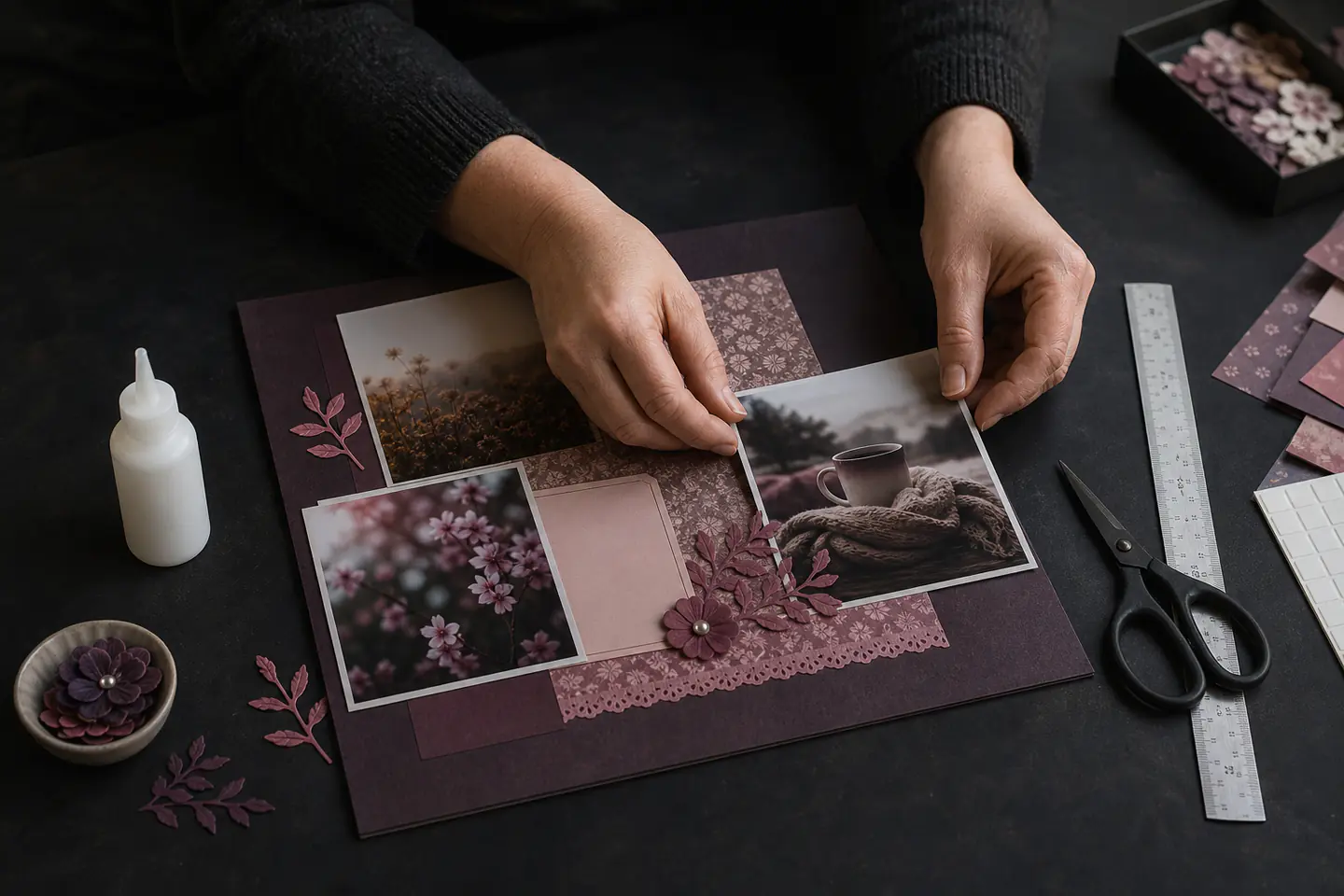
Choose one event or ordinary moment, print one to three photos and place them loosely on a sheet before attaching anything. Add a title and two or three sentences in your own words. Slide the finished page into a protective album sleeve.
- 01
Work with copies or replaceable prints while learning; keep irreplaceable originals stored separately.
- 02
Choose products described as acid-free and photo-safe, but still use adhesive sparingly.
- 03
A ruler, pencil and scissors can make the first page. A trimmer is a convenience, not an entry fee.
- 04
Leave some empty space. A page becomes easier to read when every gap is not filled.
What to expect
The story matters more than the shopping
Scrapbooking can look product-heavy online, yet the durable skill is editing: deciding which image leads, what detail is worth recording and what can be left out.
Layout
Move everything while it is dry. One clear focal photo usually works better than several equal-sized images competing for attention.
Journalling
Names, place, date and one remembered detail are more useful later than a page made entirely from decorative slogans.
Adhesive
Too much liquid glue can buckle paper and make later conservation difficult. Use small controlled amounts and let the page dry flat.
Materials
Decorative paper and ephemera can age differently. Keep newspaper, receipts and acidic originals in separate protective enclosures or use copies.
Style
The first pages will not all match. Repetition gradually reveals which colours, spacing and level of decoration actually feel natural.
Photo care
Make the page without risking the only copy
Separate preservation from decoration
An album page is a display object, not the safest possible archive for every original. National Archives and Library of Congress guidance favours cool, dry, stable storage and chemically stable enclosures. Scan or reprint photographs that cannot be replaced, then enjoy designing with the copies.
Use reversible choices where they matter
Photo corners hold a print without coating its back and make replacement easier. A small amount of photo-safe adhesive is reasonable for modern duplicates and ordinary paper elements. Avoid self-adhesive magnetic albums, rubber cement, pressure-sensitive tape and unknown glue on valued material.
Protect the whole page
A top-loading sleeve reduces handling and rubbing. Check that pages and sleeves are sold as acid-free and photo-safe, then store the closed album upright or flat away from radiators, damp and direct sun. Those labels help, but good environment and careful handling still do most of the preservation work.
Starter products
A useful album, paper and controlled adhesive
The album sets the page size, the paper gives a coordinated starting palette and the precision glue handles paper details. Use photo corners for irreplaceable originals; the checked glue is best treated as a controlled craft adhesive, not a reason to coat entire photographs.
Lanpn 12 × 12 Archival Top-Load Album
The top-loading format lets a page be arranged on a flat sheet and protected after it is complete.
Bearly Art Precision Craft Glue Mini, 2 fl oz
Fine tips make small dots and lines possible, reducing mess and buckling on paper layers.
Stamperia Silent Sea 12 × 12 Paper Pad
Matching 12 × 12 sheets remove an early colour-shopping problem and can form backgrounds, borders and cards.
First page
Build one page around one sentence
Pick a moment small enough to finish. The aim is a readable memory, not a catalogue of every technique.
- 01
Choose the story
Write one sentence about what the page should preserve. Select one leading photo and up to two supporting images.
- 02
Make safe working copies
Scan and reprint any unique photograph or document. Record names and dates separately before arranging it.
- 03
Choose a quiet background
Start with one sheet or a plain base plus one patterned strip. Avoid cutting until the main photo position feels settled.
- 04
Arrange without glue
Place the title, photos and journalling block. Keep important faces and words away from the page edge and sleeve holes.
- 05
Attach in layers
Fix the largest pieces first with minimal adhesive, then add smaller paper elements. Allow liquid glue to dry flat.
- 06
Write the useful detail
Add names, place, approximate date and the detail that a future reader would not know from the picture alone.
Composition
Improve the layout before buying decoration
Build a simple visual hierarchy
Make one photo largest, repeat one colour in two or three places and align several edges. These small rules create order without a template. Test the arrangement through a phone photograph; the dominant element and awkward gaps are often easier to see at thumbnail size.
Cut deliberately
Scissors and a ruler are enough for occasional straight cuts. A small paper trimmer makes repeated mats faster, but the checked Fiskars model is A4-sized: it will not cut the full edge of every 12 × 12 sheet in one pass. It suits photo mats, journalling cards and smaller paper pieces. Buy a true 12-inch trimmer later if full-sheet work becomes routine.
Let journalling breathe
Draft text on scrap paper first or print it on a separate card. A small mistake can then be replaced without dismantling the page. Decorative labels should support the actual story rather than substitute for it.
Skip for now
What can wait
A coherent page needs fewer categories of supplies than a craft-room tour suggests.
- 01
The A4 paper trimmer
Useful for photo mats and repeated small cuts after scissors become slow. It is not a full-width 12 × 12 cutter.
- 02
A die-cutting machine
Machines add repeatable shapes and lettering but also dies, storage and a new design system. Prove that handmade pages hold attention first.
- 03
Large sticker collections
Theme-specific packs are easy to buy and hard to use. Finish several pages before choosing embellishments around a genuine recurring style.
- 04
Original tickets and newspaper
Scan or photocopy unstable ephemera. Keep valued originals separately rather than trapping unknown inks and acids against photographs.
- 05
A printer upgrade
Small batches from a trusted photo lab are a sensible starting point. Home printing matters when control and frequent iteration justify ink and paper costs.
Upgrade path
Add speed or preservation—not clutter
Each upgrade should solve a repeated limitation in pages already being made.
One protected page
About £30–£5012 × 12 album + safe attachment + a few prints
Learn selection, placement, journalling and page protection.Repeatable cutting
About £20–£45Paper trimmer + metal ruler + cutting mat
Create consistent borders and batches of journalling cards faster.Personal visual system
About £30–£100 over timeSmall coordinated paper and embellishment library
Repeat colours and motifs without buying for every individual page.Archival family project
Project dependentScans + preservation enclosures + labelled digital backup
Separate long-term care of originals from the creative display copy.Safety
Protect the person and the photographs
Most risks are modest, but blades, sprays and old material still deserve deliberate handling.
- Cut away from hands on a stable surface; retract or cover blades when they are not in use.
- Use spray adhesive, solvent products and fixatives only with the ventilation and protective equipment specified by the maker.
- Wash hands before handling photographs and avoid food or drinks over irreplaceable material.
- Do not dismantle historically important, mouldy or badly damaged albums without conservation advice.
- Keep small blades, eyelets and embellishments away from children and pets.
Classes
When outside help is useful
A class is optional. It is most valuable for trying specialist tools, learning album construction or getting feedback on a coherent multi-page project.
Use national preservation guides before placing unique photographs, letters or newsprint into a decorative album.
Look for a session that includes materials and a completed page rather than a sales demonstration.
Useful when the aim shifts from decorating pages to constructing a durable custom album.
Representative UK availability and prices checked 27 July 2026; local subsidised sessions vary widely.
Sources
Where the guidance came from
Preservation advice comes from national and museum collections guidance. Community discussions informed the deliberately small starter list and the recurring preference for a reliable trimmer once cutting becomes frequent.
-
01
The National Archives · Storing family papers and photographs
Stable storage, handling and enclosure guidance for personal archives.
Open source -
02
Library of Congress · Care, handling and storage of albums and scrapbooks
Preservation risks in albums and practical storage guidance.
Open source -
03
Florida Department of State · Preserving scrapbooks
Advice on acidic materials, adhesives, sleeves and copies.
Open source -
04
American Museum of Natural History · Preserving personal books and papers
Environmental and handling principles for personal collections.
Open source -
05
r/scrapbooking · Beginner essentials
Community advice to begin with an album, adhesive, paper and cutting basics.
Open source -
06
r/scrapbooking · First photo-album supplies in the UK
UK beginner discussion about photo prints, albums, adhesive and accessible sources.
Open source -
07
Morley College London · Textile scrapbooks
Representative UK structured scrapbook course and tool-supported learning.
Open source -
08
Amazon UK · Lanpn 12 × 12 archival album
Exact top-loading 30-sleeve album; £18.99 observed and available.
Open source -
09
Amazon UK · Bearly Art Precision Craft Glue Mini
Exact acid-free precision adhesive; £14.99 observed and available.
Open source -
10
Amazon UK · Stamperia Silent Sea paper pad
Exact 12 × 12 acid-free double-sided pad; £13.23 observed and available.
Open source -
11
Amazon UK · Fiskars SureCut A4 trimmer
Exact A4 narrow-base trimmer; £23.80 observed and available.
Open source
Guide information and links checked 27 July 2026.