Beginner’s guide · Reflect & explore
Learn one deal from auction
to the final trick.
Bridge becomes approachable when four beginners play open practice deals, separate bidding from card play and review one decision at a time.
Quick answer
Learn the complete turn before studying advanced theory
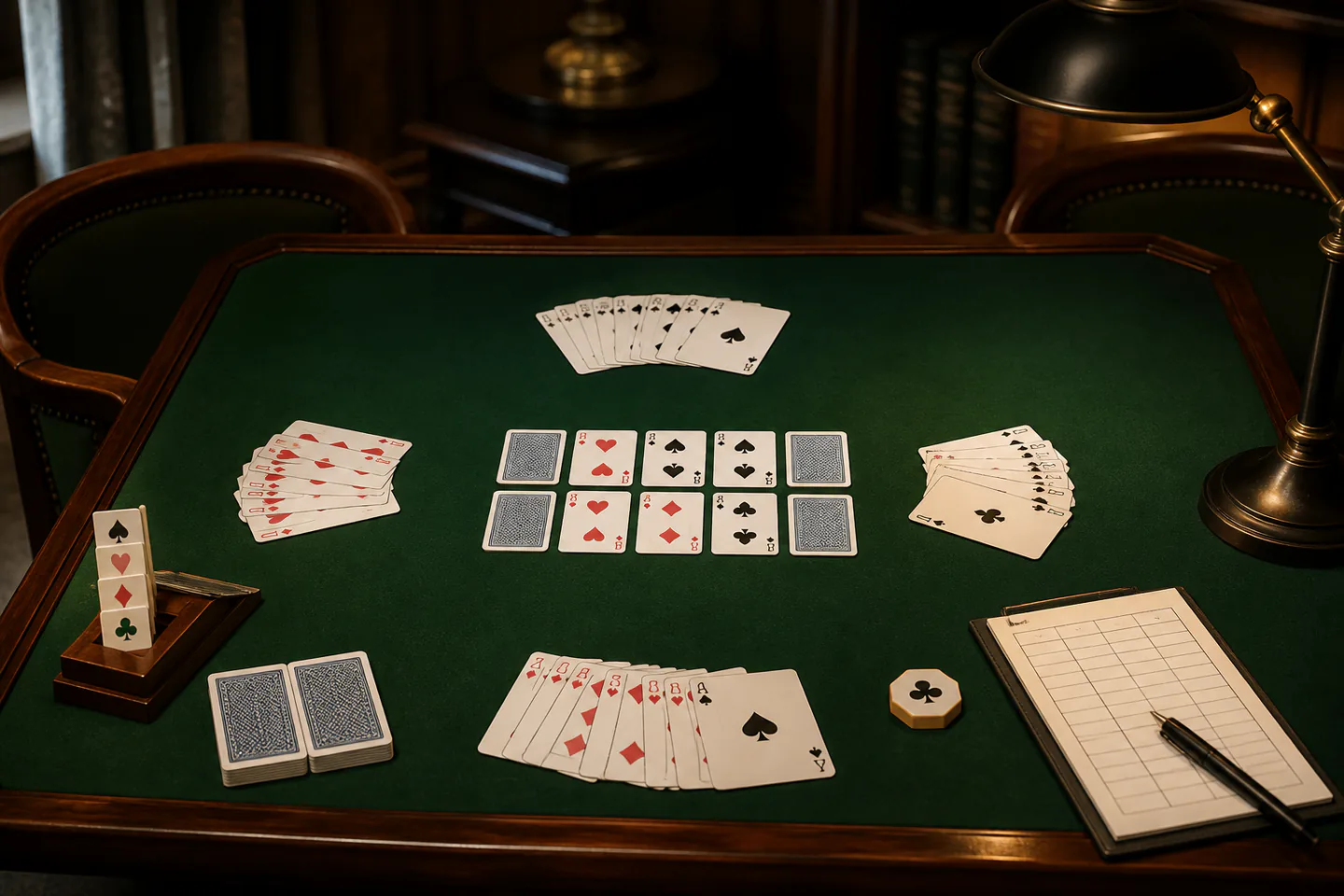
Begin with four open hands and a teacher or beginner app. Learn suits and trick order, make a short natural auction to a simple contract, expose dummy and play all thirteen tricks before introducing conventions.
- 01
Use one standard deck, seat fixed partnerships, sort cards by suit and agree the beginner bidding system and scoring reference before dealing. Keep the first attempt narrow enough that preparation, the main action and the result can all be reviewed together.
- 02
Pause at each call and trick to state legal options and the partnership information available without revealing a concealed hand. Keep the first attempt narrow enough that preparation, the main action and the result can all be reviewed together.
- 03
Review whether the final contract was reasonable, whether declarer counted winners and losers and whether defenders followed suit and communicated legally. Keep the first attempt narrow enough that preparation, the main action and the result can all be reviewed together.
- 04
Return the full deck, rotate dealer, record contract and result and choose one auction or play decision for review before the next deal. Keep the first attempt narrow enough that preparation, the main action and the result can all be reviewed together.
What to expect
Fluent play grows from repeated small decisions
A short open game with visible explanation teaches more than memorising expert sequences without context.
The first attempt
One open-hand deal shows how auction, dummy and trick play connect without making memory and secrecy the first obstacles. For bridge, note what actually happened rather than relying on memory; that turns the next attempt into a controlled change instead of another guess.
The control point
Pause at each call and trick to state legal options and the partnership information available without revealing a concealed hand. For bridge, note what actually happened rather than relying on memory; that turns the next attempt into a controlled change instead of another guess.
The useful signal
Review whether the final contract was reasonable, whether declarer counted winners and losers and whether defenders followed suit and communicated legally. For bridge, note what actually happened rather than relying on memory; that turns the next attempt into a controlled change instead of another guess.
The common trap
Memorising several conventions before understanding natural bids and trick-taking creates confident calls with no plan for the hand. For bridge, note what actually happened rather than relying on memory; that turns the next attempt into a controlled change instead of another guess.
Core method
Learn the rules, play openly, review and repeat
Prepare deliberately
Use one standard deck, seat fixed partnerships, sort cards by suit and agree the beginner bidding system and scoring reference before dealing. For bridge, note what actually happened rather than relying on memory; that turns the next attempt into a controlled change instead of another guess.
Control the central variable
Pause at each call and trick to state legal options and the partnership information available without revealing a concealed hand. For bridge, note what actually happened rather than relying on memory; that turns the next attempt into a controlled change instead of another guess.
Read the result
Review whether the final contract was reasonable, whether declarer counted winners and losers and whether defenders followed suit and communicated legally. For bridge, note what actually happened rather than relying on memory; that turns the next attempt into a controlled change instead of another guess.
Reset before repeating
Return the full deck, rotate dealer, record contract and result and choose one auction or play decision for review before the next deal. For bridge, note what actually happened rather than relying on memory; that turns the next attempt into a controlled change instead of another guess.
Useful products
Products with a clear job in the setup
Blank cards can support bidding and hand-pattern exercises, flash cards capture one convention at a time and a chess timer is optional discipline rather than bridge equipment.
Apostrophe Games Blank Playing Cards, 180 Cards
Custom cards can isolate one concept without altering a real deck.
Oxford A6 Ruled Flash Cards, Pack of 80
A movable small set prevents a beginner system from becoming an unreadable sheet.
DGT DGT1002 Bonus Chess Timer
It helps a club practise tempo without using a phone at the table.
First project
Play one open-hand contract
Complete auction, dummy, thirteen tricks and scoring before adding a second convention.
- 01
Set up
Use one standard deck, seat fixed partnerships, sort cards by suit and agree the beginner bidding system and scoring reference before dealing. For bridge, note what actually happened rather than relying on memory; that turns the next attempt into a controlled change instead of another guess.
- 02
Begin the first attempt
One open-hand deal shows how auction, dummy and trick play connect without making memory and secrecy the first obstacles. For bridge, note what actually happened rather than relying on memory; that turns the next attempt into a controlled change instead of another guess.
- 03
Hold one variable steady
Pause at each call and trick to state legal options and the partnership information available without revealing a concealed hand. For bridge, note what actually happened rather than relying on memory; that turns the next attempt into a controlled change instead of another guess.
- 04
Inspect the result
Review whether the final contract was reasonable, whether declarer counted winners and losers and whether defenders followed suit and communicated legally. For bridge, note what actually happened rather than relying on memory; that turns the next attempt into a controlled change instead of another guess.
- 05
Reset and record
Return the full deck, rotate dealer, record contract and result and choose one auction or play decision for review before the next deal. For bridge, note what actually happened rather than relying on memory; that turns the next attempt into a controlled change instead of another guess.
What can wait
What can wait until the first result
Delay tournament accessories and advanced systems until ordinary play feels fluent.
- 01
A large first setup
Scale multiplies Memorising several conventions before understanding natural bids and trick-taking creates confident calls with no plan for the hand. before the basic routine is known. For bridge, note what actually happened rather than relying on memory; that turns the next attempt into a controlled change instead of another guess.
- 02
Premium specialist equipment
It should solve a limitation you can describe after several bridge sessions. For bridge, note what actually happened rather than relying on memory; that turns the next attempt into a controlled change instead of another guess.
- 03
Several methods at once
Changing materials and technique together makes the cause of a result hard to see. For bridge, note what actually happened rather than relying on memory; that turns the next attempt into a controlled change instead of another guess.
- 04
Buying for a future version
Finish and review the small route before equipping an imagined advanced practice. For bridge, note what actually happened rather than relying on memory; that turns the next attempt into a controlled change instead of another guess.
Upgrade path
Upgrade the repeated limitation
Add study and competition only after games are easy to complete.
Try it
About £5–£25 or free onlineStandard deck and one-page rules
Complete one meaningful result and learn the whole sequence.Repeat it
About £5–£25 or free onlineBeginner app or four-person practice group
Reduce setup friction and compare several attempts.Improve the bottleneck
£100–£400One agreed bidding system and guided review
Address Memorising several conventions before understanding natural bids and trick-taking creates confident calls with no plan for the hand. with a targeted change.Go deeper
VariableDuplicate club sessions and convention card
Add scale, precision or public participation with evidence from practice.Safety & care
Keep partnership information inside the rules
Bridge depends on disclosed agreements, tempo awareness and respectful partnership behaviour.
- Use the same explained bidding system with both partnerships in learning games. Follow current manufacturer, food-safety, access, wildlife or local guidance wherever it applies.
- Do not signal through tone, gesture, card handling or remarks about concealed cards. Follow current manufacturer, food-safety, access, wildlife or local guidance wherever it applies.
- Take movement and vision breaks during long sessions. Follow current manufacturer, food-safety, access, wildlife or local guidance wherever it applies.
- Protect account and payment details when using online bridge services. Follow current manufacturer, food-safety, access, wildlife or local guidance wherever it applies.
- Treat errors as review material and avoid blaming a partner for one result. Follow current manufacturer, food-safety, access, wildlife or local guidance wherever it applies.
Outside help
When outside help earns its place
An English Bridge Union beginner course is valuable because bidding is a shared language best learned with complete deals and live correction.
Use one complete lesson that covers preparation, the central technique, common mistakes and finishing. For a first bridge attempt, one coherent method is easier to diagnose than fragments collected from several creators.
Outside help earns its place when safe setup, access, identification or live correction removes a real obstacle. Ask what equipment, materials, access and follow-up support are included before booking.
Representative UK learning options checked 31 August 2026; local prices, access, materials and tutor support vary.
Sources
Where the guidance came from
The method is grounded in specialist, manufacturer and public guidance, then checked against recurring beginner problems and the exact products linked here.
-
01
English Bridge Union · Learn bridge
UK beginner courses, rules and clubs.
Open source -
02
World Bridge Federation · Laws
Current laws and competition framework.
Open source -
03
American Contract Bridge League · Learn
Beginner bridge teaching and practice.
Open source -
04
Bridge Base Online
Online practice and beginner playing context.
Open source -
05
Reddit · r/bridge
Community evidence on learning systems, practice and beginner mistakes.
Open source -
06
Amazon UK · Blank Playing Cards, 180 Cards
Exact Amazon UK product page or ISBN used for the recommendation; current price, seller, specification and availability should be confirmed.
Open source -
07
Amazon UK · A6 Ruled Flash Cards, Pack of 80
Exact Amazon UK product page or ISBN used for the recommendation; current price, seller, specification and availability should be confirmed.
Open source -
08
Amazon UK · DGT1002 Bonus Chess Timer
Exact Amazon UK product page or ISBN used for the recommendation; current price, seller, specification and availability should be confirmed.
Open source
Guide information and links checked 31 August 2026.