Beginner’s guide · Make & create
Make one wheel turn freely,
then make the toy beautiful.
A simple pull-along body with bought wheels and axles teaches square cutting, drilling, edge rounding and assembly. Decorative objects are not automatically safe children’s toys.
Quick answer
Build a decorative prototype before a child’s toy
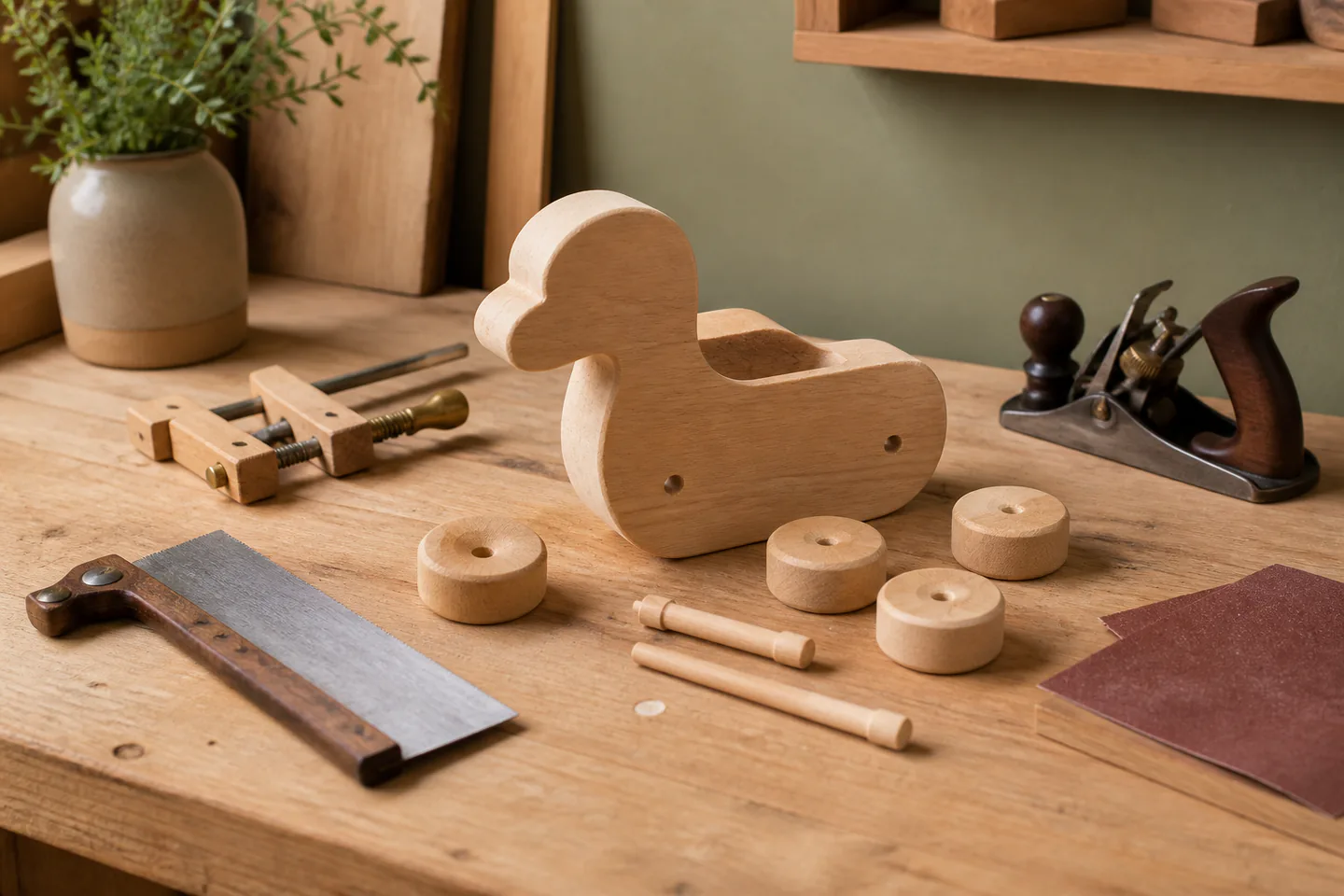
Use traceable solid timber, a simple rectangular body and bought matching wheels and axles. Saw and plane the body, drill paired axle holes with a guide, dry-fit until all wheels turn freely, round every accessible edge and finish the first object as a decorative prototype.
- 01
The age and intended use determine hazards such as small parts, cords, coatings and impact. Keep the first attempt narrow enough that preparation, the main action and the result can all be reviewed together.
- 02
A finish described as natural or non-toxic does not by itself prove a completed toy is compliant. Keep the first attempt narrow enough that preparation, the main action and the result can all be reviewed together.
- 03
Paired axle holes must be parallel or the toy will bind and veer. Keep the first attempt narrow enough that preparation, the main action and the result can all be reviewed together.
- 04
Use tight mechanical construction and traceable materials rather than relying on glue to hide poor fit. Keep the first attempt narrow enough that preparation, the main action and the result can all be reviewed together.
What to expect
Movement exposes accuracy immediately
A body can look square while one axle hole is enough out of line to make a wheel rub.
Wood
Close-grained timber and sound plywood behave predictably; splinters, knots and unknown coatings do not. For wooden toy making, note what actually happened rather than relying on memory; that turns the next attempt into a controlled change instead of another guess.
Axles
Wheel bore, axle diameter, washer space and end retention must work as one system. For wooden toy making, note what actually happened rather than relying on memory; that turns the next attempt into a controlled change instead of another guess.
Edges
A small chamfer or round-over changes handling and reduces fragile corners. For wooden toy making, note what actually happened rather than relying on memory; that turns the next attempt into a controlled change instead of another guess.
Safety status
A handmade object intended for play may enter product-safety duties even if it is given rather than sold. For wooden toy making, note what actually happened rather than relying on memory; that turns the next attempt into a controlled change instead of another guess.
Core method
Build accuracy and safety into the prototype
Define the user and status
Decide whether this is a decorative model, adult desk toy or product intended for a child. For wooden toy making, note what actually happened rather than relying on memory; that turns the next attempt into a controlled change instead of another guess.
Prepare the body
Mark from one reference face, saw slightly proud and plane to the line. For wooden toy making, note what actually happened rather than relying on memory; that turns the next attempt into a controlled change instead of another guess.
Drill as a matched operation
Clamp a fence or guide and drill both axle positions from consistent references. For wooden toy making, note what actually happened rather than relying on memory; that turns the next attempt into a controlled change instead of another guess.
Fit, finish and reassess
Test rolling before glue, remove sharpness and review every detachable part and coating. For wooden toy making, note what actually happened rather than relying on memory; that turns the next attempt into a controlled change instead of another guess.
Useful products
Products with a clear job in the setup
The saw, clamps and block plane form a simple hand-tool route. Wheels, axles and any coating should be chosen as a compatible traceable system from a specialist supplier.
Spear & Jackson Predator 10-Inch Tenon Saw
It can prepare simple toy bodies and axles without a powered machine.
IRWIN Quick-Grip 300 mm Clamps, Twin Pack
Stable work is easier to cut accurately and keeps hands farther from tools.
Stanley No. 220 Block Plane
Rounded and chamfered edges improve handling on a first wooden toy.
First project
Make a four-wheel rolling prototype
Keep the silhouette plain so wheel alignment and edge quality remain the actual project.
- 01
Mark one reference face
Take every length and hole position from the same edge. For wooden toy making, note what actually happened rather than relying on memory; that turns the next attempt into a controlled change instead of another guess.
- 02
Cut and true
Saw the body and plane the edges straight. For wooden toy making, note what actually happened rather than relying on memory; that turns the next attempt into a controlled change instead of another guess.
- 03
Drill test holes
Use scrap of the same thickness before drilling the body. For wooden toy making, note what actually happened rather than relying on memory; that turns the next attempt into a controlled change instead of another guess.
- 04
Dry-fit the running gear
Check spin, side clearance and straight rolling. For wooden toy making, note what actually happened rather than relying on memory; that turns the next attempt into a controlled change instead of another guess.
- 05
Round and finish
Ease edges, control dust and apply only a researched compatible finish if needed. For wooden toy making, note what actually happened rather than relying on memory; that turns the next attempt into a controlled change instead of another guess.
What can wait
What can wait until the first result
Extra equipment becomes useful only when the basic method has exposed a specific, repeated limitation.
- 01
A pull cord
Length, attachment and loops create additional entanglement questions. For wooden toy making, note what actually happened rather than relying on memory; that turns the next attempt into a controlled change instead of another guess.
- 02
Loose decorative parts
Eyes, buttons and pegs can become small parts. For wooden toy making, note what actually happened rather than relying on memory; that turns the next attempt into a controlled change instead of another guess.
- 03
Complex animal shapes
Thin ears and tails introduce weak grain and breakage. For wooden toy making, note what actually happened rather than relying on memory; that turns the next attempt into a controlled change instead of another guess.
- 04
Selling or gifting as a child’s toy
Compliance, records, marking and testing need a deliberate route. For wooden toy making, note what actually happened rather than relying on memory; that turns the next attempt into a controlled change instead of another guess.
Upgrade path
Upgrade the repeated limitation
Add repeatable jigs and documented safety decisions before decorative complexity.
Decorative prototype
£20–£60Hand tools, body and wheels
Learn alignment and rolling.Repeatable pair
£40–£120Drill guide, template and better holding
Make matched parts consistently.Moving mechanism
£60–£200Cams, linkages and guarded clearances
Add controlled motion.Toy production
VariableRisk assessment, standards and testing
Support lawful supply for children.Safety & care
A smooth finish is not the whole safety case
Small parts, cords, trapped fingers, coatings, impact and foreseeable misuse all matter.
- Use current UK product-safety and toy-safety guidance before presenting an object as suitable for children. Follow current manufacturer, food-safety, access, wildlife or local guidance wherever it applies.
- Clamp work and keep hands behind saws, planes and drills. Follow current manufacturer, food-safety, access, wildlife or local guidance wherever it applies.
- Control wood dust and avoid unknown, treated or contaminated timber. Follow current manufacturer, food-safety, access, wildlife or local guidance wherever it applies.
- Choose finishes and adhesives by documented suitability for the intended use and allow full cure. Follow current manufacturer, food-safety, access, wildlife or local guidance wherever it applies.
- Reject cracked wood, loose axles, detachable small parts and any cord arrangement that has not been assessed. Follow current manufacturer, food-safety, access, wildlife or local guidance wherever it applies.
Outside help
When outside help earns its place
A woodworking induction helps with drilling and edge tools; commercial toy making needs standards or testing advice as well.
Look for work holding, drilling square and edge-tool safety.
Use competent current UK guidance before supplying an object for child play.
Representative UK learning options checked 31 August 2026; local prices, access, materials and tutor support vary.
Sources
Where the guidance came from
Official toy-safety guidance sets the legal boundary; woodworking sources support accurate, controlled construction of the prototype.
-
01
UK Government · Toy safety regulations
Official duties for toy manufacturers and suppliers.
Open source -
02
BSI · Playing Safe consumer guide
Overview of the BS EN 71 toy-safety series.
Open source -
03
HSE · Woodworking
UK woodworking hazard and control guidance.
Open source -
04
HSE · Wood dust
Wood-dust health risks and controls.
Open source -
05
British Woodworking Federation
UK woodworking industry context and good practice.
Open source -
06
Amazon UK · Predator 10-Inch Tenon Saw
Exact Amazon UK product page or ISBN used for the recommendation; current price, seller, specification and availability should be confirmed.
Open source -
07
Amazon UK · Quick-Grip 300 mm Clamps, Twin Pack
Exact Amazon UK product page or ISBN used for the recommendation; current price, seller, specification and availability should be confirmed.
Open source -
08
Amazon UK · No. 220 Block Plane
Exact Amazon UK product page or ISBN used for the recommendation; current price, seller, specification and availability should be confirmed.
Open source
Guide information and links checked 31 August 2026.