Beginner’s guide · Grow & care
Plan one bed for the vase
and sow in small successions.
Cut-flower growing works best as a narrow seasonal plan linking site, cultivar, succession sowing, support, harvest stage and post-harvest care.
Quick answer
Stabilise one small living system first
Measure one sunny bed or a few large containers, choose three reliable annual cut flowers with different forms and sow small batches at recommended intervals. Support early, water roots deeply and harvest into clean water at the correct stage.
- 01
Record sun, soil, water access, wind and vase goals, then make a dated sowing plan using named cultivars suitable for cutting. Keep the first attempt narrow enough that preparation, the main action and the result can all be reviewed together.
- 02
Keep spacing, support and watering consistent while staggering one crop in small successions rather than sowing the whole packet at once. Keep the first attempt narrow enough that preparation, the main action and the result can all be reviewed together.
- 03
Track stem length, strength, pest pressure, harvest stage and vase life so next season’s plan reflects useful flowers rather than seed-catalogue variety. Keep the first attempt narrow enough that preparation, the main action and the result can all be reviewed together.
- 04
Clean secateurs and buckets, remove diseased material appropriately and update the sowing and harvest record after every cutting session. Keep the first attempt narrow enough that preparation, the main action and the result can all be reviewed together.
What to expect
Water quality and routine matter more than a busy installation
A small observed system exposes imbalances sooner and is easier to correct than an ambitious first build.
The first attempt
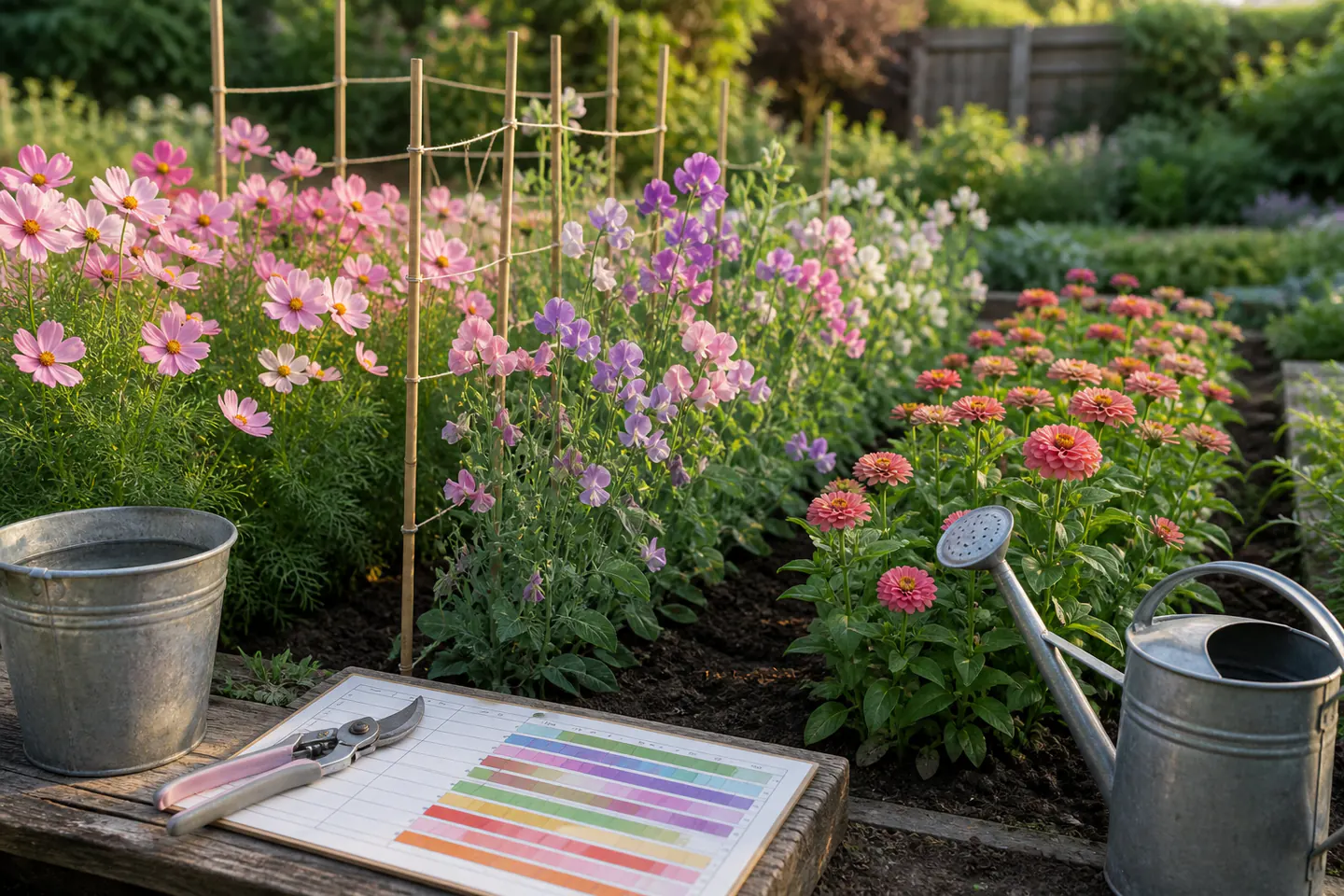
Cosmos, calendula, sweet peas or zinnias can supply a first vase while teaching pinching, support and repeated picking. For cut-flower growing, note what actually happened rather than relying on memory; that turns the next attempt into a controlled change instead of another guess.
The control point
Keep spacing, support and watering consistent while staggering one crop in small successions rather than sowing the whole packet at once. For cut-flower growing, note what actually happened rather than relying on memory; that turns the next attempt into a controlled change instead of another guess.
The useful signal
Track stem length, strength, pest pressure, harvest stage and vase life so next season’s plan reflects useful flowers rather than seed-catalogue variety. For cut-flower growing, note what actually happened rather than relying on memory; that turns the next attempt into a controlled change instead of another guess.
The common trap
Too many species create incompatible sowing, support and harvest schedules and leave too few stems of any one kind for a coherent vase. For cut-flower growing, note what actually happened rather than relying on memory; that turns the next attempt into a controlled change instead of another guess.
Core method
Cycle, measure, adjust slowly and keep records
Prepare deliberately
Record sun, soil, water access, wind and vase goals, then make a dated sowing plan using named cultivars suitable for cutting. For cut-flower growing, note what actually happened rather than relying on memory; that turns the next attempt into a controlled change instead of another guess.
Control the central variable
Keep spacing, support and watering consistent while staggering one crop in small successions rather than sowing the whole packet at once. For cut-flower growing, note what actually happened rather than relying on memory; that turns the next attempt into a controlled change instead of another guess.
Read the result
Track stem length, strength, pest pressure, harvest stage and vase life so next season’s plan reflects useful flowers rather than seed-catalogue variety. For cut-flower growing, note what actually happened rather than relying on memory; that turns the next attempt into a controlled change instead of another guess.
Reset before repeating
Clean secateurs and buckets, remove diseased material appropriately and update the sowing and harvest record after every cutting session. For cut-flower growing, note what actually happened rather than relying on memory; that turns the next attempt into a controlled change instead of another guess.
Useful products
Products with a clear job in the setup
Reliable bypass secateurs solve clean harvest cuts, while the two books provide seasonal and vegetable-plot planning that transfers to a small productive cutting bed.
FELCO FELCO 2 Classic Secateurs
Replaceable parts and a clean bypass action suit repeated harvesting.
Alan Buckingham Allotment Month by Month
The calendar mindset supports small successions and timely bed preparation.
Lucy Chamberlain RHS Step-by-Step Veg Patch
Productive-bed discipline applies well to cut flowers even though the examples include vegetables.
First project
Grow three annuals for one mixed vase
Choose one focal flower, one airy filler and one vertical form, then sow enough of each to cut generously.
- 01
Set up
Record sun, soil, water access, wind and vase goals, then make a dated sowing plan using named cultivars suitable for cutting. For cut-flower growing, note what actually happened rather than relying on memory; that turns the next attempt into a controlled change instead of another guess.
- 02
Begin the first attempt
Cosmos, calendula, sweet peas or zinnias can supply a first vase while teaching pinching, support and repeated picking. For cut-flower growing, note what actually happened rather than relying on memory; that turns the next attempt into a controlled change instead of another guess.
- 03
Hold one variable steady
Keep spacing, support and watering consistent while staggering one crop in small successions rather than sowing the whole packet at once. For cut-flower growing, note what actually happened rather than relying on memory; that turns the next attempt into a controlled change instead of another guess.
- 04
Inspect the result
Track stem length, strength, pest pressure, harvest stage and vase life so next season’s plan reflects useful flowers rather than seed-catalogue variety. For cut-flower growing, note what actually happened rather than relying on memory; that turns the next attempt into a controlled change instead of another guess.
- 05
Reset and record
Clean secateurs and buckets, remove diseased material appropriately and update the sowing and harvest record after every cutting session. For cut-flower growing, note what actually happened rather than relying on memory; that turns the next attempt into a controlled change instead of another guess.
What can wait
What can wait until the first result
Delay extra capacity and livestock until the small system remains stable.
- 01
A large first setup
Scale multiplies Too many species create incompatible sowing, support and harvest schedules and leave too few stems of any one kind for a coherent vase. before the basic routine is known. For cut-flower growing, note what actually happened rather than relying on memory; that turns the next attempt into a controlled change instead of another guess.
- 02
Premium specialist equipment
It should solve a limitation you can describe after several cut-flower growing sessions. For cut-flower growing, note what actually happened rather than relying on memory; that turns the next attempt into a controlled change instead of another guess.
- 03
Several methods at once
Changing materials and technique together makes the cause of a result hard to see. For cut-flower growing, note what actually happened rather than relying on memory; that turns the next attempt into a controlled change instead of another guess.
- 04
Buying for a future version
Finish and review the small route before equipping an imagined advanced practice. For cut-flower growing, note what actually happened rather than relying on memory; that turns the next attempt into a controlled change instead of another guess.
Upgrade path
Upgrade the repeated limitation
Increase capacity only after maintenance is predictable.
Try it
About £35–£100One prepared bed and three seed packets
Complete one meaningful result and learn the whole sequence.Repeat it
About £35–£100Succession plan, supports and clean buckets
Reduce setup friction and compare several attempts.Improve the bottleneck
£100–£400Propagation space and season extension
Address Too many species create incompatible sowing, support and harvest schedules and leave too few stems of any one kind for a coherent vase. with a targeted change.Go deeper
VariablePerennials, shrubs and planned event quantities
Add scale, precision or public participation with evidence from practice.Safety & care
Harvest safely and protect garden ecology
Correct plant identity, clean tools and proportionate pest control matter because stems enter the home.
- Identify every plant and keep toxic species away from children, pets and food preparation. Follow current manufacturer, food-safety, access, wildlife or local guidance wherever it applies.
- Use clean sharp secateurs and carry them closed with the blade away from the body. Follow current manufacturer, food-safety, access, wildlife or local guidance wherever it applies.
- Follow pesticide labels for ornamental crops, pollinators, re-entry and disposal. Follow current manufacturer, food-safety, access, wildlife or local guidance wherever it applies.
- Do not collect wild flowers or foliage without permission and legal certainty. Follow current manufacturer, food-safety, access, wildlife or local guidance wherever it applies.
- Lift water-filled buckets carefully and avoid leaving them where small children could access them. Follow current manufacturer, food-safety, access, wildlife or local guidance wherever it applies.
Outside help
When outside help earns its place
A local flower farm workshop is useful for cultivar choice and harvest stage, but an RHS-led sowing calendar is enough for the first bed.
Use one complete lesson that covers preparation, the central technique, common mistakes and finishing. For a first cut-flower growing attempt, one coherent method is easier to diagnose than fragments collected from several creators.
Outside help earns its place when safe setup, access, identification or live correction removes a real obstacle. Ask what equipment, materials, access and follow-up support are included before booking.
Representative UK learning options checked 31 August 2026; local prices, access, materials and tutor support vary.
Sources
Where the guidance came from
The method is grounded in specialist, manufacturer and public guidance, then checked against recurring beginner problems and the exact products linked here.
-
01
RHS · Cut flowers
UK plant choice, growing and cutting guidance.
Open source -
02
Garden Organic · Growing advice
Soil, sowing and wildlife-aware growing.
Open source -
03
National Garden Scheme · Cut flowers
UK garden and seasonal learning context.
Open source -
04
Flowers from the Farm
UK seasonal flower farms and training context.
Open source -
05
Reddit · r/Cutflowers
Community evidence on varieties, support, harvest and vase life.
Open source -
06
Amazon UK · FELCO 2 Classic Secateurs
Exact Amazon UK product page or ISBN used for the recommendation; current price, seller, specification and availability should be confirmed.
Open source -
07
Amazon UK · Allotment Month by Month
Exact Amazon UK product page or ISBN used for the recommendation; current price, seller, specification and availability should be confirmed.
Open source -
08
Amazon UK · RHS Step-by-Step Veg Patch
Exact Amazon UK product page or ISBN used for the recommendation; current price, seller, specification and availability should be confirmed.
Open source
Guide information and links checked 31 August 2026.