Beginner’s guide · Play & perform
A relaxed one-minute single-stroke pattern in time
Learn rebound and time before buying a full kit.
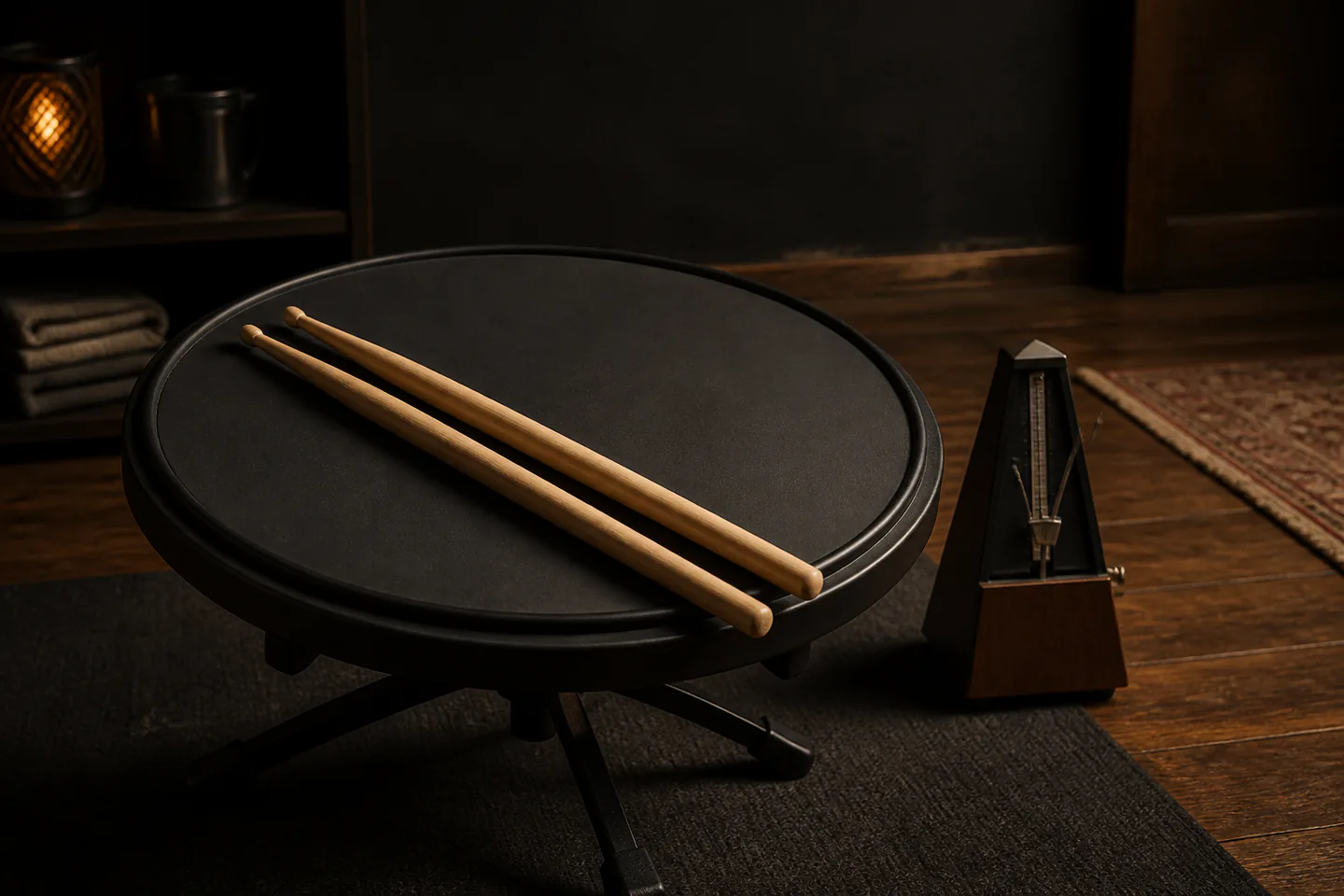
Start with a 12-inch practice pad, 5A sticks and a metronome. Controlled full strokes, taps and one basic rudiment build grip and pulse quietly enough to test the hobby without storing a drum kit.
Quick answer
Play alternating full strokes on a pad at a slow click
Place a 12-inch pad on a stable stand or firm surface at a height that lets forearms slope slightly downward. Hold matched 5A sticks with a relaxed fulcrum, let the remaining fingers guide rather than squeeze and play alternating right–left full strokes at 60 beats per minute. Aim for equal stick heights, sound and rebound. Add groups of four low taps, then record one minute without increasing tempo when tension appears.
- 01
A practice pad teaches grip, rebound, timing and rudiments but not full-kit coordination or sound production.
- 02
5A is a common middle-size starting point, not a universal anatomical rule. Try sticks if grip size or weight causes strain.
- 03
A pillow removes rebound and can be a brief control exercise, but a good pad gives clearer feedback and lower impact.
- 04
Pads are quieter than drums, not silent. Use a mat, sensible hours and a non-resonant stand to reduce transmission.
What to expect
What the first drumming result really teaches
Drumming is movement organised in time. Speed is the outcome of relaxed repeatable motion, not a target reached by squeezing the sticks.
Grip
A stable fulcrum and guiding back fingers allow the stick to rebound; clenched hands choke it.
Height
Matching stick heights produces more equal dynamics before the ears judge fine tone.
Click
Place notes with the metronome, then use subdivisions rather than following it reactively.
Weak hand
Lead simple exercises with the non-dominant hand and keep tempo where both hands remain relaxed.
Rudiment
A single stroke, double stroke and paradiddle are movement vocabularies, not races.
Transfer
A tutor or real kit later teaches pedals, cymbal angles, drum tone and limb coordination.
Core method
Build one repeatable drumming workflow
Set height and grip
Sit on a stable chair with feet flat and shoulders relaxed. Put the pad around snare height. Balance each stick between thumb and index area without pinching, wrap the other fingers lightly and make slow strokes that return naturally.
Match full strokes
Lift both sticks to the same moderate height and alternate right–left at 60 bpm. Let the tip strike the centre and rebound to its starting height. Stop after a minute, shake out hands and compare grip marks, sound and height.
Add taps and accents
Play four low alternating taps, then one higher accent without squeezing. Keep the unaccented hand low while the accented stick rises. Use a mirror or phone video from the front to check that shoulders and wrists remain symmetrical.
Build a short practice loop
Spend two minutes on full strokes, two on taps and accents, two on a slow single-stroke roll and two applying the pattern to a favourite track. Record the last minute and write the highest relaxed tempo, not the fastest attempted tempo.
Useful products
Products with a clear job in the setup
The Evans RealFeel is the durable pad route, Vic Firth 5A sticks are the conventional baseline and Stick Control supplies a long structured exercise sequence. A free metronome app completes the start.
Evans RealFeel 12-Inch Two-Sided Practice Pad
It recurs in teacher and player recommendations and remains useful after a kit is purchased.
Vic Firth American Classic 5A Drumsticks
5A offers a middle ground from which a player can later choose lighter, heavier or different tips.
George Lawrence Stone Stick Control for the Snare Drummer
It turns the pad into a repeatable curriculum and is widely used by teachers.
First project
Record sixty seconds of even alternating strokes
Equal height, sound and spacing reveal more useful progress than a brief high-speed burst.
- 01
Set pad height
Keep shoulders low and forearms comfortable.
- 02
Find relaxed rebound
Let each stick return without lifting it forcibly.
- 03
Match eight slow strokes
Compare right and left height and tone.
- 04
Add a metronome
Use 60 bpm and count subdivisions aloud.
- 05
Play low taps and accents
Change height rather than grip pressure.
- 06
Record one minute
Stop at tension and log the relaxed tempo.
What can wait
What can wait until the first result
A full acoustic or electronic kit multiplies space, sound and coordination before the hands and practice habit are tested.
- 01
A full drum kit
A pad establishes whether regular timing practice is enjoyable and sustainable.
- 02
Very heavy sticks
Extra weight is not a shortcut to speed and may reinforce tension.
- 03
A double pedal
Feet and coordinated kit movement belong after a basic pulse and supervised setup.
- 04
High practice volume
Hearing risk applies to rehearsal rooms, headphones and electronic kits as well as acoustic drums.
- 05
Speed targets
Increase tempo only after several relaxed accurate repetitions.
Upgrade path
Upgrade the repeated limitation
Move from hand control to kit coordination when regular pad practice creates a specific musical goal.
Pad start
About £45–£7012-inch pad + 5A sticks + metronome
Learn grip, rebound and pulse.Stand and lessons
About £60–£220Pad stand + focused tuition
Improve ergonomics and movement.Electronic practice kit
About £350–£1,200Mesh kit + throne + headphones
Add pedals and coordination at reduced acoustic volume.Acoustic setup
About £700–£3,000+Kit, cymbals, treatment and hearing protection
Develop touch and ensemble sound.Safety & care
Protect hearing, joints and neighbours
Repetition, high impact, unstable stands and loud rehearsal spaces cause preventable trouble even before a full kit appears.
- Use relaxed motion, warm up gradually and stop for sharp pain, numbness, swelling or persistent tingling.
- Set pad, chair and later drums to avoid raised shoulders, twisted wrists and unsupported lower back.
- Keep pads and stands stable, check stick splinters and never practise where a flying or broken stick can hit another person.
- Use suitable hearing protection around acoustic drums and moderate headphone or electronic-kit volume.
- Respect shared-space hours and isolate stand contact where possible; a pad can transmit repetitive impact through floors.
Outside help
When outside help earns its place
A pad and good demonstrations can start the hands. An early teacher is valuable because small grip, height and posture issues are easier to correct before speed makes them habitual.
Use grip, rudiment and practice material from established educators.
Take the pad and ask for grip, rebound, timing and ergonomic feedback.
Representative UK product, workshop, lesson and club costs checked 13 August 2026; local prices, access, materials and tutor support vary.
Sources
Where the guidance came from
Instrument makers and percussion organisations establish technique and rudiments; long-running drum communities provide pad, stick and practice evidence.
-
01
Percussive Arts Society · Rudiments
Standard international drum rudiment reference.
Open source -
02
Vic Firth · Education
Manufacturer-supported technique and educator resources.
Open source -
03
Evans · RealFeel pads
Manufacturer pad specifications and use.
Open source -
04
Drumeo · Beginner lessons
Specialist structured drumming instruction.
Open source -
05
Reddit · r/drums
Recurring recommendations for pads, 5A sticks and first practice.
Open source -
06
Amazon UK · Evans RealFeel 12-inch pad
Exact product page, model or ISBN, observed price and availability checked for this guide.
Open source -
07
Amazon UK · Vic Firth American Classic 5A
Exact product page, model or ISBN, observed price and availability checked for this guide.
Open source -
08
Amazon UK · Stick Control book
Exact product page, model or ISBN, observed price and availability checked for this guide.
Open source
Guide information and links checked 13 August 2026.