Beginner’s guide · Make & create
Stabilise one worn book,
and know when to stop.
Begin with an ordinary replaceable book and reversible conservation-minded materials. Valuable, rare, mouldy, wet or structurally complex books belong with a qualified conservator.
Quick answer
Practise on a replaceable book, not an heirloom
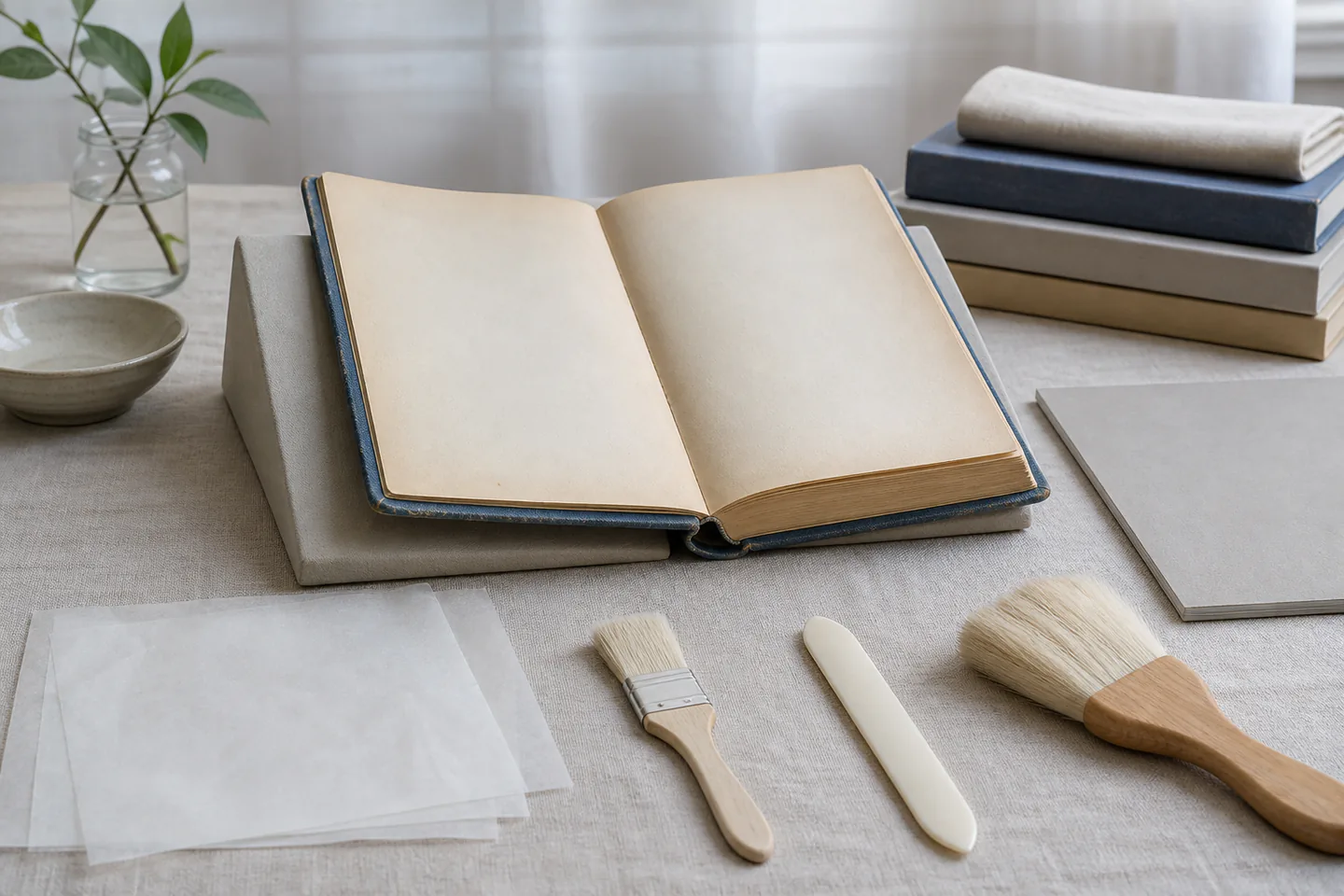
Choose a common modern book with no financial or family value, photograph and describe its condition, surface-clean only where appropriate, make a protective enclosure first, then attempt one minimal repair using reversible conservation-minded material and stop if moisture, mould, leather, coated paper or structural sewing is involved.
- 01
The first question is whether repair is needed, not which glue to apply. Keep the first attempt narrow enough that preparation, the main action and the result can all be reviewed together.
- 02
Pressure-sensitive household tape and general-purpose glue cause stains and difficult future work. Keep the first attempt narrow enough that preparation, the main action and the result can all be reviewed together.
- 03
Japanese tissue and wheat-starch paste are standard conservation materials, but technique and object value still matter. Keep the first attempt narrow enough that preparation, the main action and the result can all be reviewed together.
- 04
Mould, pests, flood damage and valuable books require professional assessment. Keep the first attempt narrow enough that preparation, the main action and the result can all be reviewed together.
What to expect
A neat repair can still be harmful
Strong modern adhesive may hold today while staining paper, changing flexibility and blocking later conservation.
Value
Market, family and research value can exceed the cost of a replacement copy. For book repair & restoration, note what actually happened rather than relying on memory; that turns the next attempt into a controlled change instead of another guess.
Paper
Brittle, coated or water-sensitive paper reacts differently from ordinary modern stock. For book repair & restoration, note what actually happened rather than relying on memory; that turns the next attempt into a controlled change instead of another guess.
Structure
A loose page, broken hinge and detached board are not the same repair. For book repair & restoration, note what actually happened rather than relying on memory; that turns the next attempt into a controlled change instead of another guess.
Reversibility
No intervention is perfectly reversible, so minimal treatment remains the safer aim. For book repair & restoration, note what actually happened rather than relying on memory; that turns the next attempt into a controlled change instead of another guess.
Core method
Document, support and intervene minimally
Triage the book
Record value, material, damage, mould, odour and previous repairs without forcing the opening. For book repair & restoration, note what actually happened rather than relying on memory; that turns the next attempt into a controlled change instead of another guess.
Clean the workspace
Use dry clean supports and isolate any suspected pest or mould issue. For book repair & restoration, note what actually happened rather than relying on memory; that turns the next attempt into a controlled change instead of another guess.
Make an enclosure
A fitted acid-free box or wrapper can prevent further loss without touching the binding. For book repair & restoration, note what actually happened rather than relying on memory; that turns the next attempt into a controlled change instead of another guess.
Practise one repair
Use a disposable test paper and an ordinary book before applying tissue and paste to a real tear. For book repair & restoration, note what actually happened rather than relying on memory; that turns the next attempt into a controlled change instead of another guess.
Useful products
Products with a clear job in the setup
The Lineco adhesive and tool kits are common bookbinding supplies; conservation tissue and paste may need a specialist supplier. The kits are alternatives and contain more than a first repair requires.
Lineco Neutral pH Adhesive, 8 oz
It is better documented than household glue for new repair structures.
Jodsen 23-piece Bookbinding Tool Kit
It supports enclosures and practice structures as well as repair.
DaKuan 20-piece Bookbinding Tool Set
Choose one kit only after identifying the actual repair.
First project
Make an enclosure and mend one test tear
The enclosure gives an immediate protective result while the tissue test builds control away from the book.
- 01
Document condition
Photograph cover, spine, text block and damage. For book repair & restoration, note what actually happened rather than relying on memory; that turns the next attempt into a controlled change instead of another guess.
- 02
Make a fitted wrapper
Use archival board or paper without adhesive touching the book. For book repair & restoration, note what actually happened rather than relying on memory; that turns the next attempt into a controlled change instead of another guess.
- 03
Prepare a mock tear
Use similar scrap paper and feathered tissue edges. For book repair & restoration, note what actually happened rather than relying on memory; that turns the next attempt into a controlled change instead of another guess.
- 04
Apply minimal paste
Control moisture and align without overlapping the tear. For book repair & restoration, note what actually happened rather than relying on memory; that turns the next attempt into a controlled change instead of another guess.
- 05
Dry under suitable restraint
Use release layers and check for distortion before treating a real page. For book repair & restoration, note what actually happened rather than relying on memory; that turns the next attempt into a controlled change instead of another guess.
What can wait
What can wait until the first result
Extra equipment becomes useful only when the basic method has exposed a specific, repeated limitation.
- 01
Removing old tape
Solvents and weakened paper need conservator judgement. For book repair & restoration, note what actually happened rather than relying on memory; that turns the next attempt into a controlled change instead of another guess.
- 02
Rebacking leather
Materials, tooling and value make it specialist work. For book repair & restoration, note what actually happened rather than relying on memory; that turns the next attempt into a controlled change instead of another guess.
- 03
Flattening wet books
Emergency salvage has time-sensitive mould and blocking risks. For book repair & restoration, note what actually happened rather than relying on memory; that turns the next attempt into a controlled change instead of another guess.
- 04
Making it look new
Restoration that erases evidence can reduce value and integrity. For book repair & restoration, note what actually happened rather than relying on memory; that turns the next attempt into a controlled change instead of another guess.
Upgrade path
Upgrade the repeated limitation
Improve diagnosis and material knowledge before attempting stronger repair.
Protective enclosure
£10–£30Archival board and measured wrapper
Prevent further abrasion and loss.Practice tear repair
£15–£50Japanese tissue, paste and test paper
Learn fibre direction and moisture.Ordinary book repair
£30–£100Appropriate adhesive, cloth and tools
Stabilise a replaceable volume.Conservation treatment
Professional quoteQualified conservator and documentation
Protect valuable or complex material.Safety & care
Valuable and contaminated books are not practice material
Mould exposure, fragile media and irreversible repair can harm both the person and the object.
- Do not work on mouldy, wet, pest-affected, rare, signed, antique or sentimentally valuable books without professional advice. Follow current manufacturer, food-safety, access, wildlife or local guidance wherever it applies.
- Avoid household tape, hot glue and unknown solvent cleaners. Follow current manufacturer, food-safety, access, wildlife or local guidance wherever it applies.
- Use blades on a cutting mat with hands outside the path and store sharps safely. Follow current manufacturer, food-safety, access, wildlife or local guidance wherever it applies.
- Control moisture and test media solubility before any wet treatment. Follow current manufacturer, food-safety, access, wildlife or local guidance wherever it applies.
- Keep food, drink and dirty tools away from the work and document every intervention. Follow current manufacturer, food-safety, access, wildlife or local guidance wherever it applies.
Outside help
When outside help earns its place
A bookbinding class teaches structure; a qualified conservator is needed for valuable objects and complex treatment decisions.
Begin with handling, storage and enclosure advice.
Check whether it distinguishes ordinary repair from conservation treatment.
Representative UK learning options checked 31 August 2026; local prices, access, materials and tutor support vary.
Sources
Where the guidance came from
National conservation bodies prioritise preventive care, minimal reversible intervention and professional referral for valuable or complex books.
-
01
Canadian Conservation Institute · Basic care of books
Authoritative handling, enclosure and repair limits.
Open source -
02
British Library · Collection care
Professional conservation context and preventive care.
Open source -
03
National Archives · Caring for books and documents
UK collection-care guidance.
Open source -
04
Institute of Conservation · Find a conservator
UK route to qualified professional help.
Open source -
05
Library of Congress · Care, handling and storage of books
Preventive care and handling guidance.
Open source -
06
Amazon UK · Neutral pH Adhesive, 8 oz
Exact Amazon UK product page or ISBN used for the recommendation; current price, seller, specification and availability should be confirmed.
Open source -
07
Amazon UK · 23-piece Bookbinding Tool Kit
Exact Amazon UK product page or ISBN used for the recommendation; current price, seller, specification and availability should be confirmed.
Open source -
08
Amazon UK · 20-piece Bookbinding Tool Set
Exact Amazon UK product page or ISBN used for the recommendation; current price, seller, specification and availability should be confirmed.
Open source
Guide information and links checked 31 August 2026.