Beginner’s guide · Cook & bake
Make the dough predictable.
Then turn up the heat.
A normal oven, a metal tray and ingredients weighed in grams are enough to make a useful first pizza. Learn fermentation, shaping and restrained topping before a steel, peel or dedicated pizza oven changes the bake.
Quick answer
Weigh the dough and bake on metal
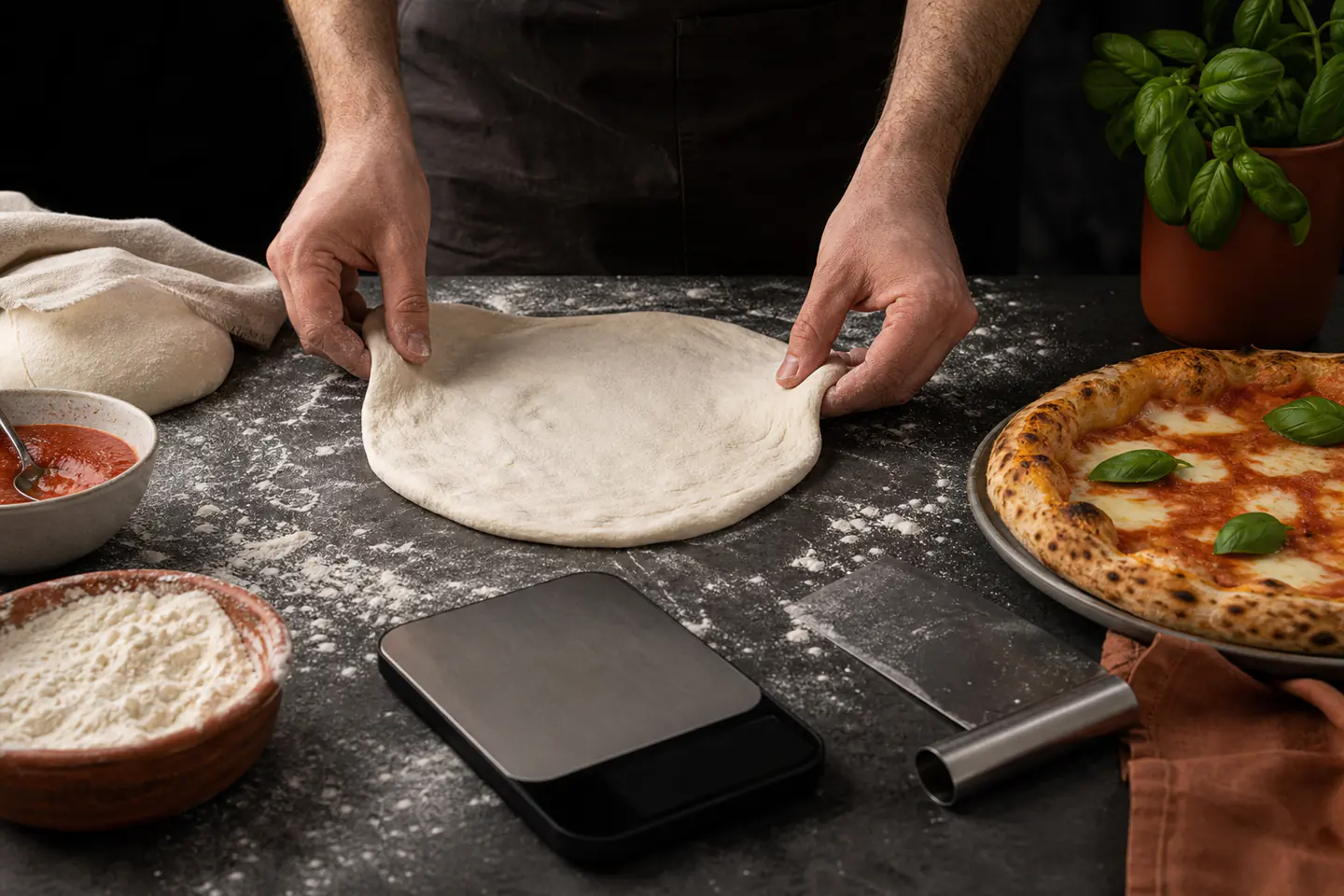
Make one simple yeasted dough by weight, give it enough fermentation time, shape it into a lightly oiled metal tray and top it sparingly. Bake at the oven’s maximum rated temperature until the base is browned and the centre is cooked.
- 01
Use a digital scale for flour, water, salt and yeast. Volume cups hide the ratio that controls the dough.
- 02
Choose a tray pizza for the first bake. It removes the stressful transfer from worktop to hot steel.
- 03
Do not bury the centre under wet sauce and toppings. A home oven needs help evaporating moisture.
- 04
Judge the underside as well as the cheese. A pale base needs more preheat, a lower rack or a hotter surface, not simply more topping time.
What to expect
Most of the improvement happens before the oven door opens
Pizza is quick to eat and slow to learn because dough temperature, fermentation, handling and oven heat all leave evidence in the same crust.
Stickiness
A tacky dough is normal. Adding handfuls of flour while shaping can make the crust dense and dry.
Timing
Yeast follows temperature, not the clock on a video. Cooler rooms need more time; warm dough can overproof.
Shaping
A rolling pin makes an even flat base; hand stretching preserves more gas at the rim. Either can produce a good first pizza.
Transfer
A topped pizza becomes heavier and wetter by the second. Tray baking postpones peel technique until the dough is familiar.
Heat
Domestic ovens are cooler than many pizzeria ovens. Longer baking changes the crust and topping even when the recipe uses “Neapolitan” language.
Repeatability
One change per bake—water, time, topping amount or rack position—teaches more than replacing the whole recipe.
Dough & oven
Treat the recipe as ratios and temperatures
Begin with a recipe written in grams
A reliable recipe specifies flour, water, salt, yeast, dough temperature or room conditions, fermentation time and expected pizza size. Weigh the bowl, tare the scale and add ingredients directly. Salt and yeast quantities may be small; if a five-kilogram scale cannot register them consistently, weigh a larger batch or use a separate precision scale only when the recipe demands it.
A useful first dough is moderate in hydration and designed for a domestic oven. Very wet artisan dough can be harder to shape and may stay pale or soft during a longer home-oven bake. Follow one tested recipe rather than combining a dough formula, a social-media fermentation schedule and an unrelated oven temperature.
Use the oven you have
Check the oven manual for its maximum temperature and safe rack or grill use. Preheat fully. A heavy metal tray can be preheated and used upside down as a hotter flat surface, but the lowest-friction first project is an oiled tray pizza assembled in the pan.
A steel or stone stores heat and transfers more energy into the base. It must fit the rack with air around it, stay within the rack’s load limit and preheat thoroughly. Steel conducts heat faster than stone and can brown the base aggressively, especially in a thin pizza.
Starter tools
Two inexpensive tools for a normal oven
The Salter scale makes the dough repeatable. The Prochef metal tray gives the first pizza a defined shape and removes the need for a peel. Use an existing digital scale or metal tray instead if they already do those jobs.
Salter 1036 BKSSDR Digital Kitchen Scale
Weighing reveals the dough ratio and makes a successful batch possible to reproduce.
Prochef Non-Stick Pizza Tray, 32.5 cm
The dough is shaped and topped in the tray, so no peel launch stands between the beginner and the first bake.
First pizza
Bake one tray pizza you can diagnose
Use a tested home-oven dough recipe and its ingredient quantities. These steps organise the workflow without silently replacing that formula.
- 01
Weigh and mix
Tare the bowl and weigh every ingredient in grams. Mix until no dry flour remains, cover and follow the recipe’s rest, kneading or fold schedule.
- 02
Let fermentation do its work
Keep the dough covered. Look for expansion, bubbles and relaxation as well as the stated time; record room temperature if results are very fast or slow.
- 03
Preheat completely
Set the rack and heat the oven to its maximum recipe-approved temperature before shaping. A hot oven should be ready before sauce touches dough.
- 04
Shape in the tray
Lightly oil the metal tray. Ease the dough outwards without tearing; if it springs back, cover it and wait ten minutes before continuing.
- 05
Top lightly
Spread a thin layer of sauce, leave the rim clear and use restrained amounts of drained cheese and toppings. Keep raw meat off the first simple pizza.
- 06
Bake, inspect and record
Bake until the top and base are cooked. Lift an edge to inspect browning, cool briefly on a rack if the underside will steam, then record time, rack and result for the next bake.
Steel & peel
A steel changes heat; a peel changes handling
The steel is an oven floor
The checked Pizza Plate is a 30 × 40 cm, 6 mm UK-made steel. It stores and conducts far more heat than a thin tray, so a preheated surface can brown and spring the base faster. That is the upgrade to buy when the topping finishes before the underside does.
Measure the oven cavity and rack first. The plate weighs several kilograms, remains dangerously hot long after baking and may need an hour of preheating depending on the recipe and oven. More thermal mass also uses more energy and can over-darken enriched or sugary dough.
The peel is a transfer tool
A wooden peel is often easier for launching because raw dough slides on its dry surface more readily than on bare metal. The checked Samuel Groves 12-inch peel also has a tapered leading edge. Build quickly, use only enough flour or semolina to prevent sticking and give the peel a test shake before approaching the oven.
A rimless baking sheet or parchment-supported launch can teach the steel first. Parchment has temperature limits and can scorch under a grill, so follow its packaging and the recipe. A separate thin metal peel becomes useful for rapid turning and retrieval in a compact high-temperature pizza oven, but one wooden peel is enough for an occasional home-oven launch.
Skip for now
What can wait
These upgrades solve heat or transfer limits. Neither is needed for the selected tray route.
- 01
A six-millimetre pizza steel
The checked UK-made plate can transform base browning after the ordinary tray has shown that heat is the limit. It is heavy, slow to preheat and not automatically right for every dough.
- 02
A wooden peel
The checked 12-inch peel is useful for launching onto a steel or stone. A tray pizza does not need it, and a peel cannot rescue sticky over-topped dough.
- 03
A dedicated pizza oven
Higher heat enables different styles and faster cooks, but adds storage, fuel or power, turning technique and appliance-specific safety.
- 04
Specialist flour in bulk
Protein, milling and absorption matter more than an Italian-looking bag. Learn one recipe with a supermarket bread or stated pizza flour before buying a sack.
- 05
Dough boxes and a spiral mixer
Covered bowls and hand mixing are enough for a few dough balls. Commercial-style equipment pays off only with repeat volume.
Upgrade path
Upgrade the limiting stage
Better pizza can mean easier workflow, stronger base heat or a different style. Those are separate goals.
Tray pizza
£0–£20Scale + metal tray + home oven
Learn dough consistency, fermentation and topping without a high-stakes launch.Hotter home-oven base
About £65–£906 mm steel + existing tray or parchment launch
Increase underside browning and oven spring while accepting weight and a long preheat.Clean launch
About £24 extraWood peel + steel or stone
Bake directly on the hot surface and learn loading, timing and confident transfer.Dedicated pizza oven
Roughly £100–£500+Indoor electric or outdoor gas/solid-fuel oven + turning peel
Reach higher temperatures and faster styles, with new safety, fuel, storage and turning decisions.Safety
Flour, heat and heavy steel need respect
The home setup avoids live flame, but it still combines raw flour, very hot metal and steam.
- Do not taste raw flour or dough; wash hands, bowls and surfaces after handling it.
- Use oven gloves rated for the job and assume trays, steel and rack remain hot after the pizza is removed.
- Check the oven rack’s load capacity and lift a steel with two hands only when it is completely cold.
- Keep loose flour away from exposed grill elements and do not throw flour into a hot oven.
- Cook meat toppings safely or use already cooked meat for a short, hot pizza bake.
- Use outdoor gas, wood or pellet pizza ovens only as their manual permits; combustion appliances can create fire and carbon-monoxide hazards.
Classes
When a class is worth the price
A class becomes useful when you want to feel correctly fermented dough, see shaping pressure and compare ovens in one session. It is not required to make a good tray pizza.
A two-hour experience can cover stretching and topping, but may use dough prepared in advance rather than teaching fermentation.
Look for dough mixing, fermentation and more than one style, not only assembling a restaurant pizza.
Representative UK pizza-class listings checked 27 July 2026; dates, meals, ingredients and oven access vary.
Sources
Where the guidance came from
Home-oven technique uses established baking guidance; community discussions were used for real-world peel and steel trade-offs.
-
01
King Arthur Baking · How to make homemade pizza
Beginner tools, weighing by scale, parchment-supported transfer and the role of a steel or stone.
Open source -
02
King Arthur Baking · How to bake pizza
Home-oven dough, shaping, tray and baking-surface guidance.
Open source -
03
King Arthur Baking · Turn any home oven into a pizza oven
Comparison of a preheated sheet pan, stone and steel, including the importance of thermal mass and preheating.
Open source -
04
Food Standards Agency · Using raw flour safely
Current warning not to eat raw pizza dough and advice for hands, surfaces and storage.
Open source -
05
r/Pizza · Pizza peel recommendations
Recurring practitioner trade-off: wood is forgiving for launching, while metal is useful for retrieval and turning.
Open source -
06
r/Pizza · Pizza steel recommendations
Community experience around steel thickness, weight, heat transfer and home-oven use.
Open source -
07
DesignMyNight · Pizza Making Workshop
Current £48.60 short workshop example used for representative pricing.
Open source -
08
Plumpton College · Pizza Making Day
Current £110 full-day beginner workshop example used for representative pricing.
Open source -
09
The Bertinet Kitchen · Pizza Making Workshop
Current £125 2026 workshop example used for representative pricing.
Open source -
10
Amazon UK · Salter 1036 digital scale
Exact five-kilogram tare scale, £15 observed price and in-stock status.
Open source -
11
Amazon UK · Prochef 32.5 cm pizza tray
Exact carbon-steel tray, £4.99 observed price and in-stock status.
Open source -
12
Amazon UK · The Pizza Plate 30 × 40 cm steel
Exact UK-made 6 mm steel, £65 observed price and in-stock status.
Open source -
13
Amazon UK · Samuel Groves 12-inch wooden peel
Exact wooden peel, £23.99 observed price and in-stock status.
Open source
Guide information and links checked 27 July 2026.