Beginner’s guide · Grow & care
Match the seed to the ground.
Lower fertility can grow more variety.
Start with a small weed-free patch and a UK-native mix suited to its soil, shade and moisture. Wildflower success begins with preparation and patient cutting, not scattering seed over grass.
Quick answer
Prepare bare ground and choose a site-specific mix
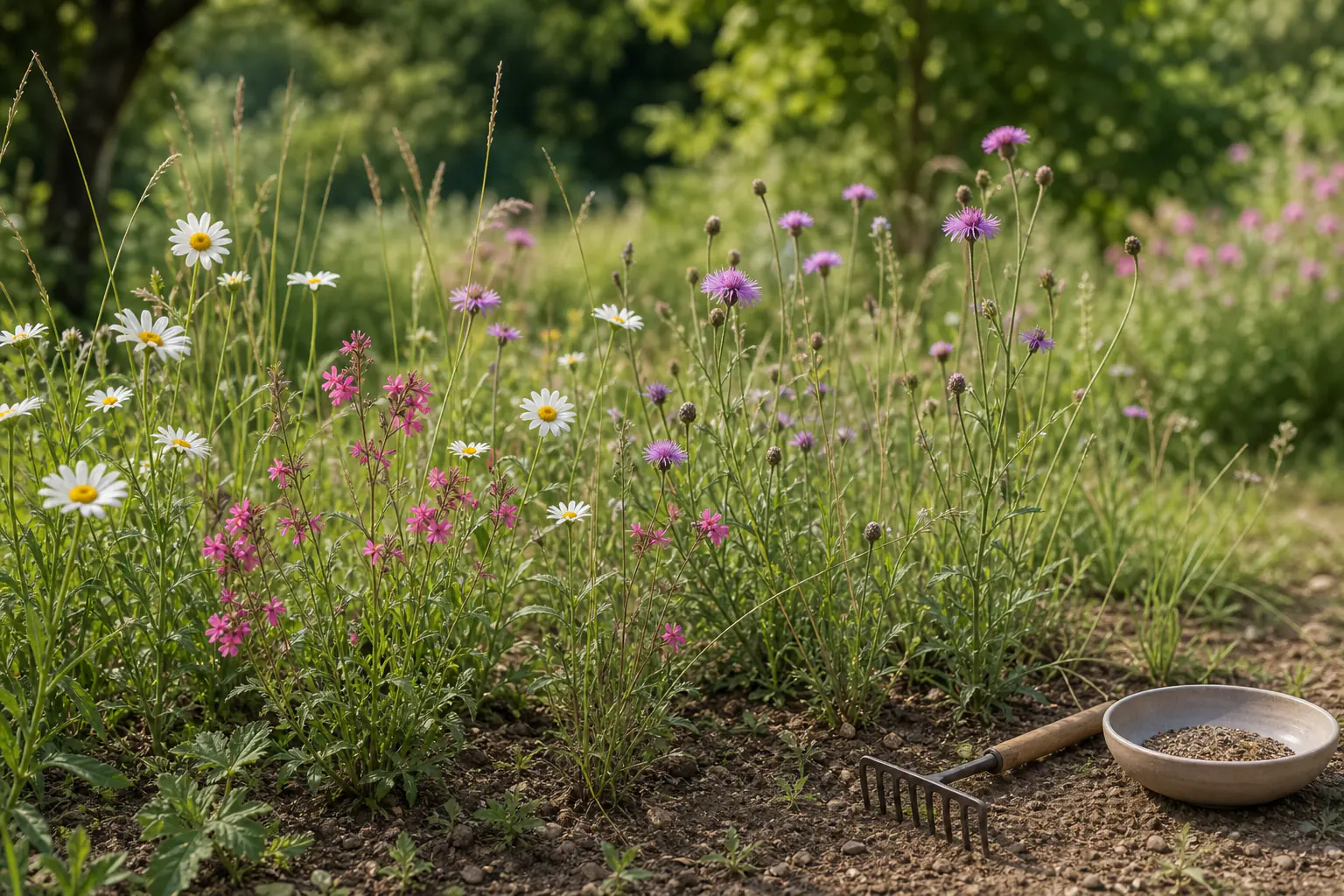
Mark a small area, identify whether it is sunny or shaded and whether the soil is free-draining, heavy or damp. Remove perennial weeds, reduce vigorous grass and expose fine firm soil. Sow a reputable UK-native mix at the stated rate in autumn or spring, press it into contact without burying deeply and keep the area distinguishable while seedlings establish.
- 01
Broadcasting seed into an established fertile lawn usually feeds the birds or loses seedlings beneath grass.
- 02
Native provenance and a mix suited to soil matter more than the largest species count on the packet.
- 03
Perennial meadow flowers may spend the first year building roots and can look sparse or weedy.
- 04
Yellow rattle can weaken grass but needs suitable autumn conditions and is not a universal instant fix.
What to expect
A meadow is managed vegetation, not an unattended lawn
The first season includes identification, selective weed control and cutting. Fertile soil favours vigorous grass and tall weeds over diverse flowers.
Preparation
Removing turf or reducing grass is the largest job and has more effect than adding extra seed.
Soil
Clay, sand, acidity, fertility and moisture change which species persist.
Timing
Some seed needs winter conditions; spring sowing can work for suitable mixes but may need more moisture.
Appearance
Seedlings are hard to identify. Mark the boundary and learn common weeds before pulling everything unfamiliar.
Cutting
Annual and perennial meadows use different regimes. Arisings usually need removal to avoid raising fertility.
Ecology
A flower-rich patch helps insects only as part of habitat that also provides food plants, shelter and pesticide restraint.
Core method
Create the conditions before expecting the flowers
Read the site for a full season if possible
Record sun, standing water, soil texture and existing plants. Avoid sowing into species-rich grassland or other valuable habitat; seek local ecological advice where the site may already be important. Choose a small ordinary lawn or cultivated patch whose management you control.
Select a credible mix by soil and origin
Use a supplier that lists species, percentage, provenance, sowing rate and intended soil. Pick a general native mix only when the site is genuinely average; use shade, clay or damp mixes for those conditions. Avoid ornamental “wildflower” blends containing unsuitable non-native species when the aim is UK habitat.
Prepare firm weed-free soil
Remove turf or suppress and cultivate the small patch, dealing with perennial weeds before sowing. Rake to a fine firm surface and allow a weed flush to appear and be removed. Mix tiny seed with dry sand for even broadcasting, sow at the label rate and tread or roll for contact without adding rich compost.
Manage the first year visibly
Water only as needed during establishment, identify seedlings and remove problem weeds before they seed. For perennial meadow mixes, use the supplier’s first-year cuts to control annual weeds, remove all arisings and avoid fertiliser. Record which species flower and adjust cutting rather than resowing blindly.
Useful products
Choose one main seed mix; add yellow rattle only when grass is the real problem
The general Restore & Enrich mix suits an ordinary prepared site. The heavy-clay and heavy-shade mixes are alternatives for those constraints. Yellow rattle is a separate targeted addition for established grass where its autumn sowing and management requirements can be met.
Boston Seeds Restore & Enrich UK Native Wildflower Seed Mix
It offers a named supplier, species-led purpose and stated sowing use rather than an anonymous novelty blend.
Boston Seeds Yellow Rattle Seed, Approximately 1,200 Seeds
It addresses an established grass-dominance problem rather than adding general fertiliser or more flower seed.
Boston Seeds Perennial Wildflower Seed Mix for Heavy Clay
It makes soil matching explicit instead of assuming a universal meadow blend.
Boston Seeds Wildflower Seed Mix for Heavy Shade
It acknowledges that ordinary sunny-meadow species are unlikely to persist under dense shade.
First project
Create a one-square-metre trial patch
A marked square is large enough to learn preparation, sowing density and weed recognition without converting the whole garden.
- 01
Assess the square
Record sun, drainage, soil and existing valuable plants.
- 02
Choose one appropriate mix
Match the packet description to the site rather than buying several blends.
- 03
Remove competition
Clear turf and perennial weeds and create firm bare soil.
- 04
Sow at the stated rate
Distribute evenly, press into contact and label the date and mix.
- 05
Identify before weeding
Photograph seedlings and remove only plants confidently known to be unwanted.
- 06
Cut and remove arisings
Follow the chosen annual or perennial regime and record the result through a full season.
What can wait
What can wait until the first result
Expand only after the trial shows how the soil, grass and management behave.
- 01
Several overlapping mixes
They obscure sowing rate, species provenance and which choice succeeded.
- 02
Fertiliser and rich compost
Higher fertility usually strengthens grass and coarse weeds.
- 03
Bulldozing an existing meadow
A species-rich area may already be more valuable than a packet mix.
- 04
Pesticide routine
It conflicts with the habitat purpose and can harm non-target insects.
- 05
Expecting instant perennial colour
Use an annual display separately if first-season flowers are essential.
Upgrade path
Upgrade the repeated limitation
Increase connected habitat and management quality, not merely seed quantity.
Trial square
About £4–£15One matched mix + bare soil
Learn establishment and weeds.Small perennial patch
About £15–£30Prepared area + planned cut regime
Build repeatable flowering over seasons.Grass suppression
About £4+Yellow rattle in suitable existing grass
Reduce competitive grass gradually.Habitat network
VariableFood plants, long grass, water and shelter
Support more life stages than flowers alone.Safety & care
Protect existing habitat, neighbours and seed provenance
Wildflower planting can damage valuable grassland or spread unsuitable species when site history and seed contents are ignored.
- Do not cultivate or reseed land that may already be species-rich without competent ecological assessment.
- Use mixes with transparent species lists and suitable UK provenance; avoid invasive or locally inappropriate plants.
- Obtain landowner permission and keep paths, visibility splays, drains and shared access clear.
- Avoid fertiliser and broad pesticide use and remove invasive weeds before they seed.
- Use gloves and dust care when handling seed and soil and identify toxic plants where children or grazing animals have access.
Outside help
When outside help earns its place
A local wildlife group can help identify existing habitat and first-year seedlings; a course is unnecessary for an ordinary garden trial.
Use current preparation, sowing and cutting instructions.
Choose a leader familiar with local soils, native provenance and sensitive sites.
Representative UK prices and free learning routes checked 3 August 2026; local availability, materials and tutor support vary.
Sources
Where the guidance came from
RHS guidance establishes garden meadow creation; UK conservation organisations provide habitat and native-seed context.
-
01
RHS · Creating wildflower meadows
Site preparation, sowing, yellow rattle and cutting guidance.
Open source -
02
Plantlife · Meadows
UK meadow ecology, threats and conservation context.
Open source -
03
Flora Locale · Native flora
Specialist guidance on native provenance and ecological planting.
Open source -
04
Natural England · Grassland habitats
Official habitat management and protection context.
Open source -
05
Amazon UK · Boston Seeds Restore & Enrich mix
Exact product page, model or ISBN, observed price and availability checked for this guide.
Open source -
06
Amazon UK · Boston Seeds yellow rattle
Exact product page, model or ISBN, observed price and availability checked for this guide.
Open source -
07
Amazon UK · Boston Seeds heavy clay mix
Exact product page, model or ISBN, observed price and availability checked for this guide.
Open source -
08
Amazon UK · Boston Seeds heavy shade mix
Exact product page, model or ISBN, observed price and availability checked for this guide.
Open source
Guide information and links checked 3 August 2026.