Beginner's guide · Write & create
Tell one page clearly.
Art comes after the read.
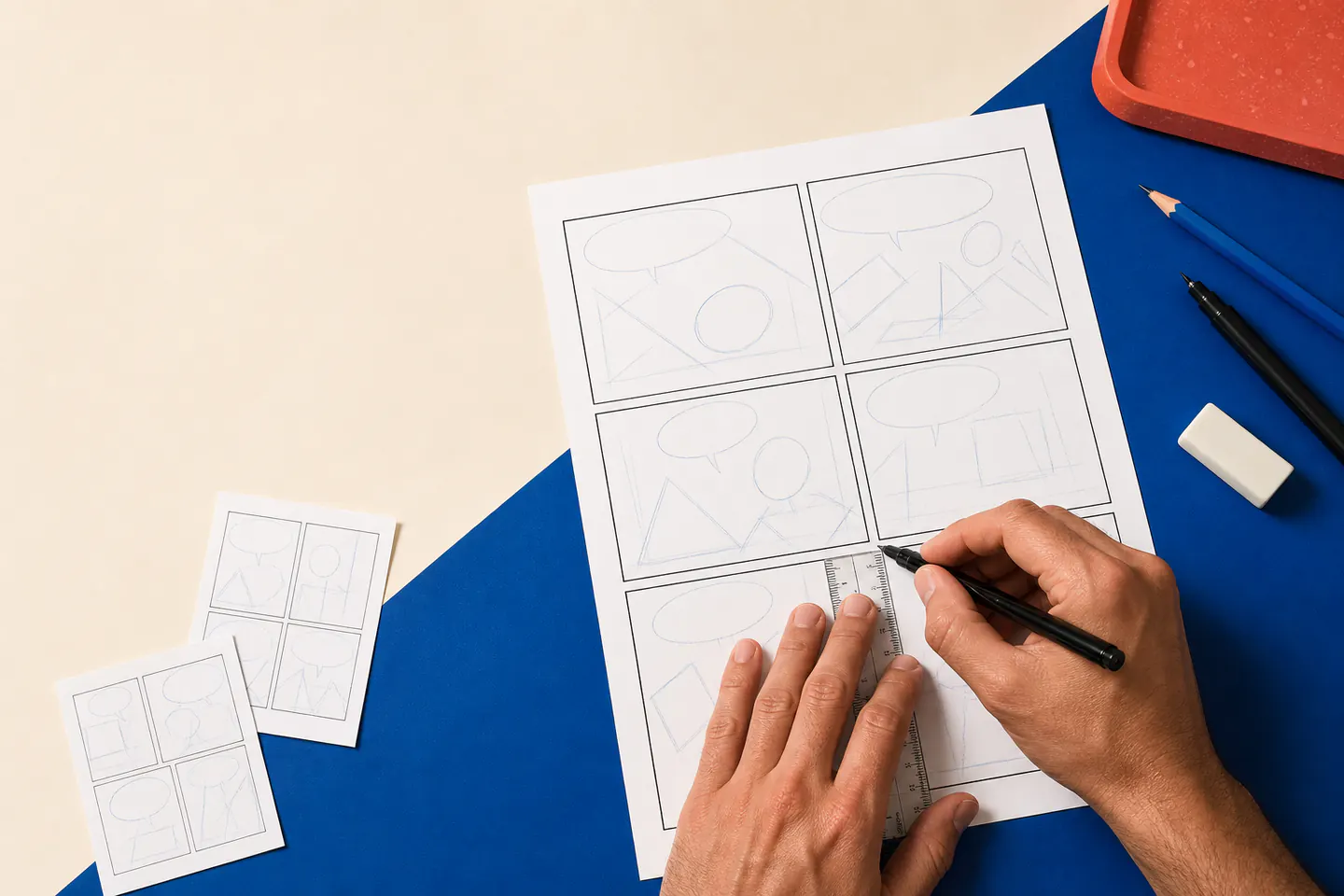
A six-panel page teaches the full sequence: premise, beats, thumbnails, readable balloons, pencils, inks and a finished scan. Stick figures are enough to test whether the reader knows what happens and in what order.
Quick answer
Tell one page clearly.
Write a one-sentence event that changes by the end, divide it into six visual beats and thumbnail each panel no larger than a matchbox. Place speech balloons before detailed drawing, keep the reading order obvious, make a full-size pencil page, ink only after a readability check and scan or photograph the finished page square-on.
- 01
Comics are sequences. A beautiful isolated drawing cannot repair a missing action or unclear panel transition.
- 02
Lettering is part of composition. Balloons need room, tails need clear speakers and text must remain readable at the final display size.
- 03
Thumbnails are meant to be disposable. Their job is to compare camera distance, silhouette and eye movement before effort becomes expensive.
- 04
Digital software helps layers, panels, lettering and export, but paper teaches the same decisions without menus, subscriptions or file setup.
What to expect
What the first attempts really involve
A finished page coordinates writing, design, drawing, lettering and production. Keeping the story tiny lets a beginner complete the entire loop and see which stage needs practice.
Reading order
Panel position, balloon order and character placement should all guide the eye the same way. Ambiguity forces the reader to solve layout instead of story.
Visual beats
Each panel needs a distinct purpose: setup, action, reaction, reveal or consequence. Repeating the same framing can flatten time.
Lettering
Too many words shrink type and crowd drawings. Rewrite dialogue shorter before enlarging every balloon.
Consistency
A character only needs repeatable identifying shapes, scale and clothing cues. Anatomical perfection is not the entry requirement.
Finish
Ink exposes decisions and removes some pencil nuance. Clean black-and-white reproduction is a production skill separate from drawing.
Fundamentals
Build the first attempt on reliable fundamentals
Write in visible actions
Make the premise something that can be shown: a person hides a broken cup before someone enters, or a cyclist realises the map is upside down. List six beats with what changes in each panel. Replace internal explanation with expression, gesture, object or concise caption only where the reader truly cannot infer it.
Thumbnail for the reader's eye
Draw several tiny versions using boxes, circles and arrows. Vary wide, medium and close views; preserve consistent screen direction unless a deliberate change is clearly established. Put the most important shape where it reads at thumbnail size. Ask someone to point through the sequence without dialogue.
Letter before detail
Write dialogue aloud, cut greetings and repeated information, then estimate balloon space. Place balloons high enough that tails can reach speakers without crossing faces or each other. Keep a natural left-to-right, top-to-bottom order for an English-language page. Use guides so hand lettering is even, or a licensed readable font.
Finish for reproduction
Use non-photo blue or light pencil if helpful, then ink with line weights suited to the final size. Let ink dry before erasing. Photograph with the camera parallel and even light, or scan at a useful resolution. Adjust levels conservatively so paper becomes clean without destroying fine lines, then keep the high-resolution master.
Useful products
One craft reference, reliable pens and paper that accepts ink
Making Comics explains the visual grammar, Sakura Microns provide predictable black line widths and Canson Bristol gives a smooth heavier surface. Copier paper and any pencil remain the correct tools for scripts and thumbnails, so the product section supports finishing rather than shopping before the story exists.
Scott McCloud Making Comics
It addresses the medium's reading and composition problems rather than only drawing technique.
Sakura Pigma Micron Fineliner Pens, six assorted sizes
Several widths make line hierarchy possible without buying specialist dip pens.
Canson Bristol Paper A4, 250 gsm
It is more forgiving for clean ink and erasing than thin copier paper while remaining a familiar A4 size.
First comic
Create a readable six-panel comic page
Use one location, no more than two characters and one change. A small finished page can be tested by a real reader without needing a series pitch or fictional universe.
- 01
Write the premise
State who acts, what happens and what is different at the end in one sentence.
- 02
List six beats
Give every panel one visual job and remove any beat that merely repeats the previous information.
- 03
Draw three thumbnails
Compare different panel sizes, camera distances and positions using only simple shapes.
- 04
Test silent reading
Show the strongest thumbnail without explanation and ask a reader what happens and where the eye moved.
- 05
Place balloons
Shorten dialogue, reserve space and arrange balloons before detailed figures and backgrounds.
- 06
Pencil full size
Use clear silhouettes, consistent character cues and only the background details needed to locate the action.
- 07
Ink and erase
Test pens on scrap, ink from less smudge-prone areas, let the page dry fully and erase gently.
- 08
Digitise and review
Scan or photograph square-on, clean levels, reduce to likely reading size and confirm that lettering and panel borders remain clear.
Troubleshooting
Read the result before changing the setup
Confusing order needs layout changed
Number the panels and balloons as the reader encountered them, then move the competing element. Arrows are rarely the first solution when position and spacing can guide naturally.
A talking-head page needs actions
Give characters an object, task or movement that changes with the conversation. Replace a repeated face with a hand, reaction, setting detail or meaningful pause.
Crowded balloons need rewritten dialogue
Read every line aloud and cut what the picture already communicates. Split a necessary long idea across panels only when the pacing benefits.
Smudged or feathered ink needs material testing
Let pens dry longer, work from a comfortable direction and test the paper. A line-quality problem is not fixed by pressing harder into an unsuitable surface.
Skip for now
What can wait
A page can be complete in pencil or black ink. Colour, software and serial publishing add substantial work after visual sequence is already functioning.
- 01
A drawing tablet
It changes hand feel and introduces software. Use one when layers and revision speed answer a real need, not because comics must be digital.
- 02
A long series bible
Complete one scene before designing years of plot. A finished page reveals character and world needs that planning cannot predict.
- 03
Full colour
Colour adds palette, lighting, flats, file preparation and print questions. Black and white exposes storytelling and line clarity directly.
- 04
Publishing accounts
Platform schedules and audience metrics can wait until several complete pages establish a sustainable process and rights are clear.
Upgrade path
What a better setup changes
Upgrade when repeated pages reveal a bottleneck in revision, lettering, reproduction or long-form organisation.
Thumbnail comics
Already ownedCopier paper + pencil + ruler
Teaches beats, panel order and readable silhouettes.Ink-ready page
About £20–£30Fineliners + Bristol paper + eraser
Produces clean black-and-white originals that digitise reliably.Digital finishing
Free–£50+Scanner or camera + image editor + lettering system
Adds clean correction, typesetting and export while preserving the paper workflow.Full digital production
Often £50–£600+Tablet + comic software + calibrated file workflow
Speeds layers, repeated panels and colour after the decisions are familiar.Before upgrading
A useful check before spending more
Test at final size
A page that looks clear on A4 may fail on a phone. Reduce it to likely display size, check text, line weight and gutters and solve the smallest unreadable element before adding detail.
Use references without copying ownership
Study pose, architecture and objects from lawful sources, transform them through the scene and keep records. Do not publish traced copyrighted art or living artists' recognisable work as an original style substitute.
Safety
Protect posture, tools and creative rights
Long drawing sessions create more risk than the pens themselves. Production also needs clear copyright and sharing boundaries.
- Take movement and distance-vision breaks, support the forearm and adjust chair and drawing angle before pain develops.
- Use knives only for paper cutting with a metal ruler, cutting mat and hands outside the path.
- Ventilate solvent-based markers, fixatives or inks according to their safety information.
- Keep originals and digital masters backed up separately.
- Use reference material lawfully and do not present copied characters, pages or artist styles as original publication.
- Read platform rights and content rules before uploading unpublished or collaborative work.
Classes
When outside help is useful
A class is helpful for live page critique, lettering and production workflows after a first page exists. It should provide reader-focused feedback rather than judge whether the beginner's drawing style is polished.
Look for scripting, thumbnails, page layout and a finished short sequence.
Useful for repeated critique, digital production and a longer complete story.
Representative UK illustration and comics-course formats checked 30 July 2026; materials and software access vary.
Sources
Sources and checking notes
Official comic-software learning materials explain page sequence and production, while experienced community resources reinforce thumbnail, lettering and collaboration practice.
-
01
Clip Studio Paint · Comic creation
Structured overview of scripting, layout, drawing, lettering and comic production.
Open source -
02
Clip Studio Paint · Comic design tips
Practical layout, panel and readability guidance.
Open source -
03
Clip Studio manual · Creating comics
Primary software documentation for page, frame, text and export workflows.
Open source -
04
Clip Studio Tips · Making a comic
Complete worked workflow from idea through page production.
Open source -
05
r/ComicBookCollabs · Beginner collaboration advice
Community discussion of scripts, page expectations, communication and rights.
Open source -
06
Amazon UK · Making Comics
Exact Scott McCloud product and direct Amazon UK listing checked for current availability, price context and model identity.
Open source -
07
Amazon UK · Pigma Micron Fineliner Pens, six assorted sizes
Exact Sakura product and direct Amazon UK listing checked for current availability, price context and model identity.
Open source -
08
Amazon UK · Bristol Paper A4, 250 gsm
Exact Canson product and direct Amazon UK listing checked for current availability, price context and model identity.
Open source
Guide information and links checked 30 July 2026.