Beginner’s guide · Make & create
Cross, twist and pin
one Torchon strip.
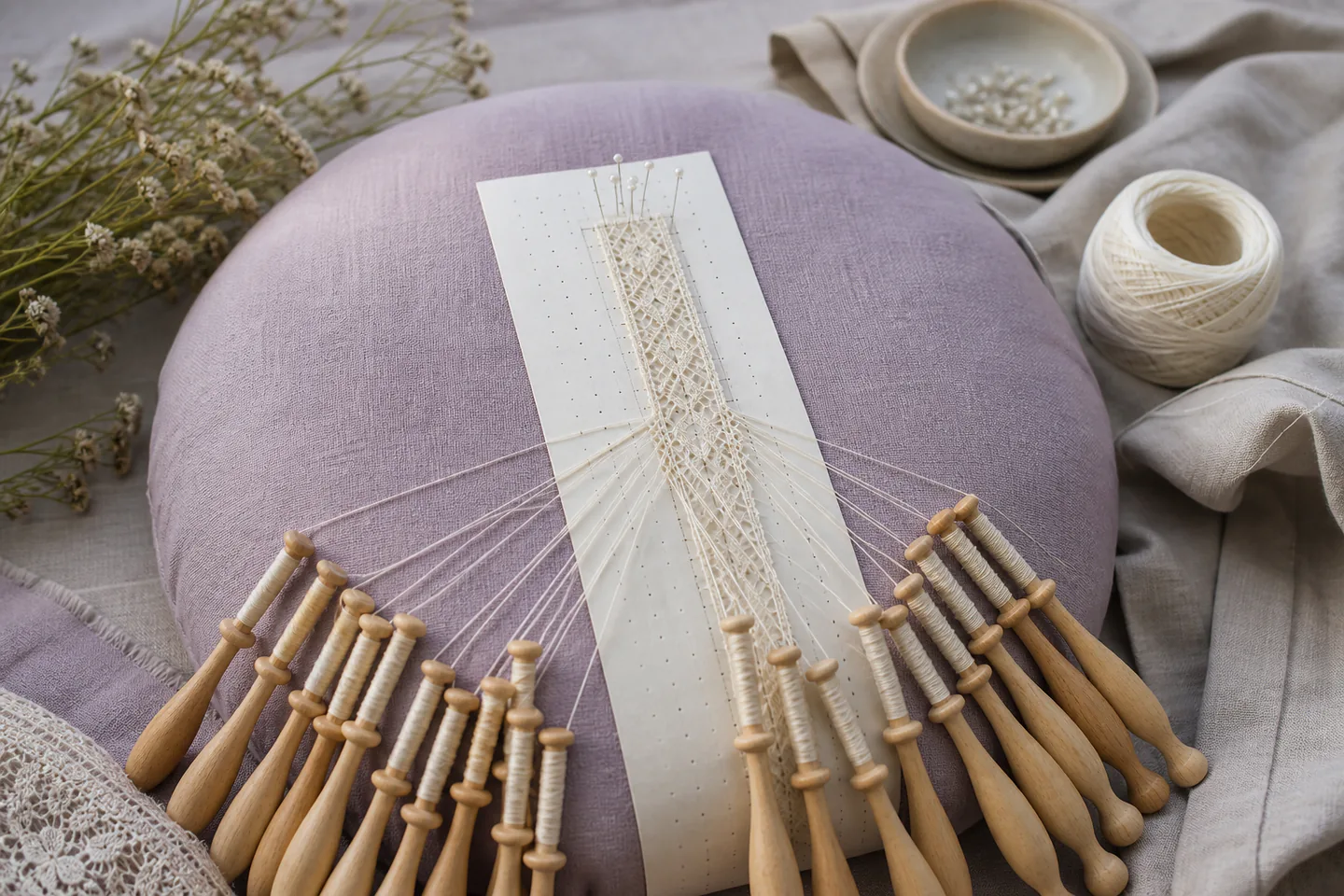
Bobbin lace making begins with a firm pillow, a small set of wound bobbins, a clear pricking and the repeated logic of cross, twist and pin.
Quick answer
Build one small, controlled result first
Borrow or assemble a firm pillow, wind the small number of pairs required by a beginner Torchon strip and follow one Lace Guild pattern that teaches cloth stitch, half stitch and pin placement in a fixed order.
- 01
Choose one beginner pattern, prick or print it at the exact scale and wind matched bobbin pairs evenly before placing the first pin. Keep the first attempt narrow enough that preparation, the main action and the result can all be reviewed together.
- 02
Move whole pairs in the stated cross-and-twist order and tighten gently after the pin rather than pulling individual threads hard. Keep the first attempt narrow enough that preparation, the main action and the result can all be reviewed together.
- 03
Pause every few pins to check pair order, edge shape, crossing direction and even tension against the pattern. Keep the first attempt narrow enough that preparation, the main action and the result can all be reviewed together.
- 04
Secure every working pair, cover pins and bobbins from disturbance and leave a written note at the exact next action. Keep the first attempt narrow enough that preparation, the main action and the result can all be reviewed together.
What to expect
Accuracy comes from the sequence, not the size of the toolkit
Preparation, one controlled variable and an honest inspection matter more than collecting specialist equipment.
The first attempt
A narrow Torchon strip uses few pairs and visible geometry, making mistakes easier to unwork than in pictorial or fine lace. For bobbin lace making, note what actually happened rather than relying on memory; that turns the next attempt into a controlled change instead of another guess.
The control point
Move whole pairs in the stated cross-and-twist order and tighten gently after the pin rather than pulling individual threads hard. For bobbin lace making, note what actually happened rather than relying on memory; that turns the next attempt into a controlled change instead of another guess.
The useful signal
Pause every few pins to check pair order, edge shape, crossing direction and even tension against the pattern. For bobbin lace making, note what actually happened rather than relying on memory; that turns the next attempt into a controlled change instead of another guess.
The common trap
An over-soft pillow, rolling bobbins, mismatched thread and an advanced pattern make thread management harder than the stitches. For bobbin lace making, note what actually happened rather than relying on memory; that turns the next attempt into a controlled change instead of another guess.
Core method
Prepare, make, inspect and reset
Prepare deliberately
Choose one beginner pattern, prick or print it at the exact scale and wind matched bobbin pairs evenly before placing the first pin. For bobbin lace making, note what actually happened rather than relying on memory; that turns the next attempt into a controlled change instead of another guess.
Control the central variable
Move whole pairs in the stated cross-and-twist order and tighten gently after the pin rather than pulling individual threads hard. For bobbin lace making, note what actually happened rather than relying on memory; that turns the next attempt into a controlled change instead of another guess.
Read the result
Pause every few pins to check pair order, edge shape, crossing direction and even tension against the pattern. For bobbin lace making, note what actually happened rather than relying on memory; that turns the next attempt into a controlled change instead of another guess.
Reset before repeating
Secure every working pair, cover pins and bobbins from disturbance and leave a written note at the exact next action. For bobbin lace making, note what actually happened rather than relying on memory; that turns the next attempt into a controlled change instead of another guess.
Useful products
Products with a clear job in the setup
A bookbinding kit supplies useful awls and threads but is not a lace kit; embroidery floss can support a visible sampler, and a dedicated pillow and bobbins should come from a lace supplier or group.
DaKuan 20-piece Bookbinding Tool Set
It supports pattern preparation without pretending to replace a lace pillow and bobbins.
AUERVO Embroidery Floss, 50 Skeins with Bobbins and Needles
Strong contrasting thread makes pair movement easier to see.
Fiskars A3 Self-Healing Cutting Mat
The larger area keeps patterns and thin materials flat.
First project
Work a narrow Torchon bookmark
Learn pair movement and gentle tension before decorative grounds or many bobbins.
- 01
Set up
Choose one beginner pattern, prick or print it at the exact scale and wind matched bobbin pairs evenly before placing the first pin. For bobbin lace making, note what actually happened rather than relying on memory; that turns the next attempt into a controlled change instead of another guess.
- 02
Begin the first attempt
A narrow Torchon strip uses few pairs and visible geometry, making mistakes easier to unwork than in pictorial or fine lace. For bobbin lace making, note what actually happened rather than relying on memory; that turns the next attempt into a controlled change instead of another guess.
- 03
Hold one variable steady
Move whole pairs in the stated cross-and-twist order and tighten gently after the pin rather than pulling individual threads hard. For bobbin lace making, note what actually happened rather than relying on memory; that turns the next attempt into a controlled change instead of another guess.
- 04
Inspect the result
Pause every few pins to check pair order, edge shape, crossing direction and even tension against the pattern. For bobbin lace making, note what actually happened rather than relying on memory; that turns the next attempt into a controlled change instead of another guess.
- 05
Reset and record
Secure every working pair, cover pins and bobbins from disturbance and leave a written note at the exact next action. For bobbin lace making, note what actually happened rather than relying on memory; that turns the next attempt into a controlled change instead of another guess.
What can wait
What can wait until the first result
Delay equipment that solves no repeated problem in the first small project.
- 01
A large first setup
Scale multiplies An over-soft pillow, rolling bobbins, mismatched thread and an advanced pattern make thread management harder than the stitches. before the basic routine is known. For bobbin lace making, note what actually happened rather than relying on memory; that turns the next attempt into a controlled change instead of another guess.
- 02
Premium specialist equipment
It should solve a limitation you can describe after several bobbin lace making sessions. For bobbin lace making, note what actually happened rather than relying on memory; that turns the next attempt into a controlled change instead of another guess.
- 03
Several methods at once
Changing materials and technique together makes the cause of a result hard to see. For bobbin lace making, note what actually happened rather than relying on memory; that turns the next attempt into a controlled change instead of another guess.
- 04
Buying for a future version
Finish and review the small route before equipping an imagined advanced practice. For bobbin lace making, note what actually happened rather than relying on memory; that turns the next attempt into a controlled change instead of another guess.
Upgrade path
Upgrade the repeated limitation
Add capacity only after the basic process is repeatable.
Try it
About £25–£100, often less second-handBorrowed pillow, few bobbin pairs and free pattern
Complete one meaningful result and learn the whole sequence.Repeat it
About £25–£100, often less second-handDedicated firm pillow and organised bobbins
Reduce setup friction and compare several attempts.Improve the bottleneck
£100–£400More pairs and a chosen regional lace style
Address An over-soft pillow, rolling bobbins, mismatched thread and an advanced pattern make thread management harder than the stitches. with a targeted change.Go deeper
VariableDesign, fine thread and guild study
Add scale, precision or public participation with evidence from practice.Safety & care
Control pins, posture and thread storage
The craft is low risk, but sharp pins and long static sessions need a deliberate setup.
- Use a covered pin container and account for every dropped pin. Follow current manufacturer, food-safety, access, wildlife or local guidance wherever it applies.
- Support the pillow so shoulders and wrists remain neutral and take regular movement breaks. Follow current manufacturer, food-safety, access, wildlife or local guidance wherever it applies.
- Keep long threads and bobbins away from children and pets. Follow current manufacturer, food-safety, access, wildlife or local guidance wherever it applies.
- Use an awl only against a protected surface and away from the holding hand. Follow current manufacturer, food-safety, access, wildlife or local guidance wherever it applies.
- Check fibre sensitivity and wash or store old second-hand materials before use. Follow current manufacturer, food-safety, access, wildlife or local guidance wherever it applies.
Outside help
When outside help earns its place
A local Lace Guild group is unusually valuable because members often lend equipment, correct pair order and help select an achievable first pattern.
Use one complete lesson that covers preparation, the central technique, common mistakes and finishing. For a first bobbin lace making attempt, one coherent method is easier to diagnose than fragments collected from several creators.
Outside help earns its place when safe setup, access, identification or live correction removes a real obstacle. Ask what equipment, materials, access and follow-up support are included before booking.
Representative UK learning options checked 31 August 2026; local prices, access, materials and tutor support vary.
Sources
Where the guidance came from
The method is grounded in specialist, manufacturer and public guidance, then checked against recurring beginner problems and the exact products linked here.
-
01
The Lace Guild · Getting started
Bobbins, stitches, beads and beginner pattern.
Open source -
02
Heritage Crafts · Bobbin lace
UK craft status, organisations and teaching.
Open source -
03
Jo Edkins · Bobbin lace for beginners
Equipment, stitches, patterns and low-cost alternatives.
Open source -
04
OIDFA · International lace organisation
International lace practice and groups.
Open source -
05
Reddit · r/BobbinLace
Community evidence on pillows, bobbins, thread and first patterns.
Open source -
06
Amazon UK · 20-piece Bookbinding Tool Set
Exact Amazon UK product page or ISBN used for the recommendation; current price, seller, specification and availability should be confirmed.
Open source -
07
Amazon UK · Embroidery Floss, 50 Skeins with Bobbins and Needles
Exact Amazon UK product page or ISBN used for the recommendation; current price, seller, specification and availability should be confirmed.
Open source -
08
Amazon UK · A3 Self-Healing Cutting Mat
Exact Amazon UK product page or ISBN used for the recommendation; current price, seller, specification and availability should be confirmed.
Open source
Guide information and links checked 31 August 2026.