Beginner's guide · Grow & care
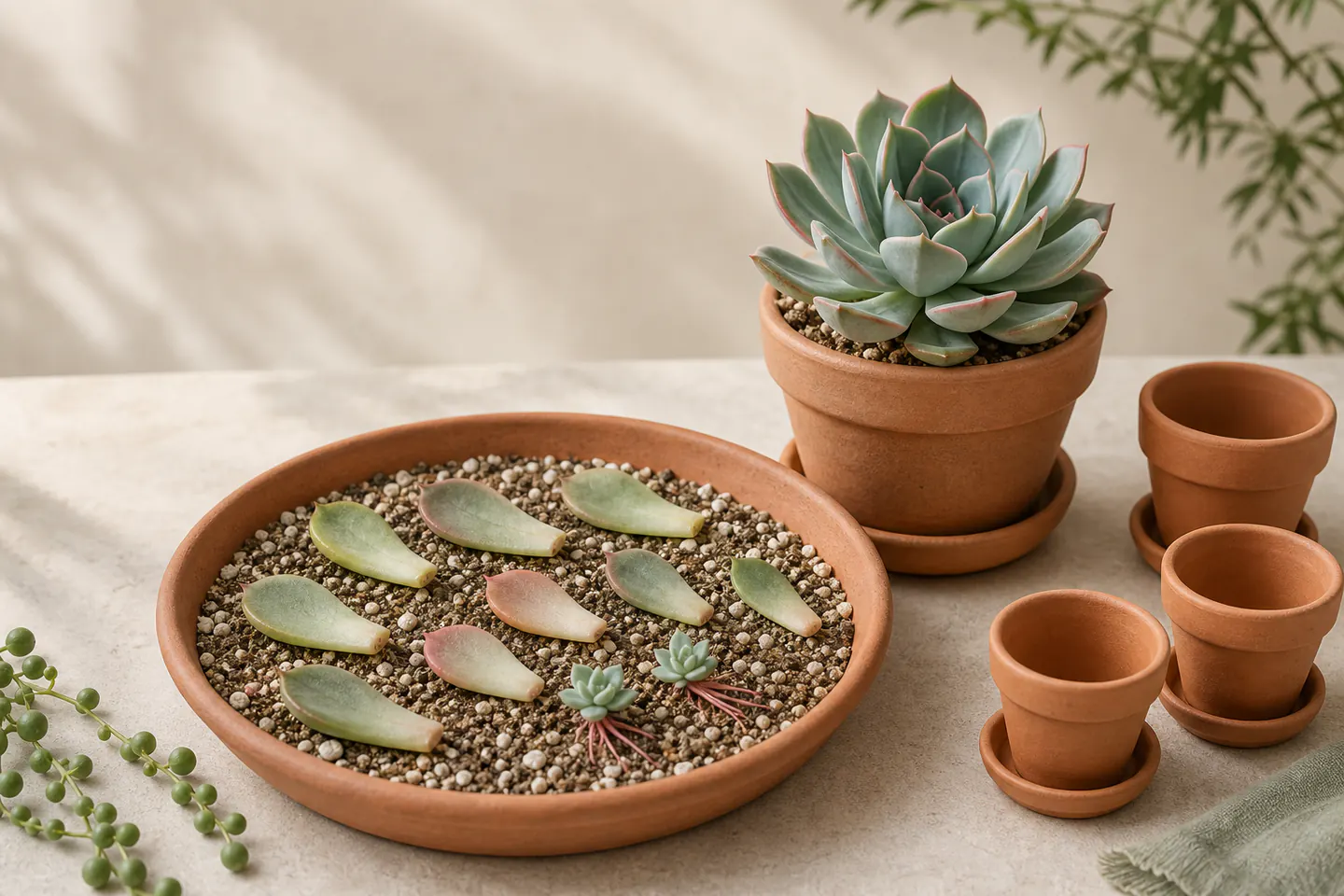
Take one complete leaf.
Then wait before watering.
Many Echeveria, Crassula and Kalanchoe can make new plants from leaves, but not every succulent propagates the same way. Identify the parent, remove healthy material cleanly, allow wounds to dry and keep the first setup bright, airy and far less wet than a seed tray.
Quick answer
Take one complete leaf.
Identify the parent succulent and confirm whether it reliably propagates from a whole leaf, stem cutting or offset. Remove healthy material with its base intact, let the wound callus in a dry airy place, then lay it on or place it in a clean free-draining medium as the method requires. Give bright indirect light and resist routine misting before roots exist.
- 01
A broken Echeveria leaf that leaves its base on the stem often fails, while a complete gently twisted leaf has the tissue needed to produce roots and a new rosette.
- 02
Sempervivum and many aloes are usually easier from offsets; some Aeonium suit stem cuttings; not every succulent makes a clone from one detached leaf.
- 03
A humidity dome and constant mist imitate seed-starting advice but can rot fleshy cuttings that store their own water.
- 04
The old leaf shrivels as it feeds new growth. Remove it only when fully dry and detached easily, not as soon as roots appear.
What to expect
What the first attempts really involve
Propagation is a biological probability, not an assembly guarantee. Several healthy leaves may root at different times, make roots without shoots or fail without indicating that every condition was wrong.
Identity
The propagation method follows genus and species. A retailer's generic “succulent” label is not enough for precise expectations.
Wound
Fresh breaks are entry points for rot. Callusing time varies with thickness, temperature and humidity rather than a universal number of days.
Light
Insufficient light weakens new growth, while intense direct sun can desiccate unrooted leaves. Bright indirect light is a safer initial compromise.
Water
Unrooted leaves cannot use a wet root zone. Moisture becomes useful gradually after roots and pups develop, with the species and environment controlling frequency.
Time
Visible progress can take weeks or months. Moving leaves daily to inspect the underside breaks new roots and slows establishment.
Fundamentals
Build the first attempt on reliable fundamentals
Identify and choose the right method
Use a reliable plant reference, seller label or specialist community with clear photographs. Decide whether the plant is best from leaf, stem, division or offset. Propagate only healthy, pest-free material taken with permission; do not use a stressed plant's final leaves as an experiment.
Make a clean complete removal
For a suitable rosette leaf, hold near the base and twist gently so the entire attachment comes away. For a stem cutting or offset, use a clean sharp blade and make the smallest purposeful wound. Label the variety and date immediately because loose leaves become difficult to identify.
Callus and place without burying
Keep material dry, shaded and ventilated until the wound is sealed and no longer looks fresh. Lay leaf cuttings on clean gritty mix with the base resting on the surface; do not bury the whole leaf. Stem cuttings may be inserted shallowly after callusing according to species guidance.
Transition only after growth appears
Keep the tray stable and inspect without lifting. Once roots and a pup develop, provide restrained moisture around roots rather than soaking the parent leaf. Increase light gradually and pot on when the new plant has a usable root system and the old leaf is naturally spent.
Useful products
Free-draining medium, small draining pots and a clean work tray
The Westland mix is an accessible base whose drainage can be assessed for the exact plant, the terracotta set offers holes and saucers for rooted pups and the Garland tray keeps loose medium contained. Existing shallow dishes and clean old pots are perfectly good starting containers.
Westland Peat-free Cacti and Succulent Potting Mix, 4 litres
The small volume suits a first tray and several rooted pups without a large leftover bag.
Oairse Six Small Terracotta Pots with Drainage and Saucers
Six pots align with the six-leaf trial without suggesting that unrooted leaves should be planted immediately.
Garland Nine-litre Garden Tray
It reduces handling and mess while leaving the propagation open to airflow.
First leaves
Propagate six leaves from one suitable plant
Use a healthy identified Echeveria or another plant confirmed for leaf propagation. Six leaves give a useful comparison without stripping the parent.
- 01
Confirm the method
Check the exact plant against a reliable propagation source and rule out an offset or stem route before removing leaves.
- 02
Prepare labels and tray
Clean the work surface and container, write plant and date and keep tools away from other plant soil.
- 03
Choose healthy leaves
Select firm mature leaves that can be removed without damaging the rosette centre or leaving the parent bare.
- 04
Remove the complete base
Twist gently at the attachment and set aside any torn leaf as a separate uncertain trial rather than counting it as equal.
- 05
Allow wounds to callus
Keep the leaves dry, airy and out of harsh sun until their bases are sealed.
- 06
Lay on the surface
Place them on clean free-draining mix with space between and leave them in bright indirect light.
- 07
Wait without routine misting
Observe weekly, avoid lifting new roots and add restrained moisture only when roots and conditions justify it.
- 08
Pot on gradually
Move established pups with roots into draining pots, transition light slowly and let the old leaf detach naturally.
Troubleshooting
Read the result before changing the setup
A translucent mushy leaf is rotting
Remove it from the tray, check for premature water, poor airflow or a fresh uncallused wound and clean any affected surface. Do not spray the remaining leaves as compensation.
Roots without a pup need more time
Leave the leaf stable and protect the roots from repeated handling and hard sun. Some leaves invest in roots long before visible top growth.
A pup stretching is asking for more light
Increase brightness gradually after it has roots, rotating the pot only occasionally. Sudden midday sun can scorch growth raised indoors.
Repeated failure may be the wrong method
Recheck the plant identity and try offsets or stem cuttings where appropriate. Do not keep removing leaves from a species that rarely propagates that way.
Skip for now
What can wait
Fleshy cuttings carry stored water. Equipment designed to maximise humidity and warmth can make the simplest propagation less reliable.
- 01
A sealed propagator
High humidity and stagnant air raise rot risk for many succulent leaves. Use an open stable tray unless species-specific guidance says otherwise.
- 02
Daily misting
Before roots, the leaf cannot use the wet surface in the same way as a seedling. Observe development and water deliberately later.
- 03
Rooting hormone
Many suitable succulents root without it. Add no powder unless trusted guidance for the exact cutting shows a benefit and safe use.
- 04
Decorative pots without drainage
Rooted pups need controllable wet-dry cycles. Use a drainage hole and keep any outer cachepot empty.
Upgrade path
What a better setup changes
A better setup improves identification, light consistency and potting control rather than accelerating biology.
Loose leaf trial
Already ownedHealthy leaves + clean shallow dish + bright indirect light
Shows whether the method works before buying propagation equipment.Organised propagation tray
About £10–£20Labelled tray + free-draining medium + stable shelf
Separates varieties and reduces handling while roots develop.Rooted pup pots
Add about £10–£20Small draining terracotta or plastic pots + suitable mix
Allows individual watering once plants have functional roots.Winter light support
Often £25–£80Measured grow light + timer + safe clearance
Reduces weak stretched growth when natural light is genuinely inadequate.Before upgrading
A useful check before spending more
Use success rate as evidence
Record how many complete leaves rooted, made pups and established. A mixed result can be normal; compare method and season before adding products.
Keep parent care separate
Removing leaves does not correct low light, pests or overwatering on the parent. Stabilise the original plant so propagation is not a rescue substitute.
Safety
Use clean material and keep plants identifiable
Most propagation work is gentle, but blades, growing media, toxic sap and pest transfer need ordinary precautions.
- Propagate only plants owned or taken with permission; do not remove material from shops, gardens or the wild.
- Check plant toxicity and irritating sap before working around children, pets or skin sensitivities.
- Use clean sharp blades away from fingers and disinfect appropriately between suspect plants.
- Wear gloves or wash hands after handling growing media and keep it away from food preparation.
- Quarantine pest-affected material instead of spreading leaves across a shared propagation tray.
- Do not release unwanted non-native plants outdoors; dispose or share them responsibly.
Classes
When outside help is useful
A class is unnecessary for common leaves but useful for identifying a mixed collection, beheading stretched plants or handling unusual caudiciforms and cacti.
Look for species-specific leaf, offset and stem comparisons rather than one method for all succulents.
Useful when participants work on their own identified plants and leave with aftercare instructions.
Representative UK nursery and houseplant workshop formats checked 30 July 2026; materials and plants vary.
Sources
Sources and checking notes
RHS propagation guidance anchors the methods, specialist succulent references distinguish leaves from offsets and stems, and community resources add practical rot and light experience.
-
01
RHS · Leaf cuttings
Authoritative propagation method including successful succulent genera.
Open source -
02
RHS · Taking cuttings
General hygiene, material selection and aftercare principles.
Open source -
03
World of Succulents · Propagation
Specialist comparison of leaf, stem and offset methods.
Open source -
04
Succulents and Sunshine · Propagating leaves
Worked succulent-specific leaf and cutting sequence.
Open source -
05
r/succulents · Beginner basics
Long-running community reference on light, soil, watering and propagation.
Open source -
06
Amazon UK · Peat-free Cacti and Succulent Potting Mix, 4 litres
Exact Westland product and direct Amazon UK listing checked for current availability, price context and model identity.
Open source -
07
Amazon UK · Six Small Terracotta Pots with Drainage and Saucers
Exact Oairse product and direct Amazon UK listing checked for current availability, price context and model identity.
Open source -
08
Amazon UK · Nine-litre Garden Tray
Exact Garland product and direct Amazon UK listing checked for current availability, price context and model identity.
Open source
Guide information and links checked 30 July 2026.