Beginner’s guide · Make & create
Build straight, balance carefully,
then learn with an instructor.
A small simulator or club-supervised trainer keeps the first lesson recoverable. Learn centre of gravity, control checks and legal flying before adding scale detail or speed.
Quick answer
Practise the full control loop before launch
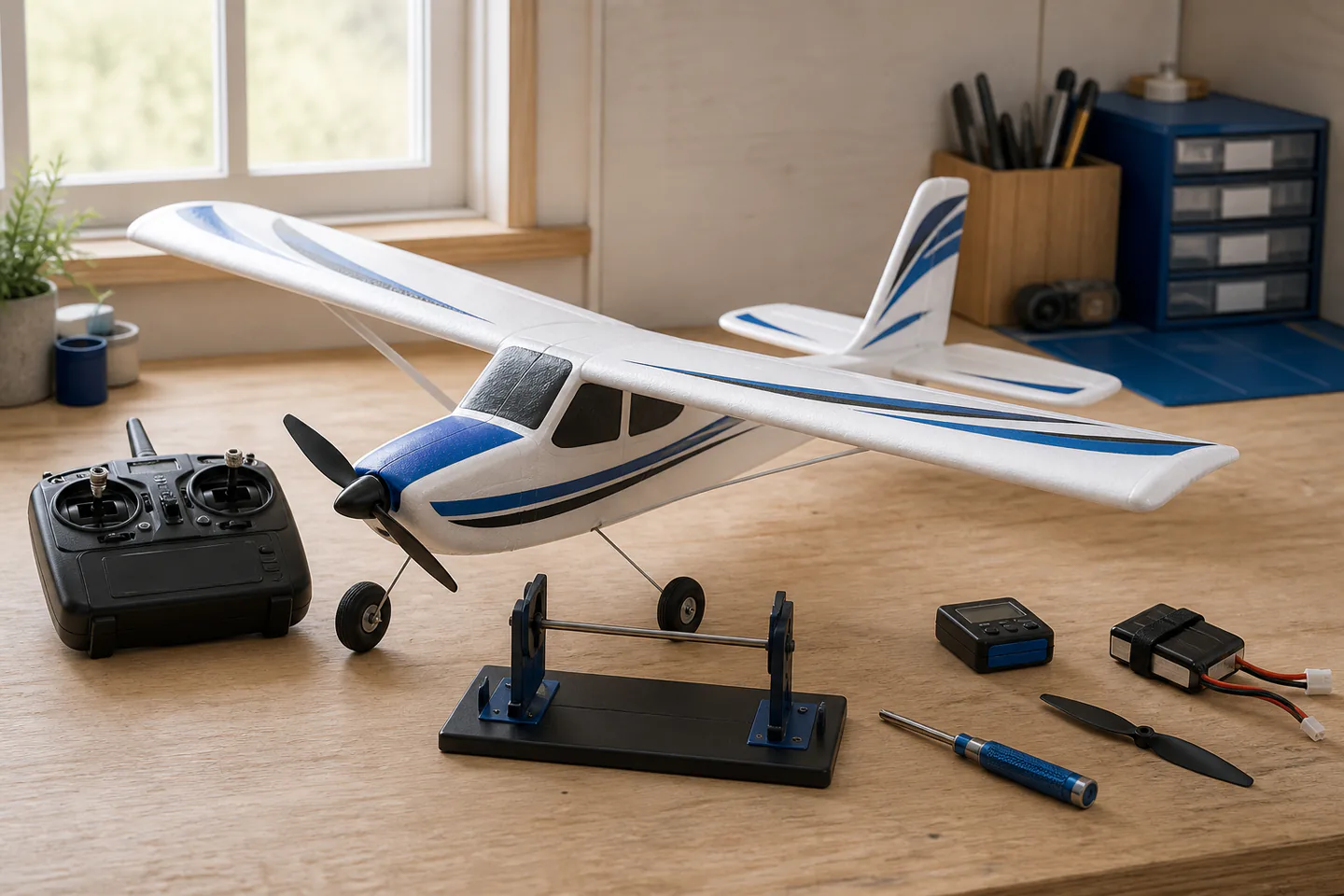
Begin with a simulator or a ready-to-fly high-wing trainer, read the current CAA and BMFA guidance, assemble exactly to the manual, set the stated centre of gravity and arrange a first flight with an experienced club instructor at a suitable site.
- 01
Confirm the aircraft mass, camera status, registration duties and site rules before outdoor flight. Keep the first attempt narrow enough that preparation, the main action and the result can all be reviewed together.
- 02
Treat the manual’s centre-of-gravity range and control directions as pre-flight checks, not suggestions. Keep the first attempt narrow enough that preparation, the main action and the result can all be reviewed together.
- 03
Use a trainer mode or buddy system to make early orientation mistakes recoverable. Keep the first attempt narrow enough that preparation, the main action and the result can all be reviewed together.
- 04
Charge, store and inspect lithium batteries exactly as their maker specifies. Keep the first attempt narrow enough that preparation, the main action and the result can all be reviewed together.
What to expect
The first challenge is orientation, not aerobatics
A model coming towards the pilot reverses the apparent left-right response, while wind and speed reduce the time available to correct it.
Assembly
A warped wing, loose linkage or reversed control can defeat an otherwise stable trainer. For rc aircraft building & flying, note what actually happened rather than relying on memory; that turns the next attempt into a controlled change instead of another guess.
Balance
A tail-heavy aircraft can become sharply unstable; the marked centre-of-gravity range must be checked with the flight battery installed. For rc aircraft building & flying, note what actually happened rather than relying on memory; that turns the next attempt into a controlled change instead of another guess.
Field
A legal open space is not automatically a safe runway or club flying site. For rc aircraft building & flying, note what actually happened rather than relying on memory; that turns the next attempt into a controlled change instead of another guess.
Weather
Light models become difficult quickly as wind and gusts rise. For rc aircraft building & flying, note what actually happened rather than relying on memory; that turns the next attempt into a controlled change instead of another guess.
Core method
Assemble, check and rehearse before flying
Choose the legal route
Read the current Drone and Model Aircraft Code and the club rules that apply to the actual aircraft. For rc aircraft building & flying, note what actually happened rather than relying on memory; that turns the next attempt into a controlled change instead of another guess.
Build to the datum
Keep wing, tail and control surfaces straight, and use only the specified fasteners and adhesives. For rc aircraft building & flying, note what actually happened rather than relying on memory; that turns the next attempt into a controlled change instead of another guess.
Run a powered ground check
Secure the model, confirm every control direction, failsafe, range check and propeller clearance. For rc aircraft building & flying, note what actually happened rather than relying on memory; that turns the next attempt into a controlled change instead of another guess.
Rehearse the circuit
Practise take-off, rectangular circuit, approach and go-around on a simulator before a supervised real flight. For rc aircraft building & flying, note what actually happened rather than relying on memory; that turns the next attempt into a controlled change instead of another guess.
Useful products
Products with a clear job in the setup
The AeroScout is a complete stable trainer route; RealFlight is a simulator alternative before weather and repairs enter the lesson; the Tamiya kit supplies modest hand tools for model assembly rather than flight electronics.
HobbyZone AeroScout S 2 1.1 m RTF Basic Trainer
Its pusher layout and recovery modes reduce, but do not remove, crash risk.
Horizon Hobby RealFlight Trainer Edition RC Flight Simulator
Repeated approaches cost no airframes and can precede a club lesson.
Tamiya RC Tool Kit, 8 piece
Correct small tools reduce damaged fasteners and rushed work.
First project
Prepare for one instructor-led trainer flight
The project finishes when the aircraft passes inspection and flies a calm circuit, not when the box is empty.
- 01
Register and choose a site
Resolve current legal and club requirements before assembly creates pressure to fly anywhere. For rc aircraft building & flying, note what actually happened rather than relying on memory; that turns the next attempt into a controlled change instead of another guess.
- 02
Assemble square
Check wing and tail alignment against the manual. For rc aircraft building & flying, note what actually happened rather than relying on memory; that turns the next attempt into a controlled change instead of another guess.
- 03
Balance and set controls
Install the real battery, verify centre of gravity, throws and directions. For rc aircraft building & flying, note what actually happened rather than relying on memory; that turns the next attempt into a controlled change instead of another guess.
- 04
Rehearse
Fly several simulator circuits and deliberate go-arounds. For rc aircraft building & flying, note what actually happened rather than relying on memory; that turns the next attempt into a controlled change instead of another guess.
- 05
Brief the flight
Agree who launches, who can take control and what conditions cancel the attempt. For rc aircraft building & flying, note what actually happened rather than relying on memory; that turns the next attempt into a controlled change instead of another guess.
What can wait
What can wait until the first result
Extra equipment becomes useful only when the basic method has exposed a specific, repeated limitation.
- 01
Scale detail
Paint and extra fittings add weight and complicate repairs. For rc aircraft building & flying, note what actually happened rather than relying on memory; that turns the next attempt into a controlled change instead of another guess.
- 02
A fast low-wing model
Speed shortens correction time before orientation is automatic. For rc aircraft building & flying, note what actually happened rather than relying on memory; that turns the next attempt into a controlled change instead of another guess.
- 03
Long-range or FPV equipment
It adds regulation, spotter and link-management issues. For rc aircraft building & flying, note what actually happened rather than relying on memory; that turns the next attempt into a controlled change instead of another guess.
- 04
A separate radio ecosystem
Compatibility choices matter only after the first trainer route is understood. For rc aircraft building & flying, note what actually happened rather than relying on memory; that turns the next attempt into a controlled change instead of another guess.
Upgrade path
Upgrade the repeated limitation
Improve instruction, durability and radio quality before adding speed.
Simulator
£30–£100Controller and trainer software
Practise orientation without crash damage.Club trainer
£150–£350Stable RTF aircraft and instructor
Learn real wind, launch and landing.Build kit
£150–£500Airframe, compatible radio and power system
Understand structure and setup choices.Advanced flying
VariableApproved site, specialist model and disciplined maintenance
Add aerobatics or scale goals safely.Safety & care
Treat every propeller and flight as live aviation
A small model can injure people, start a battery fire or conflict with other airspace users.
- Follow the current CAA Drone and Model Aircraft Code and any Article 16 or club conditions that apply. Follow current manufacturer, food-safety, access, wildlife or local guidance wherever it applies.
- Remove or isolate the propeller while configuring controls wherever the manual permits. Follow current manufacturer, food-safety, access, wildlife or local guidance wherever it applies.
- Keep spectators behind the model and never arm it indoors or while carrying it. Follow current manufacturer, food-safety, access, wildlife or local guidance wherever it applies.
- Use a fire-conscious lithium-battery charging and storage routine. Follow current manufacturer, food-safety, access, wildlife or local guidance wherever it applies.
- Stop for poor visibility, unsuitable wind, people entering the area or any uncertain control response. Follow current manufacturer, food-safety, access, wildlife or local guidance wherever it applies.
Outside help
When outside help earns its place
A BMFA-affiliated club and instructor provide a suitable site, pre-flight inspection and a buddy-control route.
Practise circuits, approaches and recovery with a controller that behaves like the intended transmitter.
Ask about insurance, registration, instructor availability, permitted aircraft and battery facilities.
Representative UK learning options checked 31 August 2026; local prices, access, materials and tutor support vary.
Sources
Where the guidance came from
CAA and BMFA guidance define the legal and training route; club and manufacturer material support model choice, assembly and pre-flight checks.
-
01
CAA · Getting what you need to fly legally
Current UK registration and competency requirements.
Open source -
02
BMFA · Members’ Handbook
Current model-aircraft operating and club guidance.
Open source -
03
BMFA · Achievement Scheme
Structured training and competency route.
Open source -
04
Oxford Model Flying Club · Advice for RC beginners
UK club advice on trainer types and first flights.
Open source -
05
HobbyZone · AeroScout S 2
Manufacturer contents, compatibility and trainer features.
Open source -
06
Amazon UK · AeroScout S 2 1.1 m RTF Basic Trainer
Exact Amazon UK product page or ISBN used for the recommendation; current price, seller, specification and availability should be confirmed.
Open source -
07
Amazon UK · RealFlight Trainer Edition RC Flight Simulator
Exact Amazon UK product page or ISBN used for the recommendation; current price, seller, specification and availability should be confirmed.
Open source -
08
Amazon UK · RC Tool Kit, 8 piece
Exact Amazon UK product page or ISBN used for the recommendation; current price, seller, specification and availability should be confirmed.
Open source
Guide information and links checked 31 August 2026.