Beginner’s guide · Cook & bake
Taste each part.
Blend five grams.
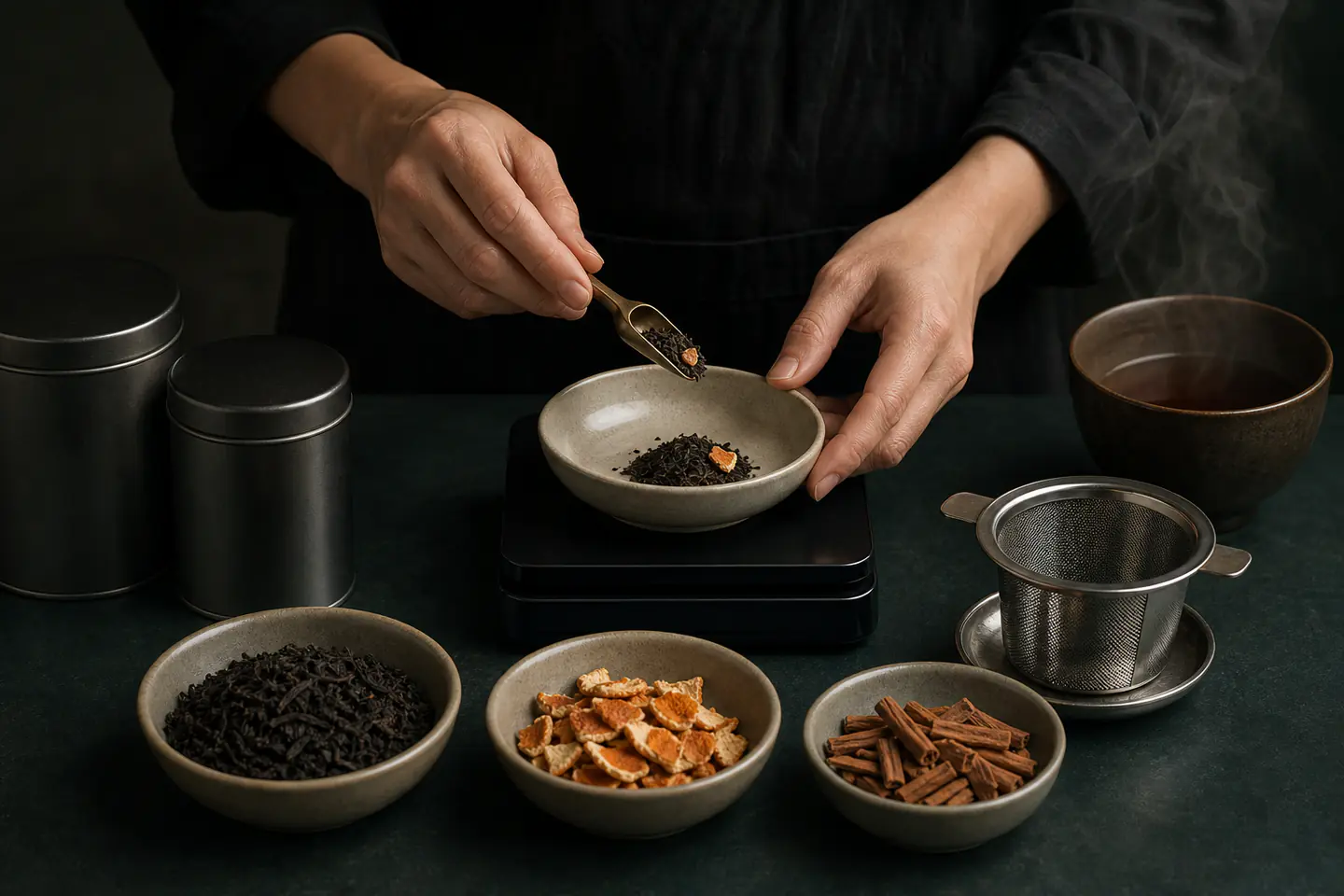
Begin with prepared loose-leaf teas and food-grade dried ingredients, taste them separately, then make one tiny base-and-accent blend by weight. Good notes beat a large jar of an experiment that cannot be repeated.
Quick answer
Learn the ingredients before combining them
Brew each prepared tea or food-grade dried ingredient separately at an appropriate time and temperature. Choose one base tea and one compatible accent, weigh a five-gram test blend, brew it in a roomy basket and record the ratio before changing anything.
- 01
Start with ingredients sold for food and infusion—not unidentified garden plants, decorative petals or essential oils.
- 02
Make tiny batches. A weak or overpowering blend should cost one cup, not an entire tin.
- 03
Use the base tea’s brewing needs as the first reference, then adjust ingredients that become bitter or vanish.
- 04
Describe flavour, aroma and strength; avoid turning a personal tea blend into an unsupported health treatment.
What to expect
Dry aroma and brewed flavour are different tests
A blend can smell balanced in the tin while one component dominates in hot water. Tasting each infusion separately gives the adjustment a reason.
Base
Black, green, oolong and white teas contribute different body and brewing tolerances. Begin with one already enjoyed alone.
Accent
Mint, citrus peel, cinnamon and floral ingredients can be powerful. Start below the amount that looks visually generous.
Particle size
Fine material settles in a tin and extracts quickly. Mix gently before measuring and compare like-sized ingredients where possible.
Water
Temperature, mineral content and time can change the cup more than a one-percent recipe adjustment.
Age
Aromatic ingredients fade and teas absorb odour. Store small amounts airtight, cool, dark and away from spices and moisture.
Blending method
Build the blend like a controlled tasting
Calibrate the palate
A sampler of finished pure and flavoured teas is useful for comparison, not as a compulsory ingredient set. Brew cups side by side and note body, aroma, bitterness, sweetness and aftertaste without trying to use professional vocabulary. The useful question is what changed and whether it was pleasant.
Make one small formula
Choose a familiar base such as black tea and one food-grade accent such as dried orange peel or cinnamon. Weigh a five- to ten-gram batch, record both weights and mix gently. Brew a measured portion in the same cup, water and infuser used for the individual ingredients.
Change one variable
If the accent disappears, increase it slightly; if it dominates, reduce it. If bitterness is the problem, test time or temperature before redesigning the recipe. Save only a small labelled amount once the cup works twice.
Starter products
A tasting set and roomy infuser are enough
The tea sampler provides contrasting finished cups for palate practice. The stainless basket allows whole leaves room to open. The precision scale and small tins become useful after measured recipes—not before tasting has identified a direction.
VAHDAM Top 10 Loose-Leaf Tea Sampler
Contrasting ready-made teas make it possible to compare body, aroma and extraction before buying individual blending ingredients.
HAUSPROFI Stainless Steel Basket Tea Infuser with Lid
A broad basket supports consistent side-by-side brewing and can be lifted out promptly.
First blend
Make a five-gram base-and-accent trial
Use only commercially prepared ingredients labelled for food or infusion and check allergens and personal contraindications.
- 01
Taste the base alone
Use a measured leaf dose, water temperature and brew time appropriate to that tea. Record body, bitterness and aroma.
- 02
Taste the accent alone
Infuse a small food-grade sample safely and note its strength. Some spices and herbs need a different time from the tea.
- 03
Choose a cautious ratio
Make about five grams with the base dominant. Write both weights before the ingredients enter the same bowl.
- 04
Brew consistently
Use the same water, cup, infuser and timer. Observe whether fine particles sink and make the sample uneven.
- 05
Adjust one thing
Change the accent weight or brewing parameter—not both—and prepare a fresh small batch.
- 06
Label the successful version
Record ingredients, ratio, date and preferred brewing method. Store only enough to confirm how it changes over a few weeks.
Ingredients
Keep flavour experiments inside food boundaries
Buy ingredients intended to be consumed
Decorative dried flowers, potpourri, craft peel and garden plants may carry pesticides, contamination or identity problems. Use reputable food suppliers and keep the original label, ingredient list, allergen information and best-before date.
Herbal does not mean universally harmless
Botanicals can interact with medicines, pregnancy, allergies and medical conditions. Build blends for flavour, and check authoritative health advice for each less-familiar ingredient. Do not borrow wellness claims from social media or assume a small spoon is risk-free.
Essential oil is not a beginner flavouring
Ordinary aromatherapy oils are concentrated and are not automatically food-safe. Even products marketed for food use require specialist formulation and accurate dosing. Dried food ingredients keep the first route visible, measurable and much easier to reverse.
Skip for now
What can wait
A shelf of ingredients creates more combinations but makes freshness, safety and learning harder to track.
- 01
The 0.01 g precision scale
Useful when repeating tiny formulas and potent accents. A standard kitchen scale may not resolve a five-gram blend accurately.
- 02
Six storage tins
Buy once several blends deserve separate airtight homes. Until then, keep ingredients in their labelled supplier packaging.
- 03
Home-dried fruit
Residual moisture can spoil a blend. Use commercially dried food-grade pieces until drying and water activity are understood.
- 04
Essential oils and flavour concentrates
Concentration and food suitability make this a specialist formulation route, not a first-cup shortcut.
- 05
Medicinal blending
Health-directed herbal use requires ingredient-specific expertise and personal medical context beyond a flavour hobby.
Upgrade path
Upgrade measurement and storage after taste
A better setup makes a successful formula repeatable; it does not make more ingredients compatible.
Side-by-side tasting
About £15–£25Tea samples + basket infuser + notebook
Learn base styles, extraction and personal flavour vocabulary.Measured micro-batches
About £10–£250.01 g scale + small bowls + timer
Repeat ratios and adjust one variable instead of guessing by volume.Small blend library
About £10–£40Airtight labelled tins + ingredient log
Track freshness, allergens and recipe versions without cross-aroma.Advanced flavouring
Training and ingredients varyFood-industry flavours + dosing equipment + formulation guidance
Move beyond visible dried ingredients only with suitable technical knowledge.Safety
Every ingredient must belong in the cup
A pleasant smell or traditional use is not enough evidence that an ingredient is safe for every drinker.
- Use ingredients sold as food or infusion material and keep their identity, allergen and storage labels.
- Do not use unknown foraged plants, florist flowers, potpourri or craft ingredients.
- Check medicine interactions, pregnancy warnings, allergies and health conditions for unfamiliar botanicals with an appropriate professional source.
- Do not ingest aromatherapy essential oils or add concentrates unless they are specifically food-grade and used with specialist dosing guidance.
- Keep ingredients and finished blends dry, airtight and away from heat, light, steam, pests and strong odours.
- When sharing a blend, provide the full ingredient list and avoid disease-treatment or guaranteed wellness claims.
Classes
When outside help is useful
A good class provides structured tasting, ingredient provenance and formula feedback—not just a table of colourful herbs.
Current small-group sessions combine tasting with one labelled take-home blend.
Premium sessions can include expert consultation and a large quantity of a finished blend; unnecessary for casual experimentation.
Three contrasting teas, identical cups and careful notes teach more at the beginning than an unstructured ingredient haul.
Representative UK tea-blending experiences and prices checked 27 July 2026.
Sources
Where the guidance came from
Food-safety and health sources define ingredient boundaries. Tea-community discussions repeatedly support tasting components first, beginning with one base and making very small recorded batches.
-
01
Food Standards Agency · Food allergies and intolerances
UK allergen information and the importance of accurate ingredient communication.
Open source -
02
NHS · Herbal medicines
Interactions, side effects and pregnancy cautions for herbal products.
Open source -
03
Tea & Herbal Association of Canada · Tea preparation
Specialist overview of water, temperature, time and leaf type.
Open source -
04
r/tea · Making tea blends resources
Community recommendation to begin with one base and one or two flavours, then record adjustments.
Open source -
05
r/tea · Advice on creating a tea blend
Specific practitioner advice to make roughly five-gram test batches before scaling.
Open source -
06
r/tea · Tea blending basics
Recent beginner discussion of base teas, dried ingredients and storage.
Open source -
07
A Little Cup Tea Co · Creative tea blending workshop
Representative £29.50 UK creative blending session.
Open source -
08
Teapro · Herbal tea blending masterclass
Representative £45 current UK workshop.
Open source -
09
Twinings · Bespoke tea blending session
Representative premium £350 session with a finished blend.
Open source -
10
Amazon UK · VAHDAM loose-leaf tea sampler
Exact ten-tea loose-leaf sampler; £14.99 observed and available.
Open source -
11
Amazon UK · HAUSPROFI tea infuser basket
Exact stainless basket infuser with lid; £6.99 observed and available.
Open source -
12
Amazon UK · ACCUWEIGHT precision scale
Exact 300 g by 0.01 g scale; £9.21 observed and available.
Open source -
13
Amazon UK · Lawei mini tea tins
Exact six double-lid 50 g tins; £10.99 observed and available.
Open source
Guide information and links checked 27 July 2026.