Beginner’s guide · Cook & bake
Start with clean apple juice
and measure the finish.
A one-gallon cider from preservative-free apple juice is approachable, but dry cider, sweet cider and sparkling cider require different finishing decisions.
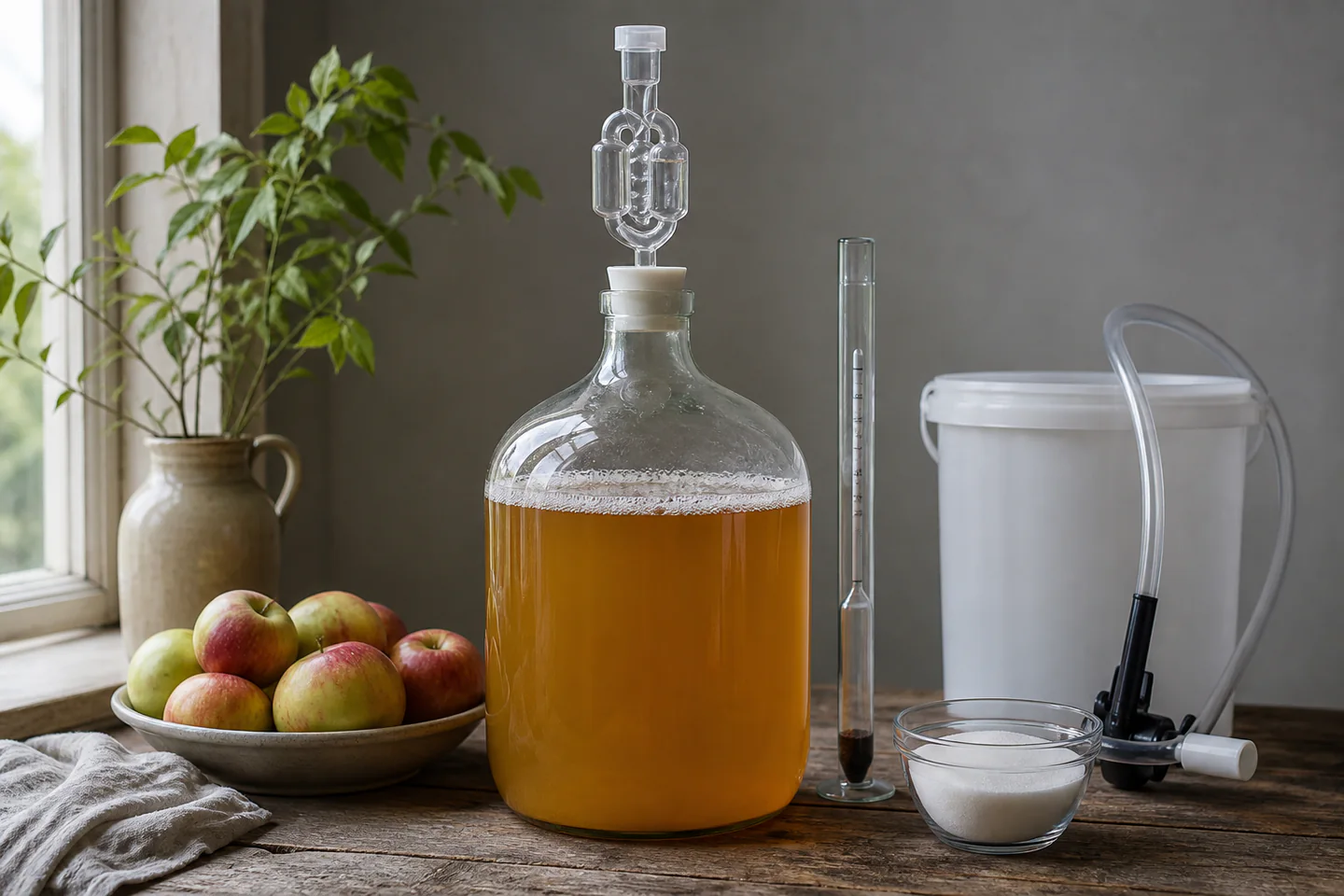
Quick answer
Make the first cider dry and still
Use preservative-free juice, sanitised equipment and cider or wine yeast. Ferment under airlock, confirm stable gravity, rack gently and bottle the first batch still rather than improvising sweetness and carbonation.
- 01
Check juice ingredients for sorbate or benzoate, sanitise equipment and record starting gravity. Keep the first attempt narrow enough that preparation, the main action and the result can all be reviewed together.
- 02
Keep yeast temperature steady and avoid oxygen once active fermentation subsides. Keep the first attempt narrow enough that preparation, the main action and the result can all be reviewed together.
- 03
Stable gravity, taste and clearing decide the next step; bubbles in an airlock do not. Keep the first attempt narrow enough that preparation, the main action and the result can all be reviewed together.
- 04
Do not add sugar to sealed bottles without a measured priming plan and pressure-rated glass. Keep the first attempt narrow enough that preparation, the main action and the result can all be reviewed together.
What to expect
Fermentation removes most apple sweetness
A simple cider often finishes dry and sharper than commercial sweet brands.
The first attempt
Juice cider is easier than pressing fruit and lets fermentation technique stand alone. For cider making, note what actually happened rather than relying on memory; that turns the next attempt into a controlled change instead of another guess.
What changes
Yeast, tannin, acidity and apple blend shape body as much as alcohol. For cider making, note what actually happened rather than relying on memory; that turns the next attempt into a controlled change instead of another guess.
The useful signal
Stable final gravity is essential before still bottling or calculated priming. For cider making, note what actually happened rather than relying on memory; that turns the next attempt into a controlled change instead of another guess.
The common trap
Back-sweetening fermentable sugar can restart fermentation and burst bottles. For cider making, note what actually happened rather than relying on memory; that turns the next attempt into a controlled change instead of another guess.
Core method
Ferment dry before exploring sweetness or sparkle
Prepare deliberately
Check juice ingredients for sorbate or benzoate, sanitise equipment and record starting gravity. For cider making, note what actually happened rather than relying on memory; that turns the next attempt into a controlled change instead of another guess.
Control the central variable
Keep yeast temperature steady and avoid oxygen once active fermentation subsides. For cider making, note what actually happened rather than relying on memory; that turns the next attempt into a controlled change instead of another guess.
Read the result
Stable gravity, taste and clearing decide the next step; bubbles in an airlock do not. For cider making, note what actually happened rather than relying on memory; that turns the next attempt into a controlled change instead of another guess.
Reset before repeating
Log gravity, temperature and taste, clean immediately and alter one finishing choice next time. For cider making, note what actually happened rather than relying on memory; that turns the next attempt into a controlled change instead of another guess.
Useful products
Products with a clear role
The shortlist covers the first workable route and one realistic improvement. Each exact Amazon UK page or ISBN was checked; confirm the current seller, specification, edition and availability.
MYPURECORE Two One-Gallon Glass Demijohns with Airlocks and Siphon
One gallon is manageable and leaves a second vessel for racking.
Lalvin ICV-D47 Wine Yeast, 5 g
Published tolerances make the process easier to plan.
Coopers DIY Beer 23 Litre Brew Kit
The hardware becomes useful once one-gallon sanitation and transfers are familiar.
First project
Bottle one gallon still and dry
A still first cider avoids the extra variables of priming and back-sweetening.
- 01
Set up
Check juice ingredients for sorbate or benzoate, sanitise equipment and record starting gravity. For cider making, note what actually happened rather than relying on memory; that turns the next attempt into a controlled change instead of another guess.
- 02
Begin
Use preservative-free juice, sanitised equipment and cider or wine yeast. Ferment under airlock, confirm stable gravity, rack gently and bottle the first batch still rather than improvising sweetness and carbonation. For cider making, note what actually happened rather than relying on memory; that turns the next attempt into a controlled change instead of another guess.
- 03
Stay with one method
Keep yeast temperature steady and avoid oxygen once active fermentation subsides. For cider making, note what actually happened rather than relying on memory; that turns the next attempt into a controlled change instead of another guess.
- 04
Finish and assess
Stable gravity, taste and clearing decide the next step; bubbles in an airlock do not. For cider making, note what actually happened rather than relying on memory; that turns the next attempt into a controlled change instead of another guess.
- 05
Record the next change
Log gravity, temperature and taste, clean immediately and alter one finishing choice next time. For cider making, note what actually happened rather than relying on memory; that turns the next attempt into a controlled change instead of another guess.
What can wait
What can wait until the method works
Buying around an unclear problem adds clutter. These upgrades make more sense after the first result exposes a repeatable limitation.
- 01
More capacity
Larger or multiple batches multiply finishing without bottle pressure risk before the small version is stable. For cider making, note what actually happened rather than relying on memory; that turns the next attempt into a controlled change instead of another guess.
- 02
Premium equipment
A fruit press and scratter are expensive seasonal tools; begin with known juice. For cider making, note what actually happened rather than relying on memory; that turns the next attempt into a controlled change instead of another guess.
- 03
Extra varieties
Blended apples, tannin and wild fermentation can follow a clean juice baseline. For cider making, note what actually happened rather than relying on memory; that turns the next attempt into a controlled change instead of another guess.
- 04
Public or commercial claims
Alcohol strength requires measurement; sweetness and taste are unreliable estimates. For cider making, note what actually happened rather than relying on memory; that turns the next attempt into a controlled change instead of another guess.
Upgrade path
Upgrade the repeated limitation
Improve gravity measurement and packaging before pressing apples.
Try it
£30–£75Suitable juice, one-gallon vessel and yeast
Fermentation is isolated from fruit processing.Repeat it
£20–£60Hydrometer and second demijohn
Completion and racking become controlled.Improve the bottleneck
£50–£150Pressure-rated bottles and measured priming tools
Sparkling cider becomes calculated rather than risky.Go deeper
VariableScratter, press and apple-blend trials
Orchard fruit can be designed into the cider.Safety & care
Prevent pressure accidents
Cider that appears finished can restart if fermentable sugar remains or is added.
- Sanitise all cooled-side equipment. Follow current manufacturer, food-safety, access, wildlife or local guidance wherever it applies.
- Confirm stable gravity before bottling. Follow current manufacturer, food-safety, access, wildlife or local guidance wherever it applies.
- Use pressure-rated bottles only for measured carbonation. Follow current manufacturer, food-safety, access, wildlife or local guidance wherever it applies.
- Never distil cider without the relevant legal authority. Follow current manufacturer, food-safety, access, wildlife or local guidance wherever it applies.
- Handle glass safely and consume alcohol responsibly. Follow current manufacturer, food-safety, access, wildlife or local guidance wherever it applies.
Outside help
When outside help earns its place
A cider club or orchard pressing day is valuable when moving from juice to fruit.
Use one complete lesson that covers preparation, the central technique, common mistakes and finishing. For a first cider making attempt, one coherent method is easier to diagnose than fragments collected from several creators.
Outside help earns its place when safe setup, access, identification or live correction removes a real obstacle. Ask what equipment, materials, access and follow-up support are included before booking.
Representative UK learning options checked 31 August 2026; local prices, access, materials and tutor support vary.
Sources
Where the guidance came from
The method is grounded in specialist, manufacturer and public guidance, then checked against recurring beginner problems and the exact products linked here.
-
01
The Craft Brewing Association
UK amateur cider and brewing context.
Open source -
02
Cider Institute of North America · Resources
Cider production education.
Open source -
03
Lalvin · Yeast
Manufacturer yeast reference.
Open source -
04
HMRC · Alcohol duties
UK regulatory context.
Open source -
05
r/cider
Recurring juice, sweetness and bottle-conditioning questions.
Open source -
06
Amazon UK · Two One-Gallon Glass Demijohns with Airlocks and Siphon
Exact Amazon UK product page or ISBN used for the recommendation; current price, seller, specification and availability should be confirmed.
Open source -
07
Amazon UK · ICV-D47 Wine Yeast, 5 g
Exact Amazon UK product page or ISBN used for the recommendation; current price, seller, specification and availability should be confirmed.
Open source -
08
Amazon UK · DIY Beer 23 Litre Brew Kit
Exact Amazon UK product page or ISBN used for the recommendation; current price, seller, specification and availability should be confirmed.
Open source
Guide information and links checked 31 August 2026.