Beginner’s guide · Make & create
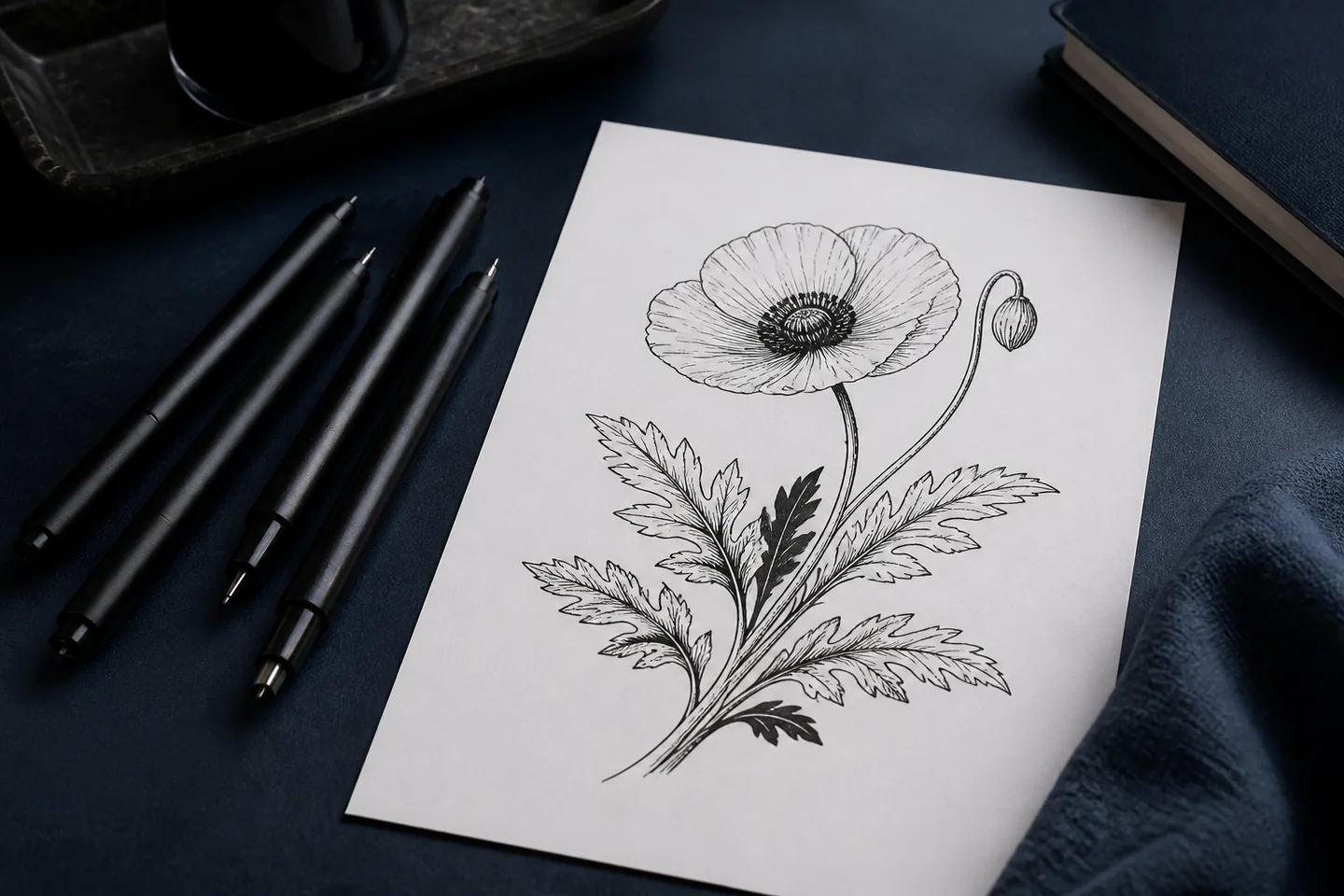
A postcard-size black-and-white botanical illustration
Let line weight describe the form.
Start with waterproof fineliners, smooth heavyweight paper and black-and-white subjects. Small studies of contour, hatching and filled shape teach a reusable ink vocabulary without a fragile dip-pen setup.
Quick answer
Use three nib sizes and turn one leaf into a line-and-hatching study
Choose a simple leaf or household object, make a faint graphite placement and test every pen on a scrap of the same paper. Draw the main contour with a medium fineliner, use a smaller nib for internal structure and hatch in one consistent direction to describe shadow. Add a few solid-black accents where forms overlap, wait for the ink to dry, then erase only the remaining pencil that lifts cleanly. Repeat the subject at thumbnail size to practise decisions rather than decoration.
- 01
Fineliner sizes are not a universal millimetre measurement across brands; compare the visible marks on a test strip.
- 02
Waterproof pigment ink is useful when later watercolour is planned, but it must be fully dry and tested on the exact paper.
- 03
Hatching follows form and value. More lines are not automatically more realistic if their spacing and direction are inconsistent.
- 04
Permanent ink stains desks and clothing; cap pens between uses and protect the work surface.
What to expect
Ink removes easy erasing but adds visual clarity
A wrong line is rarely catastrophic. It can become texture, shadow or a reason to simplify the next version; confidence grows through many small studies.
Placement
A very light pencil scaffold prevents the finished drawing from drifting off the page without tracing every contour.
Weight
Thicker or doubled lines can mark overlap and shadow-side edges; uniform weight makes space flatter.
Hatching
Parallel spacing controls value. Cross-hatching adds darkness but should still describe the plane it crosses.
Black shape
A few connected solid shapes anchor the page and make delicate lines feel intentional.
Drying
Even fast pigment ink can smear under an eraser or wet wash. Test and allow more time than the pen cap suggests.
Correction
White gouache, collage or digital cleanup can repair presentation work, but a practice drawing should preserve evidence of decisions.
Core method
Build an illustration from contour, structure and value
Make a pen and paper test
Draw straight lines, curves, dots, hatching and a filled square with each nib on the chosen Bristol paper. Label the nib beside each mark in pencil. After drying, rub with an eraser and brush with clean water if mixed media is planned; discard combinations that feather or smear.
Place the subject lightly
Mark the top, bottom, widest points and main axis in hard graphite using minimal pressure. Reduce the subject to two or three overlapping forms. The pencil is a location map, not a finished drawing that must be traced mechanically.
Vary contour by overlap
Draw foreground and shadow-side edges with the medium nib, then use the finer nib for veins, texture or smaller changes. Break or thin a line where strong light removes the boundary. Rotate the paper when it helps the hand make a clean curve.
Add designed shadow
Choose one hatch direction and space lines more closely in dark planes. Cross only the deepest areas and add one or two connected black shapes at overlaps. Let the ink dry fully, remove compatible pencil gently and scan or photograph the result before correcting it.
Useful products
Products with a clear job in the setup
The Sakura six-pack gives a useful waterproof pigment-nib range; the brush-inclusive set is an alternative when expressive thick lines matter; Canson Bristol supplies the smooth surface. Choose one pen set and the paper.
Sakura Pigma Micron Fineliner Pens, Set of 6
The range is broad enough to establish hierarchy without requiring bottled ink or interchangeable nibs.
Sakura Pigma Micron Fineliner and Brush Pen Set
It suits an illustrator who already knows they want brush-weight variation as well as hatching.
Canson Canson XL Bristol Pad, A4, 180 gsm
A4 sheets provide room for tests and a finished postcard study without an expensive board purchase.
First project
Ink one leaf in three mark families
Contour, hatching and solid black provide enough language for a complete first illustration.
- 01
Test the nibs
Make labelled marks and confirm dry-time and eraser resistance.
- 02
Place four landmarks
Mark the tip, stem, widest points and central axis faintly.
- 03
Draw the contour
Vary weight at overlaps and leave selected light edges open.
- 04
Add structure
Use the smallest nib for veins and secondary folds.
- 05
Hatch the shadow
Keep spacing deliberate and follow the leaf surface.
- 06
Add and review black shapes
Anchor one overlap, dry fully and inspect at thumbnail size.
What can wait
What can wait until the first result
Dip pens, bottled ink and elaborate correction tools can wait until the clean fineliner workflow feels limiting.
- 01
A dozen nib sizes
Three visibly different widths already teach hierarchy and edge emphasis.
- 02
A dip pen on day one
It adds nib angle, ink flow, spills and cleaning before composition and hatching are understood.
- 03
Tracing every detail
A light placement is useful; dense graphite can indent paper and make the ink drawing stiff.
- 04
Automatic cross-hatching
A second direction should solve a real value need rather than fill empty space.
- 05
Framing the first page
Make a sequence of small studies and select the strongest after the marks become consistent.
Upgrade path
Upgrade the repeated limitation
Add expressive nibs, brush ink or digital finishing when the limitation appears in actual illustrations.
Fineliner start
About £20–£40Three widths + Bristol pad
Learn contour, hatching and black shape.Expressive line
About £15–£50Brush pen or dip nib + compatible ink
Change width continuously and add gesture.Mixed media
About £25–£90Waterproof ink + watercolour/gouache
Combine permanent structure with colour.Reproduction
About £80–£500+Scanner/tablet + editing workflow
Clean, colour and prepare editions or print files.Safety & care
Protect the surface, posture and original work
Ink illustration is low risk, but permanent pigment, sharp nibs, repetitive grip and poor digital backup create avoidable problems.
- Protect the desk and clothing, cap pens when not in use and clean spills according to the manufacturer’s instructions.
- Do not put pens or brush handles in the mouth; wash hands after handling ink and keep materials away from food.
- Use only inks documented as compatible with the chosen pen, brush and ventilation conditions; solvent-based markers are a different route.
- Take regular hand, eye and posture breaks and reduce grip pressure if fingers or wrist become sore or numb.
- Scan or photograph important originals, keep the files in two locations and confirm usage rights for every reference image.
Outside help
When outside help earns its place
Free pen exercises and library books are enough for the first illustration. A course becomes useful for composition, editorial briefs or print preparation when it critiques finished work rather than selling supplies.
Use exercises that compare nib width, hatching and waterproofness.
Check whether feedback, scanning and reproduction are covered.
Representative UK product, workshop, lesson and club costs checked 13 August 2026; local prices, access, materials and tutor support vary.
Sources
Where the guidance came from
Pen and paper manufacturers establish material properties; professional illustration organisations and drawing communities add composition, workflow and reproduction practice.
-
01
Sakura · Pigma Micron
Manufacturer nib, pigment and waterproofness information.
Open source -
02
Canson · Bristol
Paper surface, weight and media suitability.
Open source -
03
Association of Illustrators
Professional illustration practice, rights and industry context.
Open source -
04
Artists Network · Pen and ink
Specialist line and hatching instruction.
Open source -
05
Reddit · r/learnart
Recurring beginner critique on line weight, hatching and materials.
Open source -
06
Amazon UK · Sakura Pigma Micron six-pack
Exact product page, model or ISBN, observed price and availability checked for this guide.
Open source -
07
Amazon UK · Sakura Micron brush set
Exact product page, model or ISBN, observed price and availability checked for this guide.
Open source -
08
Amazon UK · Canson XL Bristol A4 pad
Exact product page, model or ISBN, observed price and availability checked for this guide.
Open source
Guide information and links checked 13 August 2026.