Beginner's guide · Observe & photograph
Watch one place.
Learn who returns.
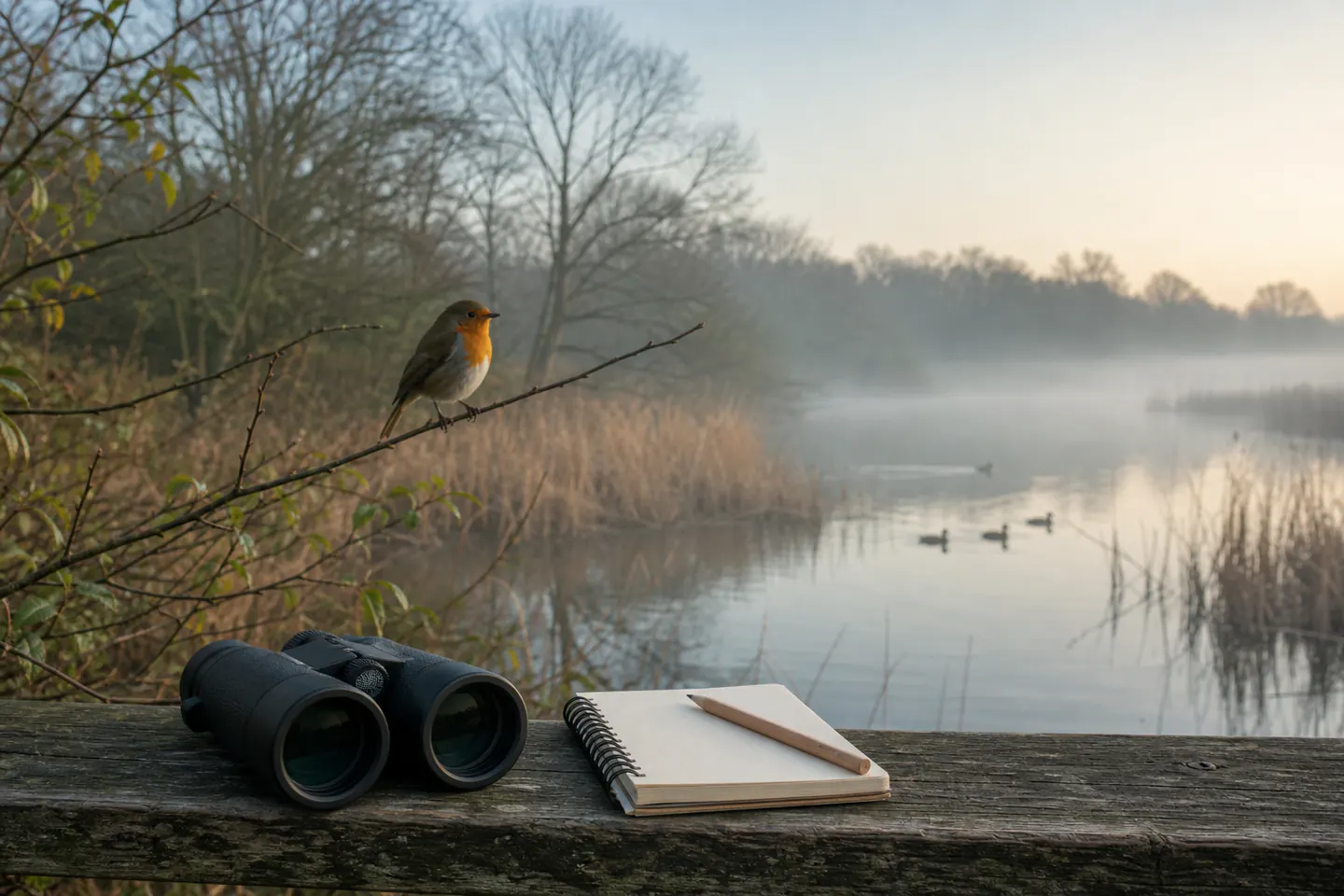
Begin with a twenty-minute sit at a window, park or local water and identify three common birds by size, shape, movement, voice and habitat. Binoculars help, but a repeatable observation routine matters first.
Quick answer
Watch one place.
Choose one safe local place and stay still for twenty minutes. Scan first with unaided eyes, then bring binoculars up to the bird without looking down. Note size, silhouette, bill, movement, voice, habitat and any obvious colour patch before opening an identification guide. A partial, honest record is more useful than a confident guess based on colour alone.
- 01
Eight-times magnification is a forgiving beginner choice; 42 mm objective lenses balance brightness and weight for general birding.
- 02
Fit matters. Set the hinge until one circular image appears, adjust eyecups for glasses and use the centre focus plus dioptre as the maker instructs.
- 03
Birdsong apps can narrow possibilities but are not proof. Record place, time and repeated phrases, then compare with a trusted guide.
- 04
Distance is an ethical tool. If a bird stops feeding, gives alarm calls or repeatedly attends a nest, move away rather than obtaining a closer view.
What to expect
What the first attempts really involve
Birds are moving, partly hidden and seasonally variable. Identification improves by combining several observations and learning the common local species well enough to notice what differs.
Light
Backlighting can erase plumage colour, while low sun changes apparent warmth. Shape, behaviour and call may remain more dependable.
Age and season
Juveniles, moulting birds and winter plumage can look unlike a guide's most colourful adult illustration.
Distance
Magnification narrows the view and exaggerates hand movement. Finding the bird with the eyes first is faster than sweeping blindly through binoculars.
Sound
A call may reveal a hidden bird, but phones, wind and other species confuse automatic recognition. Treat an app result as a hypothesis.
Access
Public paths, private land, nesting restrictions and habitat sensitivity decide where observation is appropriate.
Fundamentals
Build the first attempt on reliable fundamentals
Learn the local common set
Start with birds likely at the chosen place: perhaps robin, blackbird, woodpigeon, blue tit, magpie, mallard or gulls. Learn their size relative to a familiar bird, feeding style, flight and typical call. Rare-bird searches become easier when the ordinary comparison is secure.
Set binoculars to the observer
Adjust eyecups for glasses, fold the barrels until the two circles merge and focus on a fixed object. Follow the exact dioptre method once, then leave that setting alone. Practise lifting the binoculars while keeping the eyes on a sign or branch; the target should appear in the field immediately.
Use an evidence order
Before naming the bird, record place and habitat, approximate size, shape, bill, leg length, movement, group size, voice and only then colour markings. Rule out the common alternatives. If two features conflict, leave the identification open and collect a better observation next time.
Keep a small repeatable record
Date, start time, weather, location, species, count and one behavioural note are enough. Revisit the same route or viewpoint at different times. Changes in tide, season, leaf cover and weather become part of the hobby without requiring travel to a famous reserve.
Useful products
One general-purpose binocular and a compact reference
The Nikon 8×42 is the main equipment recommendation and the RSPB pocket guide provides a portable British reference. The Vortex harness is an optional comfort upgrade for long walks; it is unnecessary for a first twenty-minute sit.
Nikon PROSTAFF P3 8×42 Binoculars
The 8×42 format balances field of view, brightness and hand-held stability for varied UK birding.
RSPB RSPB Pocket Guide to British Birds, fifth edition
Its British scope keeps the first identification set relevant and compact.
First watch
Make a three-species local observation list
Use a window, garden, public park or accessible waterside where stopping is allowed. The goal is three supported identifications and one unanswered observation—not the longest list.
- 01
Choose the place
Select a safe legal viewpoint with a bench, rail or clear stopping area and check daylight, weather and access.
- 02
Prepare the binoculars
Set eyecups, hinge and dioptre in advance, then clean lenses only with suitable air and lens cloth.
- 03
Scan without optics
Notice movement, calls and likely perches across the whole scene before narrowing the view.
- 04
Bring optics to the bird
Keep looking at the bird, raise the binoculars and focus; lower them if the target is lost rather than sweeping continuously.
- 05
Record evidence
Write size, shape, bill, movement, habitat and sound before consulting a picture or app.
- 06
Check common alternatives
Compare the whole description with two likely species and note which feature actually separates them.
- 07
Count conservatively
For a moving group, record the minimum number known to be present rather than adding every glimpse.
- 08
End without disturbance
Leave quietly, avoid approaching nests or roosts and save one uncertainty as the question for the next visit.
Troubleshooting
Read the result before changing the setup
A double image needs the hinge adjusted
Fold or open the barrels until the view becomes one clean circle. If it remains doubled for one observer, stop using the binoculars and check alignment or obtain retailer support.
A bird that cannot be found needs a wider routine
Lower the binoculars, fix the bird's position relative to a branch, roof or reed edge and raise them without shifting gaze. Practise on stationary objects.
Two plausible species need a separating feature
Look for bill shape, wing bar, leg colour, tail movement, voice or habitat rather than revisiting the same uncertain colour patch.
A disturbed bird changes the session
Back away immediately if feeding, calling or nest attendance changes. No identification or photograph is worth increasing risk to wildlife.
Skip for now
What can wait
Observation works with the eyes and a notebook. Specialist optics solve distance and identification problems that may never occur on a local first route.
- 01
A spotting scope
It is useful for distant waterbirds and estuaries but adds a tripod, narrow view and a much higher budget.
- 02
Maximum magnification binoculars
Ten- or twelve-times power magnifies shake and narrows the field. Try them physically before deciding that more reach is more useful.
- 03
Playback of bird calls
It can alter territorial or breeding behaviour. Learn calls passively and follow site or conservation guidance.
- 04
A rare-bird travel list
Local repeat visits teach season, behaviour and identification more reliably than chasing reports before common species are familiar.
Upgrade path
What a better setup changes
A better setup should improve comfort, low-light clarity or access to genuinely distant birds while preserving the observation habit.
Eyes and notebook
Already ownedLocal viewpoint + simple field record
Teaches movement, calls, habitat and common species without equipment dependence.General binocular birding
About £120–£200Well-fitting 8×42 binocular + pocket guide
Reveals field marks while retaining a wide, steady view.Longer walks
Add about £25–£50Harness + weather cover + route planning
Reduces neck load and keeps optics accessible without changing magnification.Distant wetland observation
Often £500+ completeSpotting scope + stable tripod
Adds reach for stationary distant birds after the need appears repeatedly.Before upgrading
A useful check before spending more
Try optics with glasses and real hands
Eye relief, focus-wheel reach, weight and balance are personal. A specification table narrows options, but a retailer or reserve trial tells whether the binocular can be held steadily for several minutes.
Measure progress in observations
A useful month might add one recognised call, one seasonal change and one confident comparison. It does not need a long species total or a more expensive optic.
Safety
Protect wildlife, access and eyesight
Birdwatching is gentle only when distance, land access and the observer's surroundings stay ahead of the sighting.
- Never look at the Sun through binoculars or any optical instrument.
- Keep away from nests, roosts and displaying birds; retreat at the first sign of changed behaviour.
- Stay on permitted paths, follow reserve signage and do not enter private land without permission.
- Do not bait wildlife or use playback where it may disturb birds; follow current site and conservation guidance.
- Watch footing, water edges, tides, roads and other people before raising binoculars.
- Avoid publicly sharing precise locations of sensitive nesting or persecuted species.
Classes
When outside help is useful
A guided walk is useful for learning calls, finding birds without scanning aimlessly and comparing similar species. It belongs after or alongside local practice, not before the first observation.
Look for a small group, loan binoculars and explanation of habitat and behaviour.
Useful for song, waders or raptors once general binocular handling is comfortable.
Representative UK reserve and field-course formats checked 30 July 2026; admission and equipment hire vary.
Sources
Sources and checking notes
RSPB and BTO guidance anchors identification, optics and ethical fieldcraft; current UK community discussion adds lived beginner questions; direct listings confirm the products.
-
01
RSPB · A beginner's guide to birdwatching
UK beginner route covering where to watch, how to identify and useful equipment.
Open source -
02
BTO · Skills and tools
British Trust for Ornithology resources for identification, recording and field tools.
Open source -
03
RSPB Shop · Choosing binoculars
Specialist explanation of magnification, objective size, fit and optical trade-offs.
Open source -
04
BTO · Learn
Structured learning resources for British birds, surveys and identification.
Open source -
05
r/birdwatchinguk · Beginner discussion
Current UK community recommendations and recurring beginner questions.
Open source -
06
Amazon UK · PROSTAFF P3 8×42 Binoculars
Exact Nikon product and direct Amazon UK listing checked for current availability, price context and model identity.
Open source -
07
Amazon UK · RSPB Pocket Guide to British Birds, fifth edition
Exact RSPB product and direct Amazon UK listing checked for current availability, price context and model identity.
Open source -
08
Amazon UK · GlassPak Binocular Harness
Exact Vortex Optics product and direct Amazon UK listing checked for current availability, price context and model identity.
Open source
Guide information and links checked 30 July 2026.