Beginner’s guide · Cook & bake
Cook sugar to the right stage
then stop the heat.
Fudge, honeycomb and boiled sweets are different sugar systems. Begin with one thermometer-led fudge recipe and learn crystallisation before higher-temperature work.
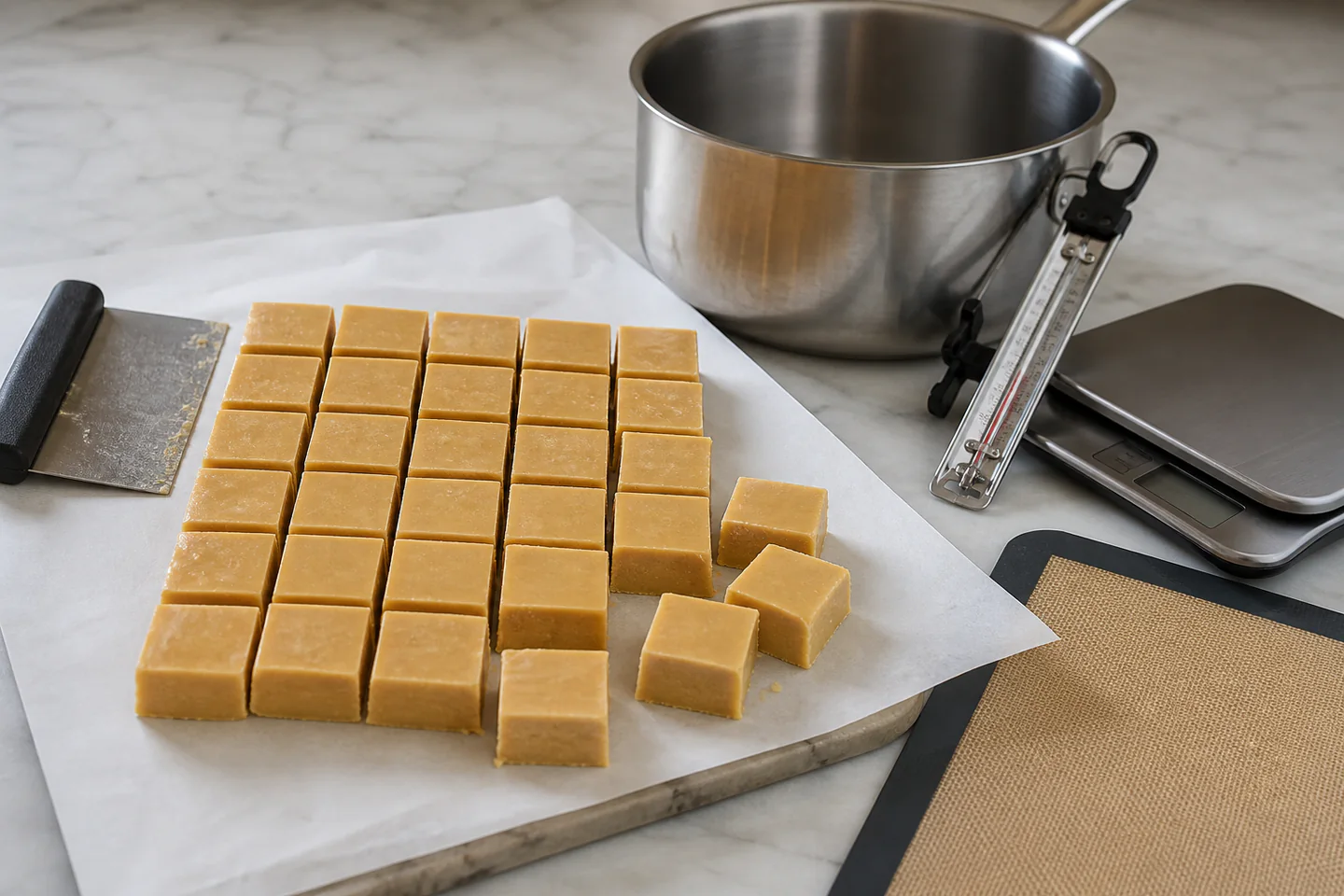
Quick answer
Begin with fudge, not hard crack
Use a tested plain fudge recipe, weigh ingredients, dissolve crystals before boiling, fit a confectionery thermometer and cool to the stated point before beating.
- 01
Set out the lined tin, brush, thermometer and clear landing space before heating sugar. Keep the first attempt narrow enough that preparation, the main action and the result can all be reviewed together.
- 02
Do not stir during stages where the recipe forbids it, and read the thermometer at the correct depth. Keep the first attempt narrow enough that preparation, the main action and the result can all be reviewed together.
- 03
Temperature, gloss, grain and final set explain whether crystallisation was controlled. Keep the first attempt narrow enough that preparation, the main action and the result can all be reviewed together.
- 04
Never touch or taste hot syrup from a spoon. Keep the first attempt narrow enough that preparation, the main action and the result can all be reviewed together.
What to expect
A few degrees change the finished texture
Concentrated sugar continues cooking after the heat is reduced and causes severe burns on contact.
The first attempt
Fudge teaches dissolution, concentration, cooling and controlled crystallisation at a lower stage than boiled sweets. For traditional sweet making, note what actually happened rather than relying on memory; that turns the next attempt into a controlled change instead of another guess.
What changes
Undissolved crystals can seed a grainy batch; excess cooking makes it dry and crumbly. For traditional sweet making, note what actually happened rather than relying on memory; that turns the next attempt into a controlled change instead of another guess.
The useful signal
The target temperature and cooling point matter more than colour alone. For traditional sweet making, note what actually happened rather than relying on memory; that turns the next attempt into a controlled change instead of another guess.
The common trap
Beating too early or too late shifts from smooth to coarse or unset. For traditional sweet making, note what actually happened rather than relying on memory; that turns the next attempt into a controlled change instead of another guess.
Core method
Use temperature to control sugar structure
Prepare deliberately
Set out the lined tin, brush, thermometer and clear landing space before heating sugar. For traditional sweet making, note what actually happened rather than relying on memory; that turns the next attempt into a controlled change instead of another guess.
Control the central variable
Do not stir during stages where the recipe forbids it, and read the thermometer at the correct depth. For traditional sweet making, note what actually happened rather than relying on memory; that turns the next attempt into a controlled change instead of another guess.
Read the result
Temperature, gloss, grain and final set explain whether crystallisation was controlled. For traditional sweet making, note what actually happened rather than relying on memory; that turns the next attempt into a controlled change instead of another guess.
Reset before repeating
Record thermometer position, peak temperature, cooling time and set after twenty-four hours. For traditional sweet making, note what actually happened rather than relying on memory; that turns the next attempt into a controlled change instead of another guess.
Useful products
Products with a clear role
The shortlist covers the first workable route and one realistic improvement. Each exact Amazon UK page or ISBN was checked; confirm the current seller, specification, edition and availability.
Tala Jam and Confectionery Thermometer
Sugar stages are separated by small temperature ranges.
Etekcity Digital Kitchen Scale, 0.1 g to 5 kg
Weights expose whether the recipe or technique changed.
Generic Thick Silicone Pastry Mat with Measurements, 40 × 50 cm
Guides make repeated dimensions easier to compare.
First project
Make one plain fudge
Nuts, chocolate and flavour extracts can alter the set; prove the base recipe first.
- 01
Set up
Set out the lined tin, brush, thermometer and clear landing space before heating sugar. For traditional sweet making, note what actually happened rather than relying on memory; that turns the next attempt into a controlled change instead of another guess.
- 02
Begin
Use a tested plain fudge recipe, weigh ingredients, dissolve crystals before boiling, fit a confectionery thermometer and cool to the stated point before beating. For traditional sweet making, note what actually happened rather than relying on memory; that turns the next attempt into a controlled change instead of another guess.
- 03
Stay with one method
Do not stir during stages where the recipe forbids it, and read the thermometer at the correct depth. For traditional sweet making, note what actually happened rather than relying on memory; that turns the next attempt into a controlled change instead of another guess.
- 04
Finish and assess
Temperature, gloss, grain and final set explain whether crystallisation was controlled. For traditional sweet making, note what actually happened rather than relying on memory; that turns the next attempt into a controlled change instead of another guess.
- 05
Record the next change
Record thermometer position, peak temperature, cooling time and set after twenty-four hours. For traditional sweet making, note what actually happened rather than relying on memory; that turns the next attempt into a controlled change instead of another guess.
What can wait
What can wait until the method works
Buying around an unclear problem adds clutter. These upgrades make more sense after the first result exposes a repeatable limitation.
- 01
More capacity
Larger or multiple batches multiply sugar temperature and crystallisation before the small version is stable. For traditional sweet making, note what actually happened rather than relying on memory; that turns the next attempt into a controlled change instead of another guess.
- 02
Premium equipment
Copper pans and marble slabs serve advanced production, not a first tray. For traditional sweet making, note what actually happened rather than relying on memory; that turns the next attempt into a controlled change instead of another guess.
- 03
Extra varieties
Honeycomb, caramel and hard sweets have different endpoints and hazards. For traditional sweet making, note what actually happened rather than relying on memory; that turns the next attempt into a controlled change instead of another guess.
- 04
Public or commercial claims
A soft or hard set is a process result, not proof of safe storage. For traditional sweet making, note what actually happened rather than relying on memory; that turns the next attempt into a controlled change instead of another guess.
Upgrade path
Upgrade the repeated limitation
Improve thermometer confidence and heat consistency.
Try it
£15–£40Heavy pan, thermometer and lined tin
Sugar stages become measurable.Repeat it
£20–£60Reliable induction or heavy-based pan
Hot spots reduce.Improve the bottleneck
£30–£100Second calibrated thermometer and heatproof tools
Readings can be checked.Go deeper
VariableCaramel, fondant and pulled-sugar methods
Crystallisation becomes a creative tool.Safety & care
Hot sugar sticks and burns deeply
Organisation matters because spilled syrup cannot be safely handled in the moment.
- Keep children and pets out of the work area. Follow current manufacturer, food-safety, access, wildlife or local guidance wherever it applies.
- Use a stable heavy pan with ample headroom. Follow current manufacturer, food-safety, access, wildlife or local guidance wherever it applies.
- Never add water to a sugar fire or touch hot syrup. Follow current manufacturer, food-safety, access, wildlife or local guidance wherever it applies.
- Wear closed shoes and use long heatproof tools. Follow current manufacturer, food-safety, access, wildlife or local guidance wherever it applies.
- Allow pans and sweets to cool fully before handling. Follow current manufacturer, food-safety, access, wildlife or local guidance wherever it applies.
Outside help
When outside help earns its place
A confectionery class is valuable before pulled sugar or high-temperature decorative work.
Use one complete lesson that covers preparation, the central technique, common mistakes and finishing. For a first traditional sweet making attempt, one coherent method is easier to diagnose than fragments collected from several creators.
Outside help earns its place when safe setup, access, identification or live correction removes a real obstacle. Ask what equipment, materials, access and follow-up support are included before booking.
Representative UK learning options checked 31 August 2026; local prices, access, materials and tutor support vary.
Sources
Where the guidance came from
The method is grounded in specialist, manufacturer and public guidance, then checked against recurring beginner problems and the exact products linked here.
-
01
Food Standards Agency · Food safety at home
UK hygiene and storage baseline.
Open source -
02
BBC Food · Techniques
Practical cooking technique reference.
Open source -
03
Serious Eats · Techniques
Comparative practical technique context.
Open source -
04
King Arthur Baking · Learn
Tested baking methods and troubleshooting.
Open source -
05
r/AskCulinary
Recurring real-world process questions.
Open source -
06
Amazon UK · Jam and Confectionery Thermometer
Exact Amazon UK product page or ISBN used for the recommendation; current price, seller, specification and availability should be confirmed.
Open source -
07
Amazon UK · Digital Kitchen Scale, 0.1 g to 5 kg
Exact Amazon UK product page or ISBN used for the recommendation; current price, seller, specification and availability should be confirmed.
Open source -
08
Amazon UK · Thick Silicone Pastry Mat with Measurements
Exact Amazon UK product page or ISBN used for the recommendation; current price, seller, specification and availability should be confirmed.
Open source
Guide information and links checked 31 August 2026.