Beginner’s guide · Research & collect
Agree the future of the recording,
before pressing record.
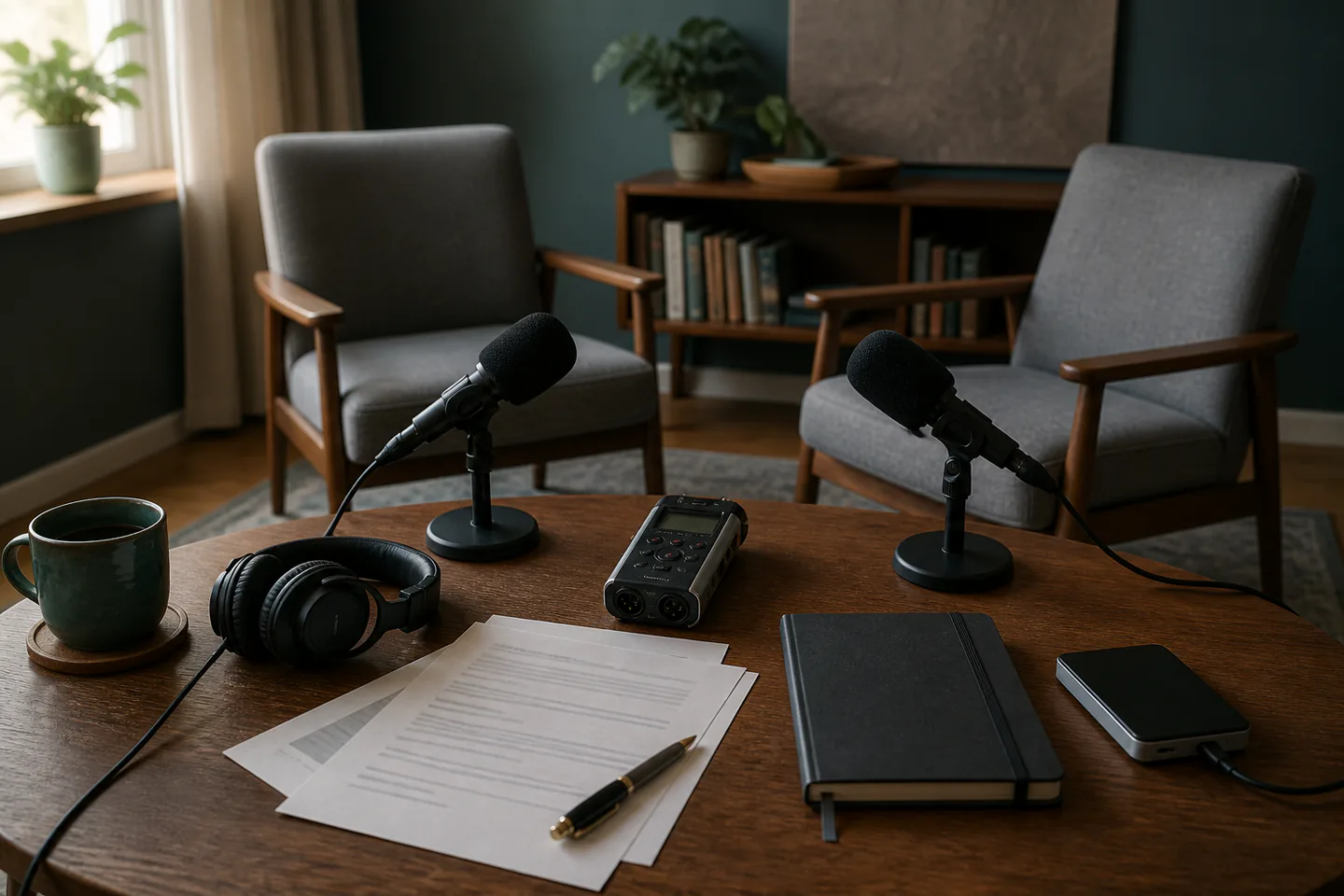
A focused interview needs informed participation, a clear recording agreement, good sound, an accurate summary and secure preservation alongside the original file.
Quick answer
Complete one archived interview before expanding the setup
Define a narrow project and identify a willing adult participant. Give them written information explaining purpose, recording, storage, access, withdrawal and future uses, obtain participation agreement, test a quiet room and backup, ask open questions and listen without correcting, then copy and verify the original immediately, create a time-coded summary, offer review and complete the recording agreement before any public use or deposit.
- 01
Consent is an ongoing informed process, not merely a signature collected after recording. Record what happened during oral history collecting so the next attempt changes one known variable instead of several guesses.
- 02
The narrator’s account is testimony with perspective and memory, not a substitute for every documentary source. Record what happened during oral history collecting so the next attempt changes one known variable instead of several guesses.
- 03
A short topic guide supports listening better than reading a rigid questionnaire. Record what happened during oral history collecting so the next attempt changes one known variable instead of several guesses.
- 04
The original recording, agreements, metadata and access restrictions belong together as one archival unit. Record what happened during oral history collecting so the next attempt changes one known variable instead of several guesses.
What to expect
What oral history collecting is really like at the start
The useful beginner controls are preparation, one bounded task and a record of the result; specialist equipment matters only when it solves a repeated limitation.
Consent
Future uses, internet publication and archive deposit need language the participant can genuinely understand. Record what happened during oral history collecting so the next attempt changes one known variable instead of several guesses.
Interview
Silence and follow-up questions often produce richer detail than rapid topic changes. Record what happened during oral history collecting so the next attempt changes one known variable instead of several guesses.
Audio
A quiet room and stable microphone distance matter more than a costly recorder. Record what happened during oral history collecting so the next attempt changes one known variable instead of several guesses.
Archive
Full verbatim transcription can take many times the recording length; a time-coded summary may be the first priority. Record what happened during oral history collecting so the next attempt changes one known variable instead of several guesses.
Core method
The core oral history collecting method
Design the ethical project
State purpose, participants, sensitive topics, storage, access, review, withdrawal and place of deposit before recruitment. Record what happened during oral history collecting so the next attempt changes one known variable instead of several guesses.
Prepare people and room
Share topics, test equipment, set levels, record room tone and confirm consent on paper and at the start. Record what happened during oral history collecting so the next attempt changes one known variable instead of several guesses.
Interview by listening
Use open prompts, request concrete examples, avoid leading claims and respect any refusal or pause. Record what happened during oral history collecting so the next attempt changes one known variable instead of several guesses.
Preserve and document
Verify copies, retain the unedited original, create metadata and summary and apply the agreed access and copyright terms. Record what happened during oral history collecting so the next attempt changes one known variable instead of several guesses.
Useful products
Products with a clear job in the route
The recorder provides immediate stereo capture, the directional microphone is optional for a compatible setup and the headphones reveal noise before the interview begins.
Zoom H1n Handy Recorder
It makes mic position, room tone and gain audible in one compact device.
RØDE VideoMicro II On-Camera Microphone
It can reduce unwanted off-axis sound compared with an exposed phone microphone.
Audio-Technica ATH-M40x Monitor Headphones
Closed backs are practical while recording and checking a first mix.
First project
Record one 30-minute object-led interview
Use a photograph or ordinary object as a prompt and keep the project narrow enough to document completely.
- 01
Share the information sheet
Explain purpose, topics, recording, storage, access and future use in advance. Record what happened during oral history collecting so the next attempt changes one known variable instead of several guesses.
- 02
Test and agree
Confirm participation, room, microphone, levels, backup and the right to pause. Record what happened during oral history collecting so the next attempt changes one known variable instead of several guesses.
- 03
Record the conversation
Begin with identity and context, listen closely and follow useful detail. Record what happened during oral history collecting so the next attempt changes one known variable instead of several guesses.
- 04
Copy and summarise
Verify at least two copies and create a time-coded content summary. Record what happened during oral history collecting so the next attempt changes one known variable instead of several guesses.
- 05
Review and complete rights
Offer the agreed review route and document access, copyright, closure and deposit terms. Record what happened during oral history collecting so the next attempt changes one known variable instead of several guesses.
What can wait
What can wait until the first result
Delay anything that adds cost, risk or another variable before the basic workflow has produced something you can review.
- 01
A large community project
One completely documented interview exposes the true time and storage work. Record what happened during oral history collecting so the next attempt changes one known variable instead of several guesses.
- 02
Automatic transcript as final record
Recognition errors, names and sensitive passages require human review. Record what happened during oral history collecting so the next attempt changes one known variable instead of several guesses.
- 03
Internet publication
Public access needs explicit permission, sensitivity review and a take-down process. Record what happened during oral history collecting so the next attempt changes one known variable instead of several guesses.
- 04
Interviewing children or vulnerable adults
Safeguarding, capacity and organisational policies require expert preparation. Record what happened during oral history collecting so the next attempt changes one known variable instead of several guesses.
Upgrade path
Add the capability you can now name
Each stage should remove a demonstrated constraint rather than make the setup look more advanced.
Use what you own
£0–£20Existing equipment and one written plan
Use a quiet room, clear agreements and a phone or borrowed recorder.Repeat the first route
Phone or borrowed recorder to about £180A complete repeatable starter setup
Complete several interviews with consistent metadata and summaries.Add one capability
Often £50–£250One selected tool, service or learning resource
Add microphones, transcription tools or archive partnership for a demonstrated need.Build specialist depth
Club, course or specialist dependentA documented specialist workflow
Run a community collection only with governance, safeguarding, data protection and long-term preservation.Safety & care
Trustworthiness is the method
Recordings can contain sensitive personal data, third-party claims, copyright and information that causes distress when shared.
- Use informed participation and recording agreements that explain storage, access, copyright, withdrawal and public use.
- Treat every interview as confidential until the documented access decision says otherwise.
- Store contact details separately from recordings and share files only through controlled access.
- Pause or stop on request and plan safeguarding and support for sensitive or traumatic topics.
- Do not publish allegations or private third-party information without proportionate legal and ethical review.
Outside help
When outside help earns its place
An Oral History Society or archive course is valuable before interviewing beyond family and friends because it connects ethics, technique and preservation.
Look for current UK consent forms, GDPR discussion, recording practice, metadata and archive deposit.
Use outside help after the first oral history collecting attempt can reveal the exact technique, access or safety problem that needs live correction.
Representative UK learning and access routes checked 1 September 2026; local prices, permissions, equipment and tutor support vary.
Sources
Where the guidance came from
Authoritative and specialist guidance supports the method and safety boundaries; community discussion contributes recurring beginner problems rather than unsupported claims.
-
01
Oral History Society · Legal and ethical advice
UK informed consent, copyright, data protection, confidentiality and archival use.
Open source -
02
Oral History Society · Legal and ethical FAQs
Internet publication, recording agreements, closure and third-party sensitivity.
Open source -
03
Oral History Society · Community groups
Participation and recording agreements, summaries, transcription, backup and project planning.
Open source -
04
Oral History Association · Principles and best practices
International ethical and methodological framework.
Open source -
05
The National Archives · Managing archives
Archive arrangement, description, preservation and access guidance.
Open source -
06
Reddit · r/Archivists
Community evidence on metadata, formats, transcription and sustainable preservation.
Open source -
07
Amazon UK · H1n Handy Recorder
Exact Amazon UK product page or ISBN used for this recommendation; current price, seller, specification and availability should be confirmed.
Open source -
08
Amazon UK · VideoMicro II On-Camera Microphone
Exact Amazon UK product page or ISBN used for this recommendation; current price, seller, specification and availability should be confirmed.
Open source -
09
Amazon UK · ATH-M40x Monitor Headphones
Exact Amazon UK product page or ISBN used for this recommendation; current price, seller, specification and availability should be confirmed.
Open source
Guide information and links checked 1 September 2026.