Beginner’s guide · Make & create
Collect less,
arrange more.
Begin with a small set of legally usable paper, one backing sheet and repositionable planning. Strong collage comes from shape, value and spacing before it comes from a huge box of materials.
Quick answer
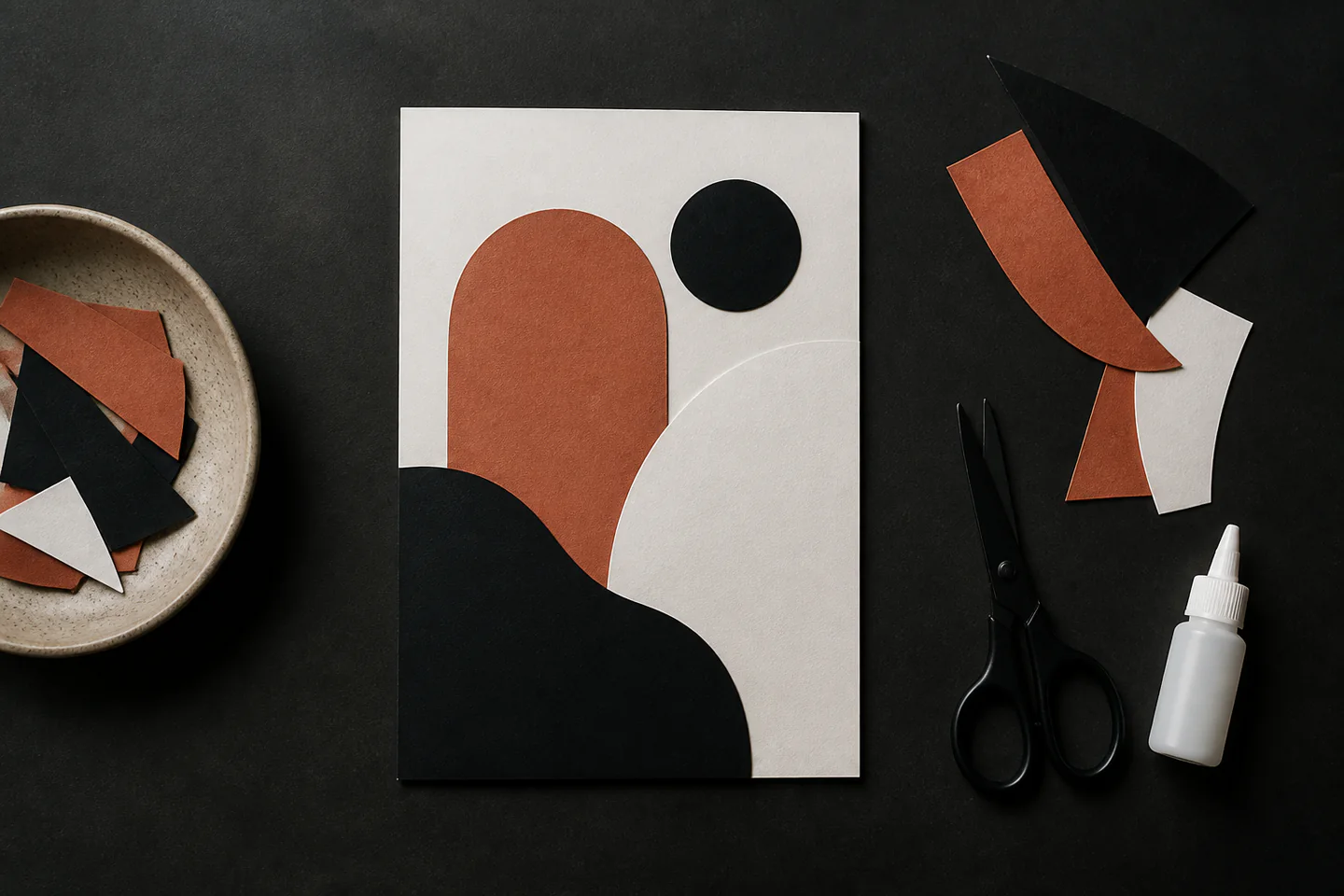
Arrange five shapes in black, white and one colour
Cut or tear five shapes from paper you own and are allowed to use, then move them on an A5 backing sheet without adhesive. Photograph three arrangements: clustered, balanced and strongly asymmetric. Choose the version with the clearest focal relationship, mark corners lightly, then glue from the lowest layer upward using a thin even film. Cover with clean release paper and press flat under suitable weight until fully dry.
- 01
Composition happens during selection and movement. Glue should record a decision, not create one under pressure.
- 02
Limit colour and material at first so scale, overlap, direction and negative space remain visible.
- 03
Paper grain, coating and absorbency change how adhesives dry. Test combinations on scraps.
- 04
Magazines, photographs and online images remain copyrighted. Owning a copy does not automatically permit commercial reproduction of its artwork.
- 05
Use knives, sprays and solvent products only with their age, ventilation and surface-safety instructions. Scissors are enough for many first pieces.
What to expect
The difficult part is choosing what to leave out
A collage can accept almost anything physically, but visual coherence usually improves when the material family and number of competing focal points shrink.
Shape
A few distinct silhouettes read better than dozens of similar scraps. Turn pieces upside down to judge shape without subject meaning.
Value
Squint or photograph in greyscale. If every paper is mid-tone, the arrangement may lack structure.
Edge
Cut edges feel deliberate and graphic; torn fibres feel softer and can reveal paper layers. Use the difference intentionally.
Overlap
Partial covering creates depth and connection, but important tiny fragments can disappear during mounting.
Adhesive
Too much water warps paper and stains thin stock. Too little at corners allows later lifting.
Pressing
Clean interleaving and even weight prevent glue transfer, impressions and curved drying.
Core method
Separate collecting, composing and mounting
Build a rights-aware material set
Use personal painted papers, packaging, maps or ephemera whose reuse is permitted, and record source information for anything that might be published or sold. Sort by value and colour rather than by sentimental importance. Exclude mouldy, greasy, brittle or irreplaceable originals from the first adhesive test.
Design small without glue
Set an A5 backing on a contrasting table and choose five shapes. Vary one large, two medium and two small pieces. Move them as groups, testing edge tension, overlap and empty space. Photograph each serious arrangement from directly above so it can be restored after pieces shift.
Test and mount from the bottom
Try the selected adhesive on the exact paper and backing, looking for curl, bleed and shine after drying. Mark only a few alignment points. Lift the upper pieces as a stack, spread a thin even film to the first shape and smooth from centre outward with clean release paper.
Dry, trim and document
Protect the face with clean non-stick or release material recommended for the adhesive, then press under a flat board and even weight. Allow the full cure time before trimming a backing edge. Photograph the final piece and keep a short material/source note with it.
Useful products
Products with a clear job in the setup
Canson mixed-media paper gives both sturdy backing and paintable source paper. Tombow Mono Multi offers controlled paper adhesion, and Fiskars’ trimmer is a later convenience for repeat straight cuts. Scissors and a brush can replace the trimmer on the first project.
Canson XL Mix Media Pad, 11 × 14 inches
One pad supports both composition surfaces and rights-clear hand-painted elements.
Tombow Mono Multi Liquid Glue, 25 ml
The applicators reduce puddles and make small corners easier to cover.
Fiskars SureCut A4 Paper Cutter, Narrow Base
It speeds consistent geometric pieces and reduces repeated knife use.
First project
Make three arrangements from the same five shapes
The comparison proves that composition, not the shopping list, is the main material.
- 01
Choose one backing
Cut an A5 sheet and decide its orientation.
- 02
Limit the palette
Select black, white and one colour in three values.
- 03
Cut five varied shapes
Include one large anchor and avoid five equal rectangles.
- 04
Photograph three layouts
Try clustered, balanced and asymmetric without glue.
- 05
Mount the chosen order
Work from bottom upward with tested thin adhesive.
- 06
Press and label
Dry flat, then record material sources and date.
What can wait
What can wait until the first result
A room full of ephemera creates storage and rights questions before it improves composition.
- 01
Vintage originals
Photocopy or scan permitted material and keep irreplaceable paper unglued until conservation needs are understood.
- 02
Spray adhesive
Overspray, ventilation and masking make it unnecessary for an A5 first piece.
- 03
A die-cut machine
Hand-cut shape and editing decisions are the actual skill being learned.
- 04
Twenty adhesives
One tested paper glue reveals compatibility before specialist media appear.
- 05
Resin coating
It changes colour, texture, safety and reversibility and is a separate chemical craft.
Upgrade path
Upgrade the repeated limitation
Upgrade cutting, archival mounting or reproduction only when the finished work demands it.
Five-shape study
About £15–£45Paper, scissors and tested glue
Learn value, overlap and negative space.Personal paper library
About £30–£100Painted papers, folders and cutting tools
Create repeatable rights-clear material.Archival work
About £60–£250Conservation board, adhesive and storage
Improve longevity and reversibility decisions.Reproduction practice
About £250–£1,200+Camera/scanner, lighting and calibrated workflow
Publish or print original collages accurately.Safety & care
Know the source before publishing the piece
Physical cutting does not erase copyright, privacy or cultural context. Keep a simple material record and obtain permission where reuse exceeds a private exercise.
- Use age-appropriate cutting tools on a protected surface, cut away from hands and contain blades and small offcuts.
- Ventilate and follow labels for adhesives, markers, paints and coatings; keep them separate from food utensils and wash hands.
- Do not use mouldy, chemically contaminated or irreplaceable historical material without appropriate conservation advice.
- Record the origin and permitted use of photographs, illustrations, maps, packaging and printed text before publishing, selling or advertising the collage.
- Use clean interleaving when pressing and keep heavy boards stable so they cannot fall or transfer adhesive to the artwork.
Outside help
When outside help earns its place
A five-shape series is enough to begin. A workshop becomes valuable for archival mounting, image-transfer methods or critique of a developing personal visual language.
Use activities focused on shape, value and found-material context.
Ask about materials, image rights, adhesives and take-home storage.
Representative UK learning options checked 17 August 2026; local prices, access, materials and tutor support vary.
Sources
Where the guidance came from
Museums and conservation organisations provide material and rights context; practising collage artists and communities add composition, adhesive and workflow evidence.
-
01
Tate · Collage
Art-historical definition and established examples.
Open source -
02
V&A · Caring for works on paper
Museum guidance on handling and storing paper objects.
Open source -
03
DACS · Copyright for artists
UK visual-arts copyright and licensing guidance.
Open source -
04
Kolaj Magazine
Specialist contemporary collage practice and artist context.
Open source -
05
Reddit · r/collage
Community evidence on materials, adhesives, composition and sourcing.
Open source -
06
Amazon UK · XL Mix Media Pad, 11 × 14 inches
Exact product catalogue page or ISBN used for the recommendation; current price, seller and availability should be confirmed.
Open source -
07
Amazon UK · Mono Multi Liquid Glue, 25 ml
Exact product catalogue page or ISBN used for the recommendation; current price, seller and availability should be confirmed.
Open source -
08
Amazon UK · SureCut A4 Paper Cutter, Narrow Base
Exact product catalogue page or ISBN used for the recommendation; current price, seller and availability should be confirmed.
Open source
Guide information and links checked 17 August 2026.