Beginner’s guide · Make & create
A neat garter-stitch square or short scarf
Make the first rows readable, not perfect.
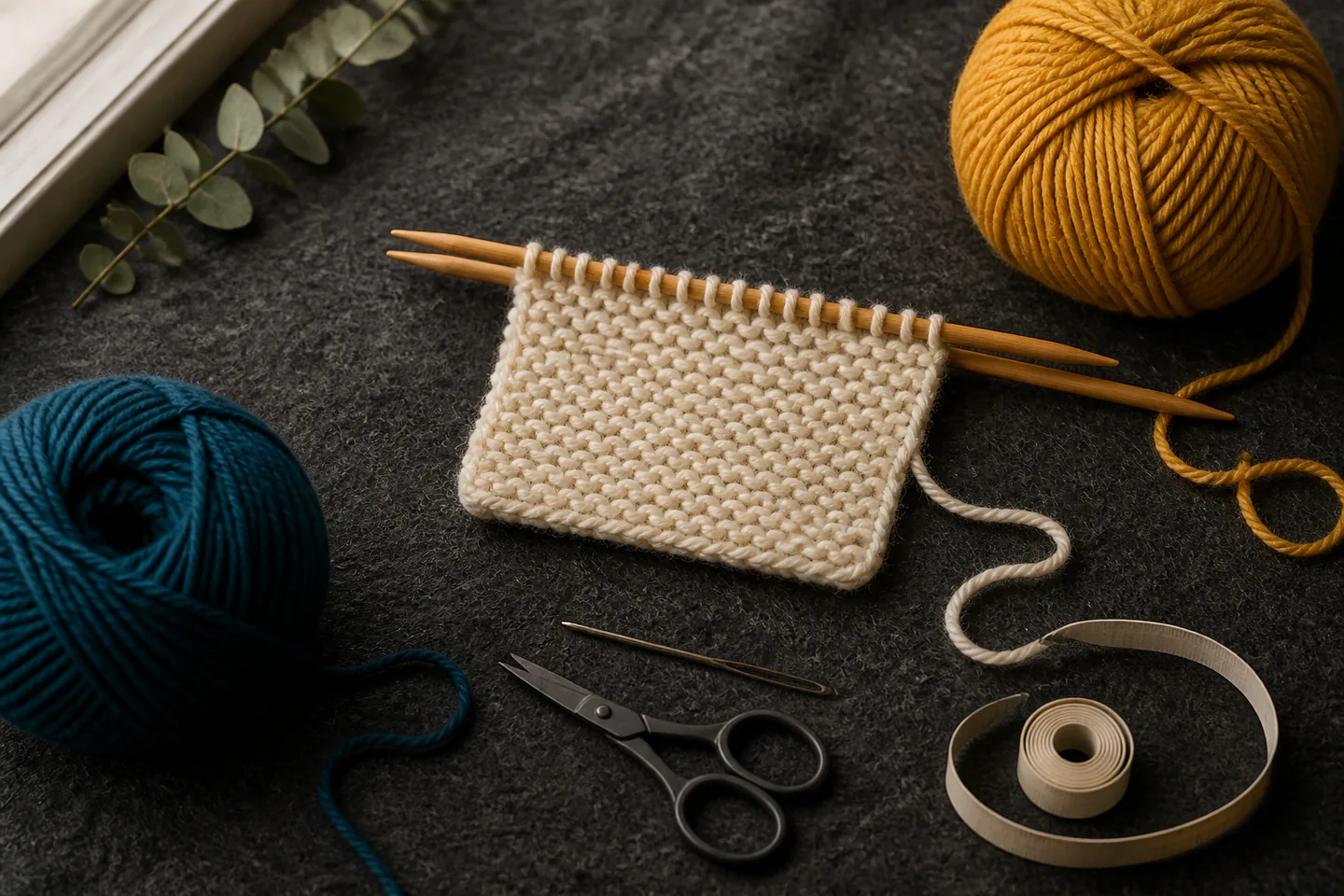
Start with smooth light-coloured DK yarn, 4 mm needles and one flat garter-stitch square. Learn casting on, the knit stitch and binding off before choosing a garment.
Quick answer
Knit one flat square before choosing a pattern
Use one 100 g ball of smooth, pale DK yarn and a pair of 4 mm straight needles. Cast on about twenty stitches, knit every row until the work is square, then bind off. Count stitches at the end of every row and place the work down whenever the hands tighten. This small sampler teaches the motions behind scarves, dishcloths and many later garments without introducing shaping or circular construction.
- 01
DK describes a yarn-weight range; the ball band gives the maker’s suggested needle size and care instructions.
- 02
Light smooth yarn makes each loop visible. Black, fluffy, chenille and highly splitty yarn hide mistakes while the hands are learning.
- 03
A dropped stitch can run downward, but it can usually be secured and repaired; it does not mean the whole piece must be discarded.
- 04
Gauge matters for fitted objects. For a first square, even tension and recognisable stitch structure matter more than an exact measurement.
What to expect
The hands learn before the fabric becomes even
Early rows commonly tighten, loosen or gain stitches at the edges. Slow counting makes the cause visible and turns each mistake into a specific correction.
Cast-on
A flexible cast-on must be loose enough for the needle to enter but firm enough to hold the first row.
Tension
Yarn should feed consistently without being wrapped painfully around a finger or pulled tight after every stitch.
Edges
Accidental yarn-overs and knitting the first loop twice are common reasons a rectangle becomes wider.
Dropped loops
Stop as soon as a vertical ladder appears, secure the live loop with a marker and repair it before continuing.
Counting
Counting every row at first is quicker than discovering ten rows later that the stitch total changed.
Finishing
Binding off too tightly pinches the final edge; washing and drying as the yarn label directs can settle uneven fabric.
Core method
Learn to read the loop you are making
Set up visible materials
Choose smooth DK yarn in a medium or pale colour and 4 mm needles around 25 cm long. Pull yarn from the outside of the ball, sit with supported forearms and keep the working area free of drinks, pets and rolling needles. Use a slip knot and a simple knitted or cable cast-on shown by a reliable tutorial.
Make the knit stitch deliberately
Insert the right needle through the front of the next loop, wrap the working yarn, draw the new loop through and slide only the old loop off. Pause after several stitches to identify the new row on the right needle and the yarn leading to the ball. Avoid tightening each loop after it reaches the thick needle shaft.
Count and diagnose the edges
Count the live loops before turning. If the total grows, check for an extra wrap over the needle or a first stitch pulled up so both legs appear to be separate stitches. If it shrinks, look for a dropped loop or two stitches worked together. Place a removable marker through an endangered loop before attempting a repair.
Bind off and evaluate
Work two stitches, lift the older loop over the newer one and repeat without stretching the yarn. Leave a tail long enough to weave through several neighbouring stitches. Wash only if the yarn label allows it, dry flat and compare the cast-on, sides and bind-off to decide which motion needs another square.
Useful products
Products with a clear job in the setup
The KnitPro needles and one Stylecraft ball form the practical setup. Brenda Lam’s book is an optional visual reference; it earns its place if pausing and replaying videos interrupts the hand movements.
KnitPro Zing Single Pointed Needles, 25 cm, 4 mm
The 4 mm size is a normal starting point for many DK yarns and the metal surface lets stitches move without the drag of rough bargain wood.
Stylecraft Special DK Acrylic Yarn, 100 g
It is easier to read and undo than novelty yarn and is widely referenced in UK patterns.
Search Press How to Start Knitting
Its bounded beginner scope supports the first techniques without requiring a subscription or class.
First project
Make a twenty-stitch garter square
A square is short enough to finish and large enough to reveal tension, edge growth and binding-off pressure.
- 01
Cast on twenty stitches
Keep each loop resting around the needle shaft rather than tightening it at the tip.
- 02
Knit the first row
Name insert, wrap, pull through and slide off until the motion is repeatable.
- 03
Count before turning
Confirm twenty live stitches and inspect the edge for accidental yarn-overs.
- 04
Continue to a square
Knit every row, stopping to secure and repair a dropped loop when it appears.
- 05
Bind off loosely
Pass the previous loop over the new one without pulling the working yarn tight.
- 06
Finish and record
Weave the tails, measure the square and note the yarn and needle size for comparison.
What can wait
What can wait until the first result
A first project needs clear loops and repetition, not a complete yarn cupboard.
- 01
A full interchangeable needle set
Buy sizes when a chosen pattern requires them; one 4 mm pair teaches the movements.
- 02
Luxury hand-dyed yarn
Beautiful colour variation can obscure stitches and makes repeated practice unnecessarily precious.
- 03
A fitted jumper
It adds gauge, shaping, seaming and a long commitment before the basic loop is automatic.
- 04
Very chunky yarn
It looks fast but can be tiring and teaches a different sense of tension from common DK projects.
- 05
Complex stitch markers and counters
A scrap of contrasting yarn and a paper tally are enough for the first flat square.
Upgrade path
Upgrade the repeated limitation
Let the next desired object identify the next tool, yarn and technique.
First square
About £9–£124 mm needles + one DK ball
Learn loop formation and edge counting.Useful scarf or dishcloth
About £10–£30More of one yarn + simple pattern
Practise consistent fabric over distance.Hat in the round
About £18–£45Circular or double-pointed needles
Remove seams and learn decreases.Fitted garment
About £35–£120+Swatch + pattern + garment quantity
Use gauge and measurements to control fit.Safety & care
Protect hands, posture and stored yarn
Knitting is low-risk, but repetitive grip, sharp tips, loose yarn and fibre sensitivities deserve ordinary care.
- Support forearms, relax the grip and take movement breaks before hand, wrist, shoulder or neck pain builds.
- Store needles with points covered and keep loose yarn away from babies, pets and robotic vacuum cleaners.
- Check fibre content where wool, lanolin or dye sensitivity is possible and wash hands after handling dusty old yarn.
- Use good task lighting and corrective lenses if needed rather than bringing sharp needles close to the face.
- Follow the ball-band washing instructions and do not promise a handmade item is child-safe without checking fibres, seams and loose attachments.
Outside help
When outside help earns its place
Free diagrams and slow video are sufficient for the square; a local group becomes useful when a persistent hand-position or repair problem is easier to see in person.
Use the beginner videos for one technique at a time and practise immediately.
Check that materials are included and that the session teaches casting on, knitting, binding off and fixing simple mistakes.
Representative UK product, club, lesson and venue costs checked 9 August 2026; local prices, access, weather, materials and tutor support vary.
Sources
Where the guidance came from
Yarn and needle standards establish terminology; independent knitters and community discussions identify the problems that repeatedly catch beginners.
-
01
Craft Yarn Council · Standards
Yarn-weight and needle-size terminology used across patterns.
Open source -
02
UK Hand Knitting · Learn to knit
UK beginner demonstrations and technique guidance.
Open source -
03
KnitPro · Zing needles
Manufacturer specifications for the selected needles.
Open source -
04
Ravelry · Knitting community
Pattern, yarn and practical project experience used as community context.
Open source -
05
Reddit · r/knitting FAQ
Recurring beginner questions about yarn, needles, tension and dropped stitches.
Open source -
06
Amazon UK · KnitPro Zing 4 mm needles
Exact product page, model or ISBN, observed price and availability checked for this guide.
Open source -
07
Amazon UK · Stylecraft Special DK yarn
Exact product page, model or ISBN, observed price and availability checked for this guide.
Open source -
08
Amazon UK · How to Start Knitting book
Exact product page, model or ISBN, observed price and availability checked for this guide.
Open source
Guide information and links checked 9 August 2026.